D1.3.5—Randomness in mutation
Mutations occur randomly with respect to need or advantage, although mutation rate can vary with mutagens, repair and DNA context.
- Syllabus
- First assessment 2025
- Objective
- D1.3.5
- Level
- HL
Mutations occur randomly with respect to need or advantage, although mutation rate can vary with mutagens, repair and DNA context.
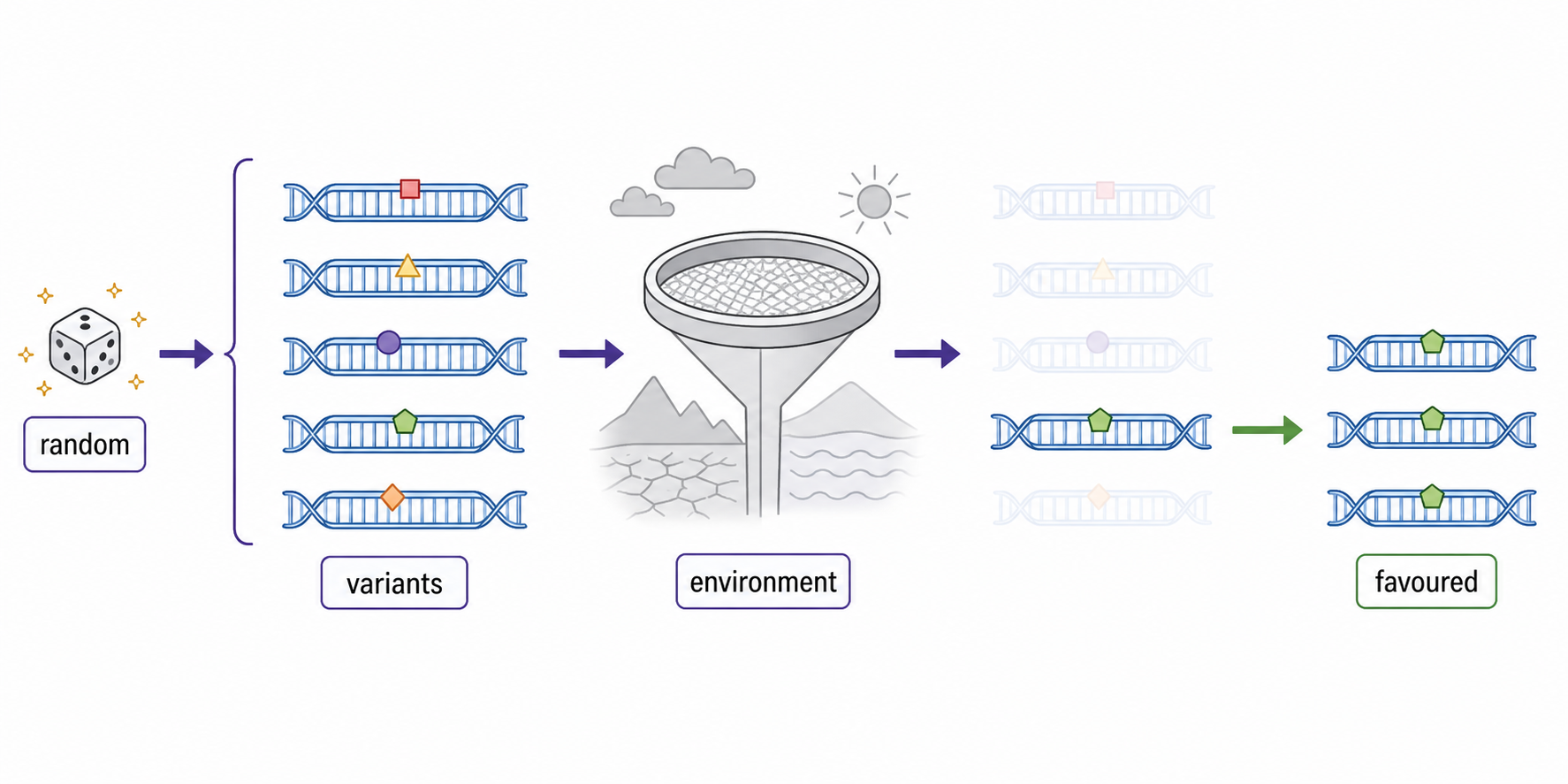
Mutations occur randomly with respect to an organism's need: no known natural mechanism deliberately changes a particular base in order to create a useful trait.
A mutation can occur anywhere in the genome before its consequence is tested by the environment. Natural selection later changes variant frequencies because some carriers reproduce more successfully.
Random relative to need does not mean uniform probability. Base identity and sequence context, DNA repair, gene activity and mutagen exposure can make some sites or cells more likely to mutate than others.
Antibiotic exposure does not instruct bacteria to make a resistance mutation. A resistant variant may already exist, then increase in frequency when susceptible cells die.
Mutation bias can make some changes more frequent without making them purposeful or directed toward advantage.
This objective is assessed through multiple choice.
Build the answer around this relationship: Mutations are not directed by an organism’s needs.
Representative question
What is a feature of mutations?
They occur randomly.
They only occur in germ cells.
The frequency cannot be increased by external factors.
They only occur in certain base sequences of the genome.
A
Gene mutations are changes in the base sequence of DNA; main types are substitution, insertion, deletion, and duplication. Base substitutions can create SNPs and change codons; degeneracy can make substitutions silent, missense, or nonsense. Insertions or deletions not in multiples of three cause frameshifts that alter downstream codons and often disrupt protein function. Mutations can arise from replication errors, repair errors, or chromosome damage; mutagens include chemicals, ionizing radiation, and ultraviolet radiation. Mutations occur randomly with respect to organism need or advantage; mutation rate varies with DNA sequence, gene expression, repair, and mutagen exposure. Germ-line mutations can be inherited by offspring; somatic mutations affect only descendant body cells and can contribute to cancer. Mutation is the original source of new alleles and genetic variation; many are neutral or harmful, but variation supplies material for natural selection.