(a)
A blood test to detect the dominant allele is available for people at risk of HD.
Suggest why some people at risk of HD may decide not to take the blood test.
[ 3 ]
 EduNinja
A blood test to detect the dominant allele is available for people at risk of HD.
Suggest why some people at risk of HD may decide not to take the blood test.
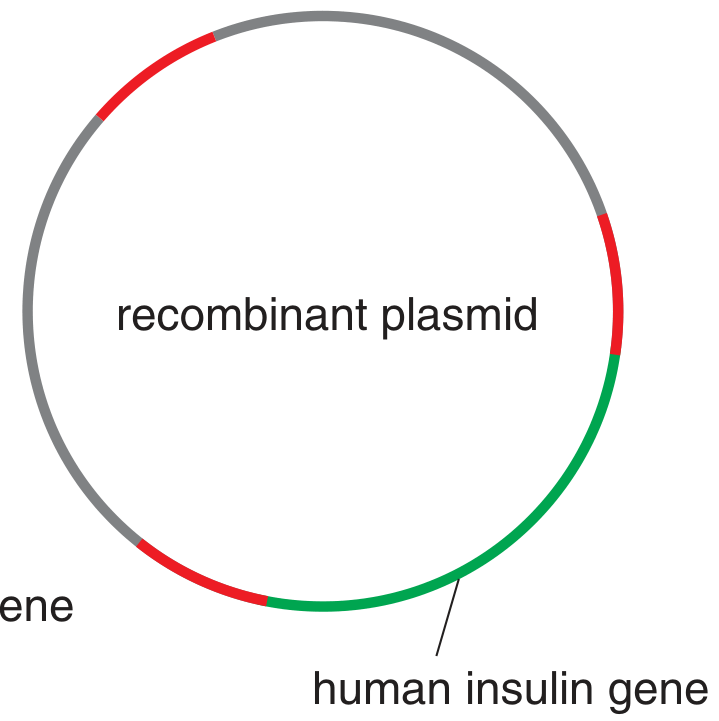
The artificial plasmid, pBR322, was constructed to act as a vector. It has often been used to insert human genes, such as the human insulin gene, into the bacterium, Escherichia coli.
The plasmid was constructed to include two genes, each giving resistance to a different antibiotic: an ampicillin resistance gene and a tetracycline resistance gene. The plasmid also has a target site for the restriction enzyme, BamHI, in the middle of the tetracycline resistance gene.
A pBR322 plasmid was cut using BamHI and the cDNA gene for human insulin inserted into it.
Fig. 2.1 shows pBR322 and the recombinant plasmid.
ampicillin resistance gene
pBR322
etracycline resistance gene
target site for BamHI
GlG A T C C
CCTA G^G
Fig. 2.1
Plasmid vectors carrying antibiotic resistance genes are now rarely used in gene technology.
Explain why antibiotic resistance genes are now rarely used.
Suggest one problem that may arise from the use of ICSI.
One cause of the genetic disease severe combined immunodeficiency (SCID) is a mutation in the ADA gene. This mutation results in a deficiency of the enzyme adenosine deaminase (ADA).
Although ADA is found throughout the body, it is especially active in lymphocytes. The absence of functional ADA causes the build-up of toxic metabolites that kill lymphocytes and damage organs.
Babies are often diagnosed with SCID by six months old. Treatment can greatly improve the life expectancy of children with SCID.
Some treatment options are available.
- Enzyme replacement therapy with recombinant human ADA made by genetically modified (GM) Escherichia coli. Weekly intra-muscular injections are given.
- Bone marrow transplant if a well-matched donor, such as a close relative, can be found.
- Gene therapy.
Suggest the social and ethical implications of gene therapy for SCID that need to be considered before treatment is carried out.
GEDmatch is described as 'an open data personal genomics website'. It can be used by people who want to upload their DNA data to trace their ancestors and other relatives.
In 2018, police in the USA solved a large number of serious crimes. Some of these crimes had been unsolved for over thirty years. The police used GEDmatch to profile DNA taken from crime scenes and to look for matching DNA profiles. In many cases the police found partial matches to the relatives of criminals. This allowed the criminals to be identified and then charged on the basis of a complete DNA profile match.
The first successful conviction resulting from the use of GEDmatch by the police was widely reported.
Some journalists and broadcasters thought that the GEDmatch website should not have been used by the police in this way.
In the days following the news, the number of citizens choosing to upload their DNA data to GEDmatch increased from 1500 to 5000 a day.
Comment on the social and ethical issues raised by this first successful conviction.
The -globin gene codes for the -globin polypeptide of haemoglobin. It has two alleles, (normal) and (sickle cell). The sickle cell allele differs from the normal allele due to a base substitution mutation and this mutation results in a single amino acid change to the -globin polypeptide.
There are three possible genotypes and phenotypes.
- , sickle cell anaemia, a severe disease
- , sickle cell trait with mild or no symptoms of sickle cell anaemia
- , normal (healthy)
A man and woman who both have sickle cell trait may choose to have children by IVF. This allows the genotype of embryos to be determined by gene testing before the embryos are implanted. Embryos with the normal genotype can then be selected and implanted into the mother.
One technique that can be used in gene testing an embryo for the allele is restriction fragment length polymorphism (RFLP) analysis. This involves digesting a DNA sample from an embryo with a restriction endonuclease and then separating the DNA fragments by gel electrophoresis. The position of the DNA fragments on the gel can show if the embryo has the allele.
Discuss the ethical and social considerations of gene testing embryos for genetic diseases.
Mammals such as sheep, Ovis aries, and goats, Capra hircus, are important agricultural animals that are sometimes kept together in mixed flocks. Very occasionally, live offspring are born from a mating between a male sheep and a female goat.
In sheep 2 n=54 and in goats 2 n=60.
Horns on agricultural animals such as goats and cattle can be dangerous to the farmer and to other animals. Horns are often prevented from growing in 5-day-old animals by a stressful procedure called disbudding.
Genetic modification can cause a deletion in the allele h coding for horns in cattle embryos, so that the allele no longer codes for a functional protein and the embryos grow into cattle that are hornless.
State an ethical advantage of this example of genetic modification.
Sickle cell anaemia is a non-infectious chronic disease. If not treated, sickle cell anaemia can be painful and life-threatening.
Sickle cell anaemia is caused by a base substitution mutation in the gene coding for the -globin polypeptide of haemoglobin. This leads to a change in the primary structure of the polypeptide, as valine is present instead of glutamine. This results in abnormal sickle-shaped red blood cells, which stick together in blood vessels.
Symptoms of sickle cell anaemia include painful attacks when red blood cells block capillaries in tissues and organs.
The number of cases of sickle cell anaemia is highest in sub-Saharan Africa, the Middle East and India. These areas also have a high incidence of malaria.
People with SCT (heterozygotes) are either unaffected or may have mild symptoms of sickle cell anaemia. One advantage of SCT is an increased resistance to malaria.
Parents who use IVF to produce embryos may decide to have embryos genetically screened by a test known as pre-implantation genetic diagnosis (PGD). Only embryos that do not have sickle cell alleles are transferred to the woman's uterus.
Discuss two ethical reasons why parents using IVF may choose not to have PGD.
Lung epithelial cells have a thin layer of watery mucus on their surface.
The normal allele of the CFTR gene codes for a transport protein that transports chloride ions out of epithelial cells.
Fig. 4.1 is a diagram of part of the cell surface membrane and the mucus layer of an epithelial cell with normal CFTR proteins.
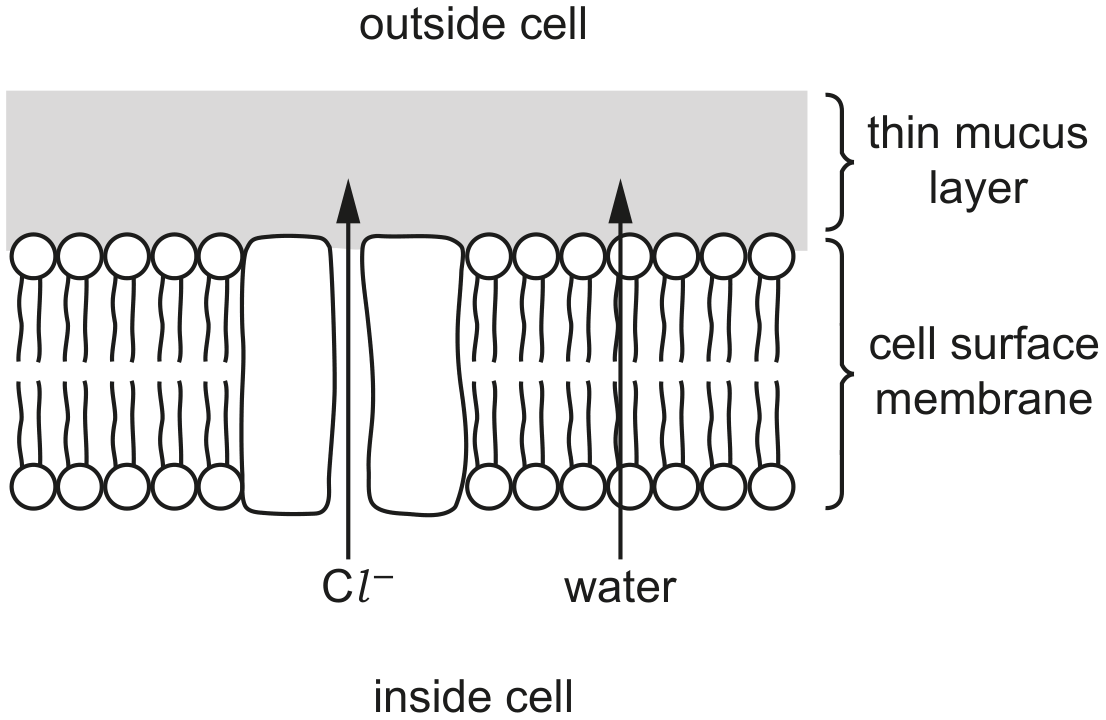
Fig. 4.1
Cystic fibrosis (CF) is a genetic disorder caused by having two recessive alleles of CFTR. In severe cases of CF, the transport proteins are not added to the cell surface membrane. This causes the mucus layer to be thick and sticky.
Embryos produced by IVF may be screened for genetic abnormalities:
- to test for a specific genetic disease, such as cystic fibrosis
- to check whether there is an abnormal number of chromosomes present.
To improve the success of implantation and pregnancy, only embryos without any form of genetic abnormality are transferred to the woman's uterus.
A new double screening method was trialled where a single embryo biopsy was taken and used to test for a specific genetic disease and to check the number of chromosomes. In the trial, 1122 embryos were tested using this double screening method.
In the trial, of the 1122 embryos tested:
- 50.6 % did not have a genetic disease
- 27.5 % did not have a genetic disease and did not have an abnormal number of chromosomes (normal embryos).
Only normal embryos were transferred into the women. The percentage of embryo transfers that resulted in pregnancy was calculated.
The results of the trial using double screening of a single biopsy were compared to the results of IVF procedures that used standard screening methods, as shown in Table 4.1.
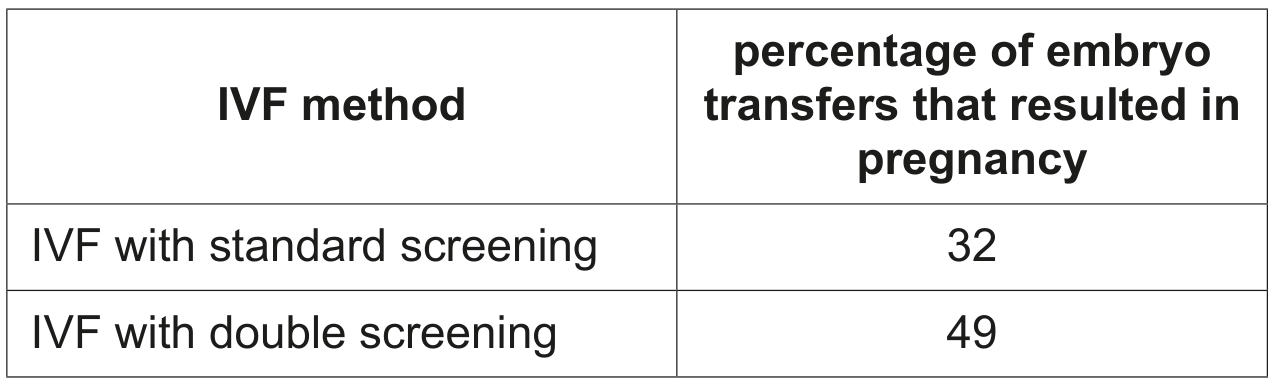
Table 4.1
Using the data in Table 4.1, discuss the social and ethical considerations of double screening for cystic fibrosis and chromosomal abnormalities in a single biopsy.