EduNinja
[Maximum number: 7]

Interferon-alpha (IFN- α\alpha ) can be produced as a recombinant human protein to treat some types of cancer. The gene IFNA2 codes for IFN- α\alpha.

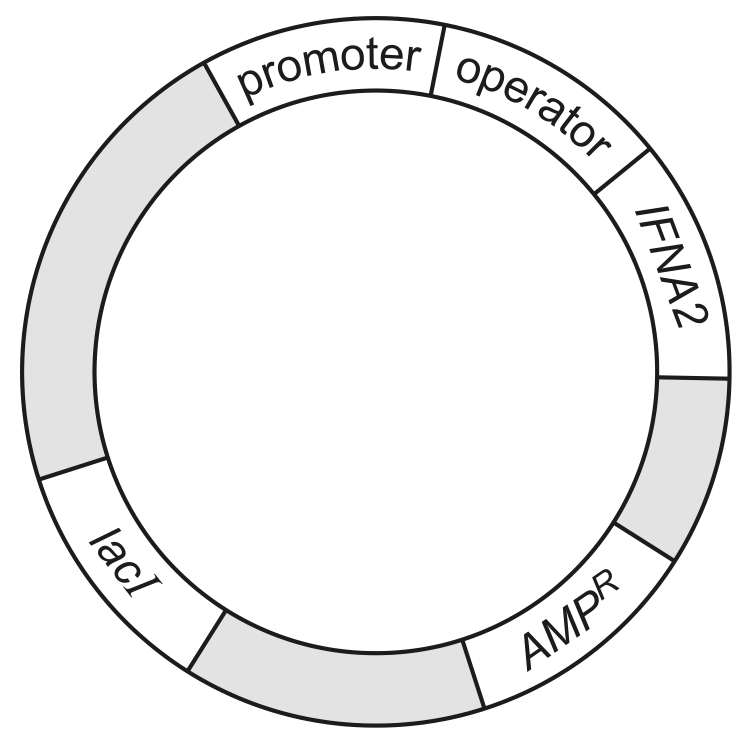
One method of producing recombinant IFN- α\alpha uses genetically engineered Escherichia coli bacteria that contain recombinant plasmids. Each recombinant plasmid contains:
- the gene IFNA2
- three regulatory sequences of the lac operon (promoter, operator and lacl)
- a gene for antibiotic resistance, AMPRA M P^{R}.

Each of the sequences for the lacI gene and AMPRA M P^{R} gene contains its own promoter. As a result, these genes are always expressed in E. coli bacteria that contain this recombinant plasmid.

Fig. 2.1 is a diagram of the recombinant plasmid. The promoter regions of the lacI gene and AMPRA M P^{R} gene are not shown.

Fig. 2.1

Fig. 2.1

(a)

The start of transcription of the gene IFNA2 by E. coli with the recombinant plasmid shown in Fig. 2.1 needs to be controlled to obtain an optimum yield of IFN α-\alpha.

Scientists investigated the effect of two inducers of transcription on the production of recombinant IFN- α\alpha :
- lactose, which is converted to allolactose in E. coli
- IPTG, which is a synthetic molecule with a very similar structure to allolactose. IPTG cannot be broken down by E. coli.

The scientists grew three cultures of E. coli containing the recombinant plasmid in the same growth medium. The growth medium contained glucose, amino acids, essential vitamins and minerals. The growth medium did not contain lactose.

After four hours, either lactose or IPTG at the same concentration was added to two of the cultures of E. coli. As a control, the third culture of E. coli was grown without adding lactose or IPTG.

The concentration of recombinant IFN- α\alpha in the cultures was measured at different times over a period of 28 hours. The results are shown in Fig. 2.2.
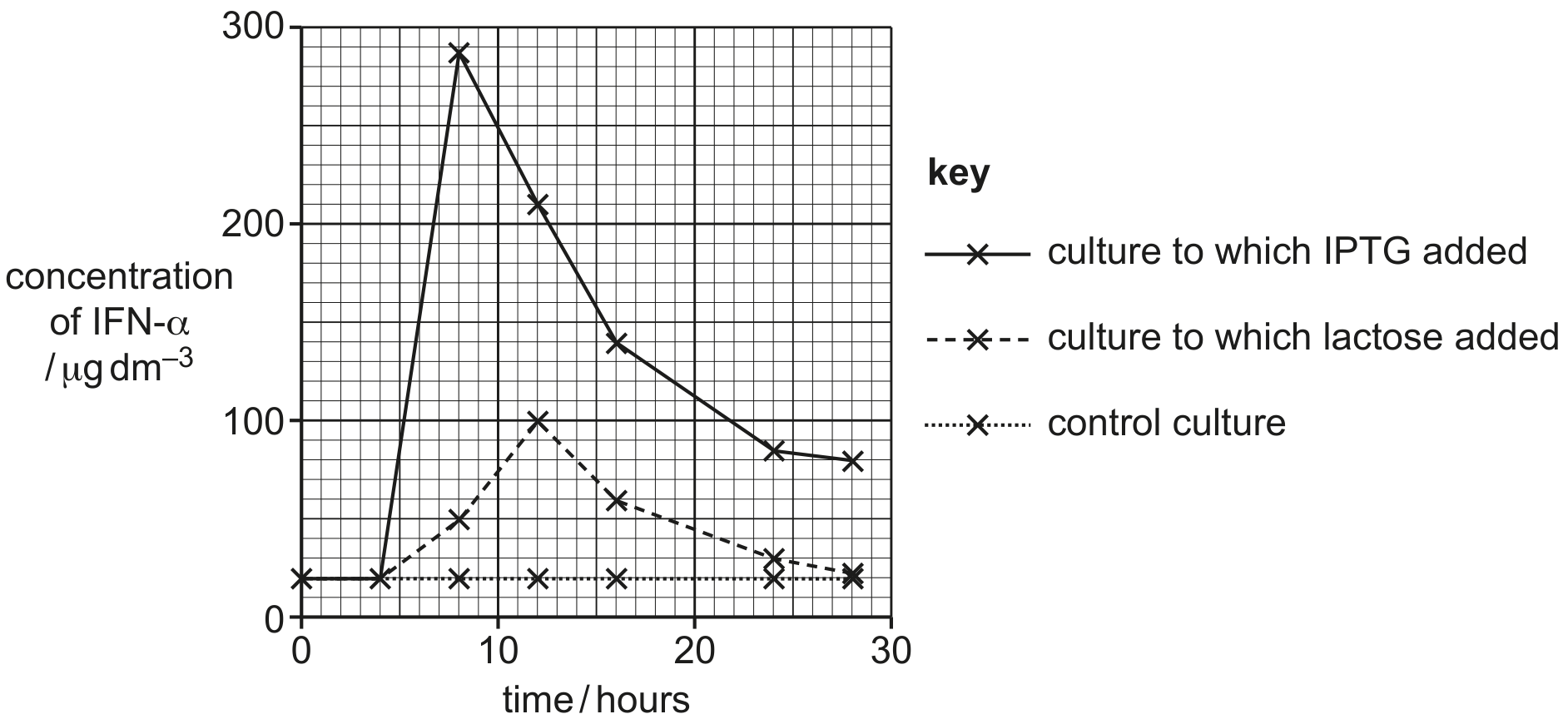
Fig. 2.2

Fig. 2.2

[ 7 ]
(i)

The regulatory sequences of the lac operon contained in the recombinant plasmid are involved in the control of transcription of the gene IFNA2.

Explain the role of the gene lacI in the control of transcription of the IFNA2 gene between 0 hours and 4 hours.

[ 2 ]
(ii)

With reference to Fig. 2.2, describe the changes in the concentration of recombinant IFN- α\alpha in the culture containing IPTG from when IPTG was added at 4 hours to the end of the experiment at 2 8 hours.

[ 3 ]
(iii)

Suggest one reason for the difference between the concentration of recombinant IFN- α\alpha in the culture at 8 hours in the presence of lactose and the concentration of recombinant IFN- α\alpha in the culture at 8 hours in the presence of IPTG.

[ 1 ]
(iv)

Suggest one reason for the change in the concentration of recombinant IFN- α\alpha in the culture containing IPTG from 12 hours to 16 hours.

[ 1 ]
[Maximum number: 7]

Gene expression in a cell is controlled. When a gene is expressed (switched on), the gene is transcribed. When a gene is not expressed (switched off), the gene is not transcribed.

Environmental changes can cause some genes to be switched on or switched off.

(a)

An example of control of gene expression in prokaryotes is regulation in the lac operon.

The lac operon is a length of DNA that is made up of different parts.
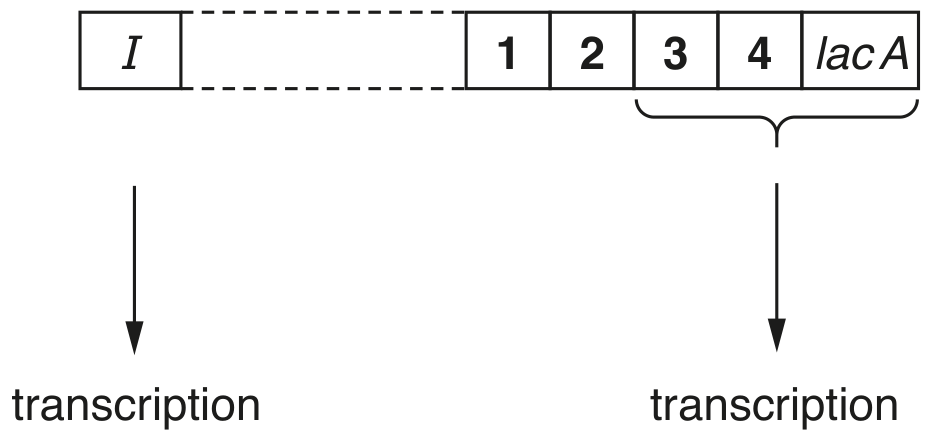
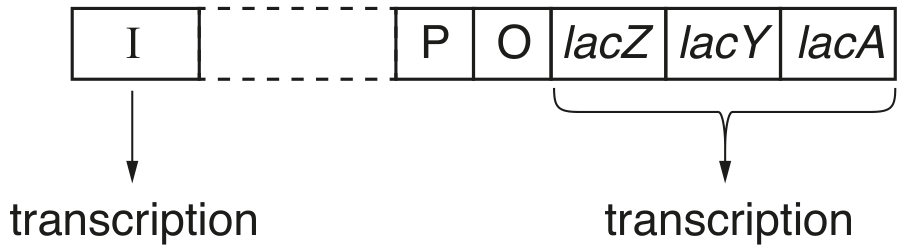
Fig. 3.1 shows a simple diagram representing the lacI (regulatory) gene and the lac operon.

Fig. 3.1

Fig. 3.1

[ 7 ]
(i)

Outline the main features of the lac operon.

[ 3 ]
(ii)

Explain the role of the l a c I gene in the regulation of the lac operon.

[ 4 ]
[Maximum number: 2]

Therapeutic proteins are used to treat disease. The first purified therapeutic protein used was insulin, in 1922. The insulin was extracted from animal pancreases. Since 1982 most insulin has been made by recombinant DNA technology.

(a)

The gene coding for salmon calcitonin is introduced into bacteria in a specially designed plasmid called an expression vector. An expression vector must contain a prokaryotic promoter, such as the lac promoter.

Explain why differences in the control of gene expression in prokaryotes and eukaryotes mean that expression vector plasmids must contain a prokaryotic promoter.

[ 2 ]
(a)

The lac operon is a section of DNA present in the genome of the bacterium Escherichia coli. The structural genes of the operon are only fully expressed when E. coli is exposed to high lactose concentrations.

[ 4 ]
(i)

Fig. 3.1 is a diagram showing the lac operon and a nearby region of the E. coli genome.

Fig. 3.1

Fig. 3.1

Name sections 1, 2, 3 and 4 shown in Fig. 3.1.
1
2
3
4

[ 2 ]
(ii)

Certain enzymes need to be present inside E. coli for it to be able to take up and use lactose. When the genes of the lac operon are expressed, the enzymes β\beta-galactosidase and lactose permease are produced in large quantities.

Outline the functions of β\beta-galactosidase and lactose permease.
β\beta-galactosidase
lactose permease

[ 2 ]
(b)
(i)

Explain why the structural genes of the lac operon are not expressed when lactose is absent.

[ 3 ]
(ii)

A strain of E. coli has been produced with a mutation in gene I. Expression of this gene results in a non-functional repressor protein.

Suggest a negative effect that this mutation will have on this strain of E. coli.

[ 1 ]
[Maximum number: 2]

Yeast cells are unicellular eukaryotes that respond to the presence and absence of different sugars by switching genes on or off. One example of this is summarised in Fig. 5.1.

If glucose is present, a sequence of events occurs.
- Yeast cells metabolise glucose using constitutively expressed enzymes.
- Mig1 transcription factor (A) binds to promoter B.
- This stops transcription of gene C.
- Production of enzyme D stops.

If galactose is present and glucose is absent, a different sequence of events occurs.
- The Msn2 transcription factor (E) binds to promoter B.
- This activates transcription of gene C.
- Enzyme D is produced and helps convert galactose to glucose.

Gene F codes for the Mig1 transcription factor, A.
Gene G codes for the Msn2 transcription factor, E.

(a)

Scientists have produced genetically engineered yeast cells. The gene coding for Mig1 transcription factor and the marker gene coding for green fluorescent protein (GFP) are transcribed together to produce a single mRNA molecule.

The resulting Mig1 transcription factor proteins contain a GFP region as part of their structure and are called tagged Mig1 molecules. These tagged Mig1 molecules show up as green fluorescent spots when viewed using a microscope with a very high resolution.

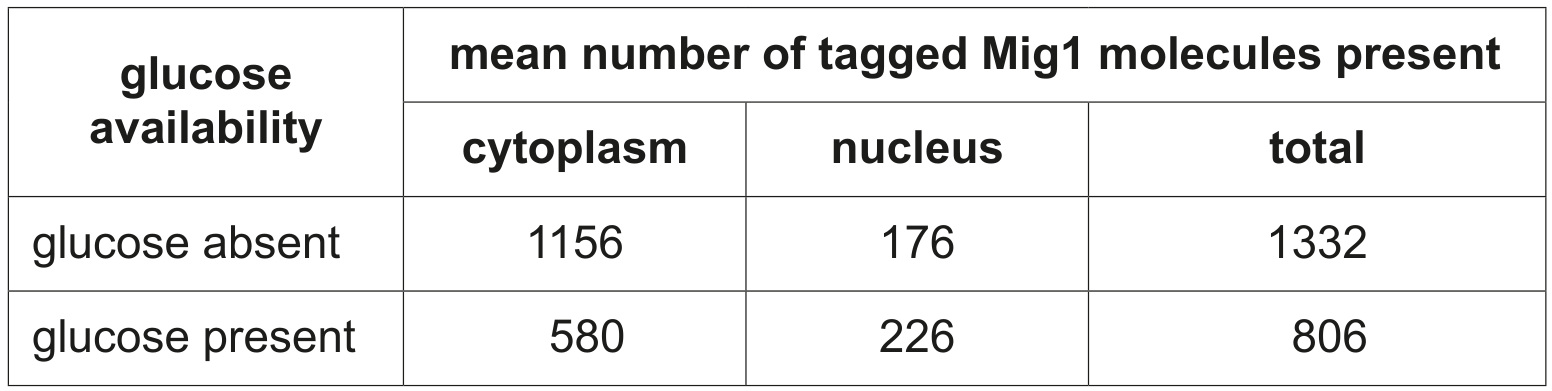
An investigation was carried out to compare the distribution of tagged Mig1 molecules in yeast cells, when glucose is absent and when glucose is present.

The results are shown in Table 5.1.

Table 5.1

Table 5.1

[ 2 ]
(i)

Calculate the percentage of Mig1 molecules in the nucleus when glucose is present.

Show your working and write your answer to two significant figures.

(ii)

When glucose is absent, 13\% of the available Mig1 molecules are present inside the nucleus.

Explain why this figure is different from your answer to (i).

[ 2 ]
[Maximum number: 4]

The bacterium, Escherichia coli, can use glucose or disaccharides, such as lactose, in its metabolism. Lactose needs to be hydrolysed by the enzyme β\beta-galactosidase to form glucose and galactose, which can then be used by E. coli.

The production of β\beta-galactosidase is controlled by a length of DNA called the lac operon.

(a)

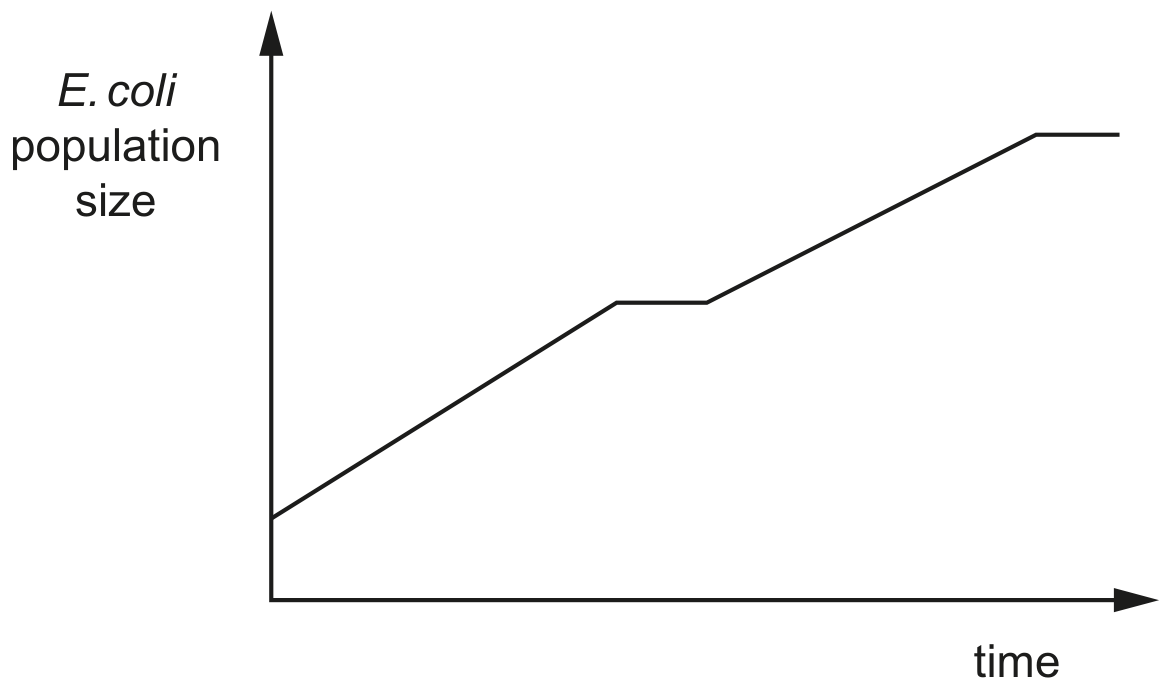
In an investigation into the growth of E. coli, a sample of the bacterium was grown in a medium that contained limited concentrations of glucose and lactose. The population size of E. coli was measured at regular intervals.

Fig. 7.3 shows the population growth curve obtained for this investigation.

Fig. 7.3

Fig. 7.3

Describe and suggest explanations for the population growth curve shown in Fig. 7.3.

[ 4 ]
(a)

The lac operon is a section of DNA present in the genome of Escherichia coli. The structural genes of the lac operon are only fully expressed when the bacteria are exposed to high lactose concentrations.

Fig. 6.1 is a diagram showing the lac operon and a nearby region of the E. coli genome.

Fig. 6.1

Fig. 6.1

[ 5 ]
(i)

Fig. 6.1 shows how the lac operon consists of structural genes and regulatory sequences.

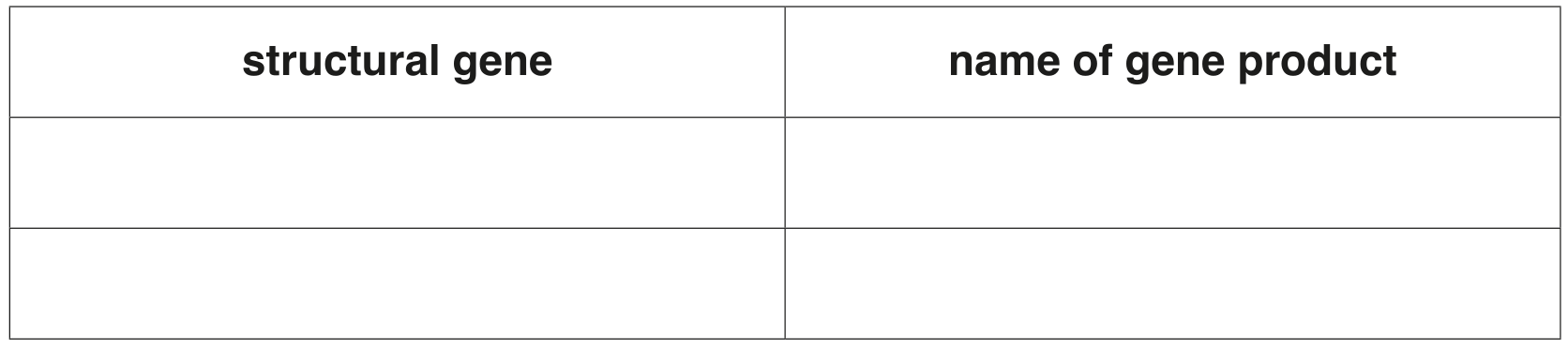
Use Fig. 6.1 to identify two structural genes.
Complete Table 6.1 to name each structural gene and its product.

Table 6.1

Table 6.1

[ 2 ]
(ii)

Gene I is transcribed all the time to produce its protein. This is constitutive expression. Explain why some genes show constitutive expression.

[ 1 ]
(iii)

Describe the effect of the product of gene I on the functioning of the lac operon.

[ 2 ]
[Maximum number: 7]

Explain genetic control of protein production in a prokaryote using the lac operon.

0