Several studies have been undertaken to determine whether there is an evolutionary explanation for menopause, the time when reproductive capacity stops in women. Two contemporary hunter-gatherer societies were studied. The graph shows what percentage of women survive to each of the ages given.
Foraging (food-getting) requires skill gained with experience and age. The Grandmother Hypothesis suggests that after menopause, women who are skilled at foraging provide greater survivorship success to the offspring of their daughters. The graph shows the foraging patterns of women in three groups.
Group I Have reached puberty, but have not begun child-bearing
Group II Are pregnant and/or have young children
Group III Have passed child-bearing age and have no children younger than 15 years old
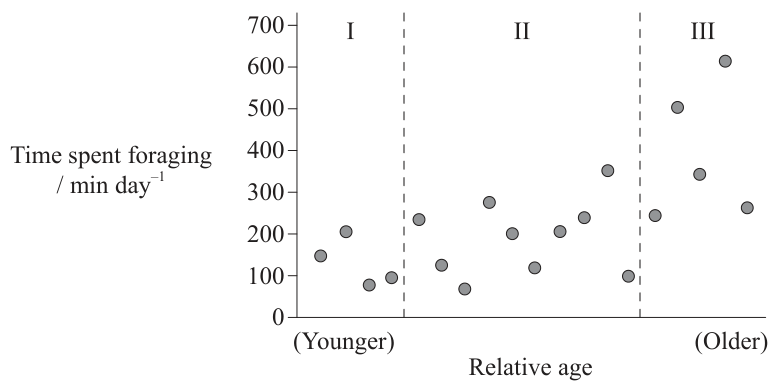
Calculate the difference in the amount of time spent foraging by the most skilled women in groups I and III.
Evaluate the data in terms of the Grandmother Hypothesis.