C3.1.17 (HL)—Tropic responses in seedlings

Tropic responses in seedlings links named stimuli, coordinating structures and effectors so body systems or plant tissues produce an integrated biological response.

Syllabus
First assessment 2025
Objective
C3.1.17
Level
HL

Tropisms make plant growth directional

HL only

Seedling tropic responses can be recorded as qualitative observations and as quantitative curvature data.

Expose comparable seedlings to a directional stimulus and include an appropriate control. At fixed times, draw labelled diagrams showing the direction and form of curvature, and measure the angle between the original growth direction and the current shoot or root direction.

Data type Example
Qualitative Labelled diagram showing a shoot curving toward lateral light
Quantitative Curvature angle in degrees after a fixed exposure time

Improve precision with a fixed camera position, a defined angle method and repeated measurements; improve accuracy with a calibrated reference and minimal parallax; improve reliability with replicate seedlings and consistent conditions.
A diagram records an observation; it does not by itself prove a hormone mechanism. Precision is repeatability/resolution, accuracy is closeness to the true value, and reliability depends on consistent replicated evidence.
Plant Signalling Integration

HL only

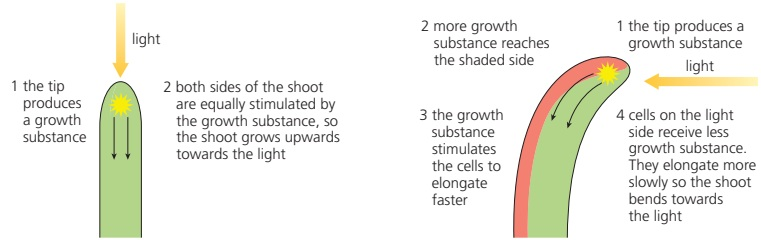
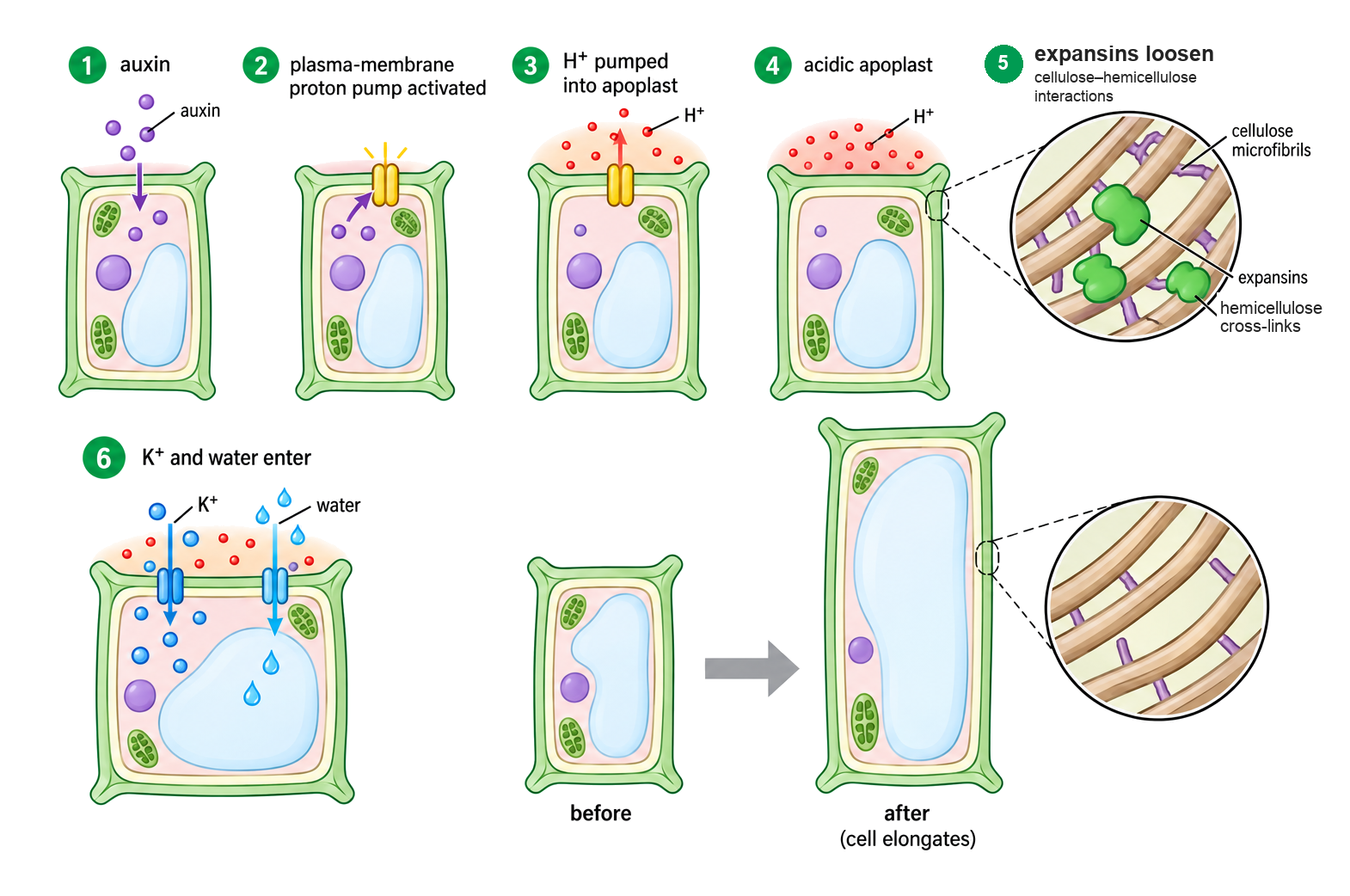
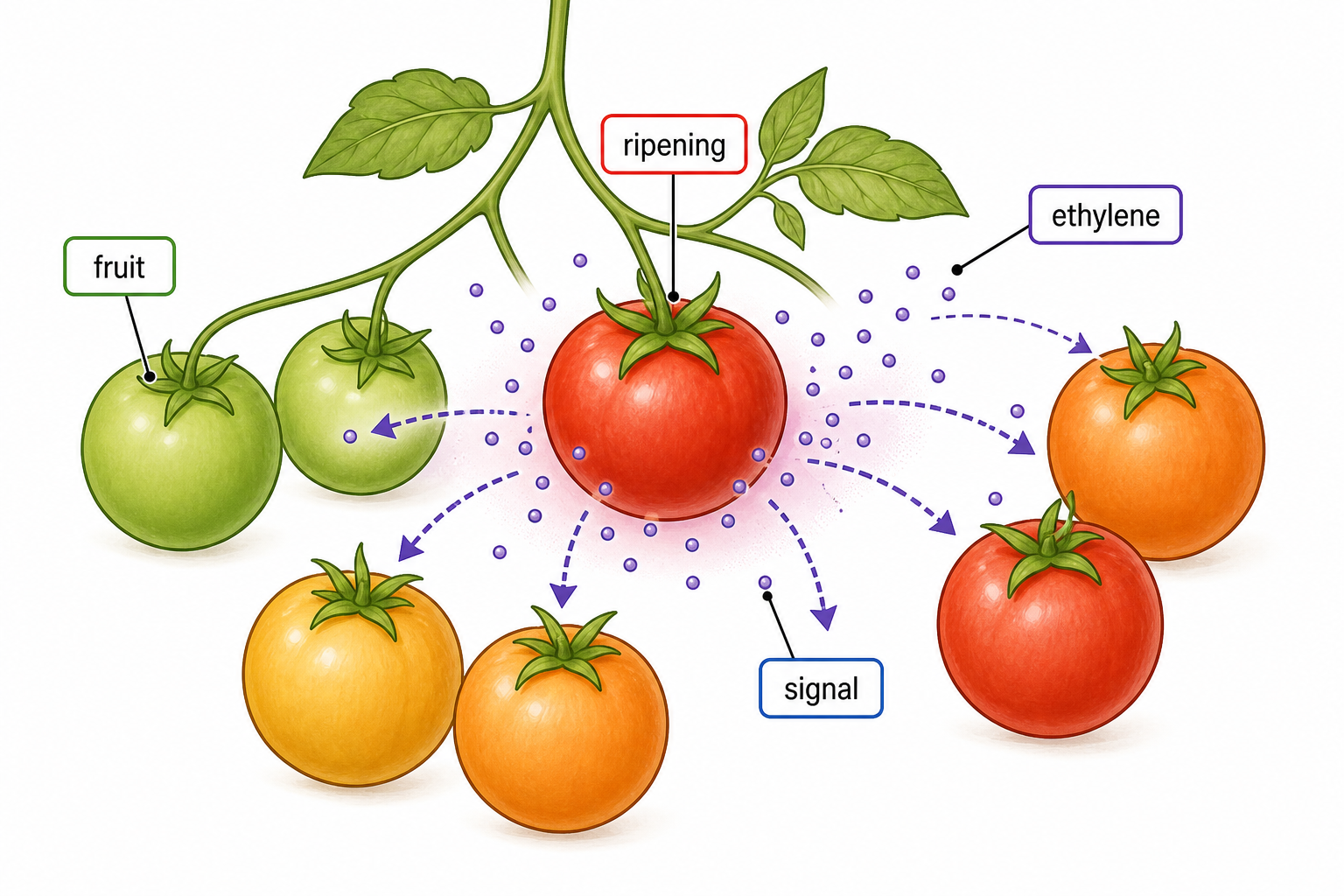
Plant signalling integrates directional growth, phytohormones, and responses to stimuli. Tropisms are directional growth responses in seedlings; experiments compare shoot or root growth under lateral light or gravity stimuli. Shoots show positive phototropism toward lateral light; auxin redistribution causes greater elongation on the shaded side. Phytohormones are plant signalling chemicals controlling growth and development; auxin, cytokinin, and ethylene coordinate responses to stimuli and internal state. PIN auxin efflux carriers actively move auxin between plant cells; asymmetric carrier placement maintains auxin gradients during tropic responses. Auxin activates proton pumping into the apoplast; acidified cell walls loosen, allowing water uptake, elongation, and bending. Auxin generally promotes root formation; cytokinin promotes shoot formation and division; their ratio coordinates root-shoot growth and plant tissue culture outcomes. Ethylene is a gaseous phytohormone that promotes fruit ripening; ripening fruit releases more ethylene, creating positive feedback in nearby fruit.

Concept essentials

  • Tropic responses in seedlings depends on linking the stimulus to the coordinating structure or signal.
  • The pathway for tropic responses in seedlings must keep information flow and response direction clear.
  • Named tissues, hormones, neurons or effectors give tropic responses in seedlings its biological specificity.
  • Evidence about tropic responses in seedlings is strongest when structure, mechanism and outcome are connected.