Question 1(b)
[Maximum number: 1]
Give the name of the process that is used:
to produce lead from molten lead(II) bromide
 EduNinja
CAIE IGCSE Chemistry Extended 4.1 Electrolysis question practice helps you revise this syllabus point with the course map in view. Use this page to focus on one topic, check the style of questions available, and connect each attempt back to the knowledge area it is testing.
EduNinja keeps Chemistry practice aligned to CAIE at Extended level, so you can move from topic review into exam-style question bank work without losing the syllabus structure. Start with a small set, mark the weak steps, then return to nearby topic links when a definition, graph, calculation, or explanation needs repair.
Give the name of the process that is used:
to produce lead from molten lead(II) bromide
Give the name of the process that is used:
to produce bromine from molten lead(II) bromide
Name the process used to:
produce lead from molten lead(II) bromide
Which statement about the electrolysis of copper(II) sulfate solution using carbon electrodes is correct?
A colourless gas is produced at the anode.
A colourless gas is produced at the cathode.
The colour of the electrolyte remains the same.
The mass of both electrodes remains constant.
Which reactions could take place at the anode during electrolysis?
1 and 2
1 and 4
2 and 4
3 and 4
Potassium reacts with chlorine to form potassium chloride, KCl.
Molten potassium chloride undergoes electrolysis.
State what is meant by the term electrolysis.
Name the products formed at the positive electrode (anode) and negative electrode (cathode) when molten potassium chloride undergoes electrolysis.
anode
cathode
Concentrated aqueous potassium chloride undergoes electrolysis.
Write an ionic half-equation for the reaction at the negative electrode (cathode).
Name the product formed at the positive electrode (anode).
Name the potassium compound that remains in the solution after electrolysis.
The diagram shows the electrolysis of an aqueous solution of X using inert electrodes.
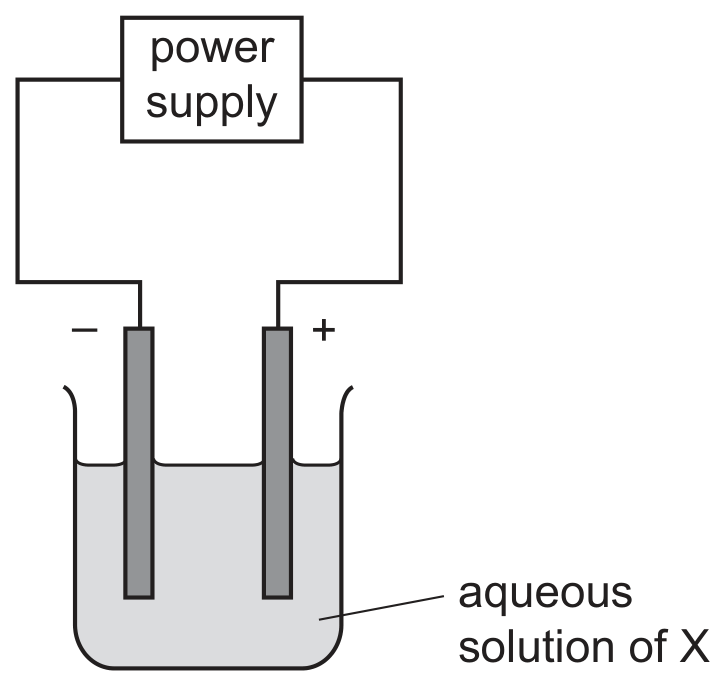
Hydrogen is produced at the cathode and chlorine is produced at the anode.
What is X ?
concentrated copper(II) chloride solution
concentrated hydrochloric acid
dilute hydrochloric acid
dilute sodium chloride solution
Which statements about the electrolysis of concentrated copper(II) chloride are correct?
1 Electrons are transferred from the cathode to the copper(II) ions.
2 Electrons move round the external circuit from the cathode to the anode.
3 Chloride ions are attracted to the anode.
4 Hydroxide ions transfer electrons to the cathode.
1 and 3
1 and 4
2 and 3
2 and 4
Which statement about electrolysis is correct?
Electrons move through the electrolyte from the cathode to the anode.
Electrons move towards the cathode in the external circuit.
Negative ions move towards the anode in the external circuit.
Positive ions move through the electrolyte towards the anode during electrolysis.
A solution of copper(II) sulfate can be electrolysed using copper electrodes or carbon electrodes. Which statements are correct?
1 Using copper electrodes, oxygen gas forms at the anode.
2 Using copper electrodes, copper atoms lose electrons at the anode.
3 Using carbon electrodes, copper metal forms at the cathode.
4 Using carbon electrodes, copper ions gain electrons at the cathode.
1 and 2
1 and 3
2, 3 and 4
4 only