EduNinja

IGCSE Chemistry Extended6.4 RedoxTopic Practice

6.4 Redox

CAIE IGCSE Chemistry Extended 6.4 Redox question practice helps you revise this syllabus point with the course map in view. Use this page to focus on one topic, check the style of questions available, and connect each attempt back to the knowledge area it is testing.

EduNinja keeps Chemistry practice aligned to CAIE at Extended level, so you can move from topic review into exam-style question bank work without losing the syllabus structure. Start with a small set, mark the weak steps, then return to nearby topic links when a definition, graph, calculation, or explanation needs repair.

Question 1(b)(v)

[Maximum number: 1]

Iron ore contains iron(III) oxide, Fe2O3\mathrm{Fe}_{2} \mathrm{O}_{3}. A blast furnace is used to extract iron from Fe2O3\mathrm{Fe}_{2} \mathrm{O}_{3}.
Equations for some of the reactions in the blast furnace are shown.

equation 1C+O2CO21 \mathrm{C}+\mathrm{O}_{2} \rightarrow \mathrm{CO}_{2}

equation 2CaCO3CaO+CO22 \mathrm{CaCO}_{3} \rightarrow \mathrm{CaO}+\mathrm{CO}_{2}

equation 3CaO+SiO2CaSiO33 \quad \mathrm{CaO}+\mathrm{SiO}_{2} \rightarrow \mathrm{CaSiO}_{3}

Iron(III) oxide, Fe2O3\mathrm{Fe}_{2} \mathrm{O}_{3}, in iron ore is converted to iron when it reacts with carbon monoxide, CO , in the blast furnace.

Name the chemical process which happens to iron when iron(III) oxide is converted to iron in the blast furnace.
Question 1

[Maximum number: 3]

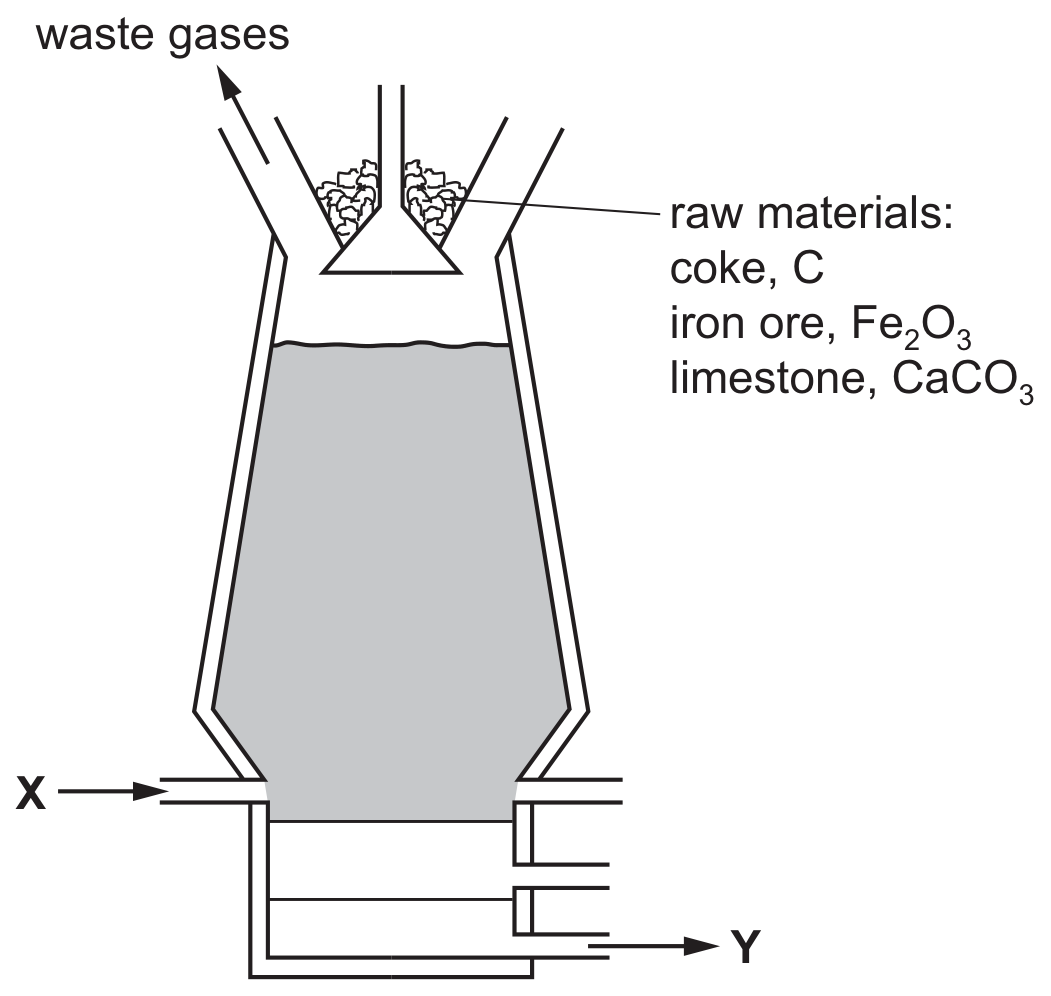
The diagram shows a blast furnace.

Question image

Question 1(a)

(a)

The following equations represent reactions which take place in the blast furnace.

A C+O2CO2\mathrm{C}+\mathrm{O}_{2} \rightarrow \mathrm{CO}_{2}

B CaCO3CaO+CO2\mathrm{CaCO}_{3} \rightarrow \mathrm{CaO}+\mathrm{CO}_{2}

C CaO+SiO2CaSiO3\mathrm{CaO}+\mathrm{SiO}_{2} \rightarrow \mathrm{CaSiO}_{3}

D CO2+C2CO\mathrm{CO}_{2}+\mathrm{C} \rightarrow 2 \mathrm{CO}

E Fe2O3+3CO2Fe+3CO2\mathrm{Fe}_{2} \mathrm{O}_{3}+3 \mathrm{CO} \rightarrow 2 \mathrm{Fe}+3 \mathrm{CO}_{2}

[ 1 ]

Question 1(a)(iii)

(i)

In which reaction is carbon both oxidised and reduced?

[ 1 ]

Question 1(c)

(b)

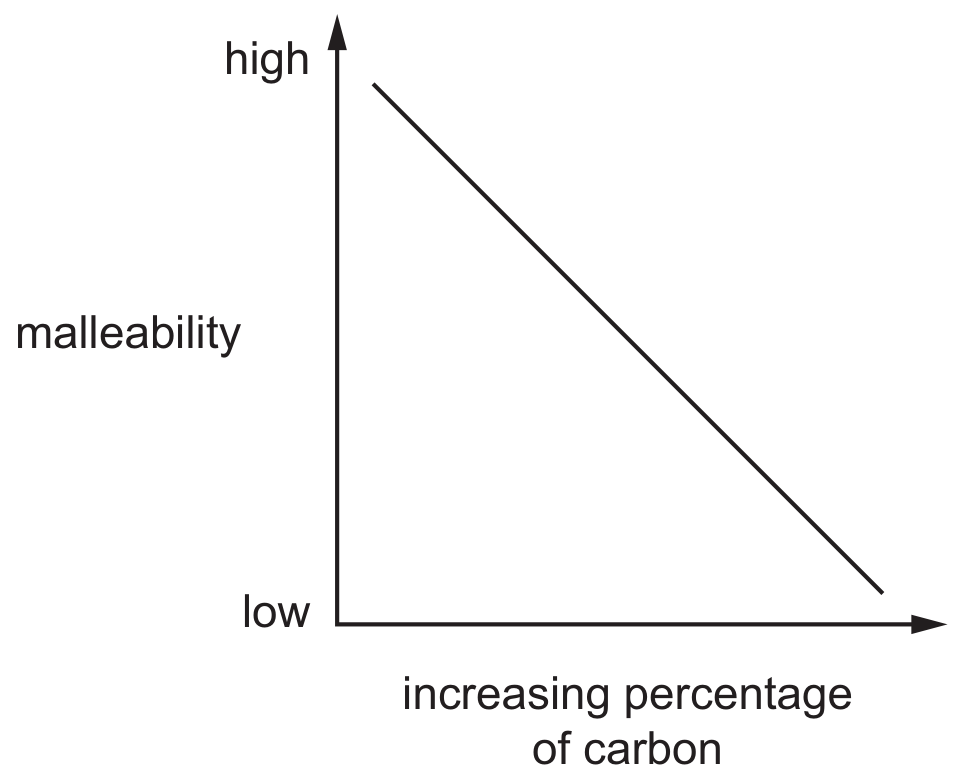
The graph shows how the malleability of iron changes as the percentage of carbon in the iron changes.

Question image
[ 2 ]

Question 1(c)(ii)

(i)

Iron obtained from the blast furnace contains high levels of carbon.

Explain how the amount of carbon in the iron can be decreased.

[ 2 ]

Question 2(a)(vi)

[Maximum number: 1]

The symbols of the elements in Period 2 of the Periodic Table are shown.
Li Be
B
C
N
0
F
Ne

Use the symbols of the elements in Period 2 to answer the questions that follow. Each symbol may be used once, more than once or not at all.

Give the symbol of the element that:

only has an oxidation number of zero.

Question 2(a)(vi)

[Maximum number: 1]

The symbols of the elements in Period 3 of the Periodic Table are shown.

Table

Use the symbols of the elements in Period 3 to answer the questions that follow. Each symbol may be used once, more than once, or not at all.

Give the symbol of the element that:

has an oxidation number of -1 when it forms a compound with hydrogen.

Question 2(b)(iv)

[Maximum number: 1]

Aluminium is extracted from its ore by electrolysis.

The reaction at the anode during the extraction of aluminium by electrolysis is shown.

2O2O2+4e2 \mathrm{O}^{2-} \rightarrow \mathrm{O}_{2}+4 \mathrm{e}^{-}

Is this process oxidation or reduction?
Give a reason for your answer.

Question 9

[Maximum number: 1]

Three ionic compounds of vanadium have the formulae V2O,VCl2\mathrm{V}_{2} \mathrm{O}, \mathrm{VCl}_{2} and V2O3\mathrm{V}_{2} \mathrm{O}_{3}.
What is the charge on the vanadium ion in each compound?

V2O\mathrm{V}_{2} \mathrm{O}

VCl2\mathrm{VCl}_{2}

 V2O3\mathrm{~V}_{2} \mathrm{O}_{3}

+1

-2

+2

+1

+2

+3

+2

-2

+2

+2

+2

+3

Question 12

[Maximum number: 1]

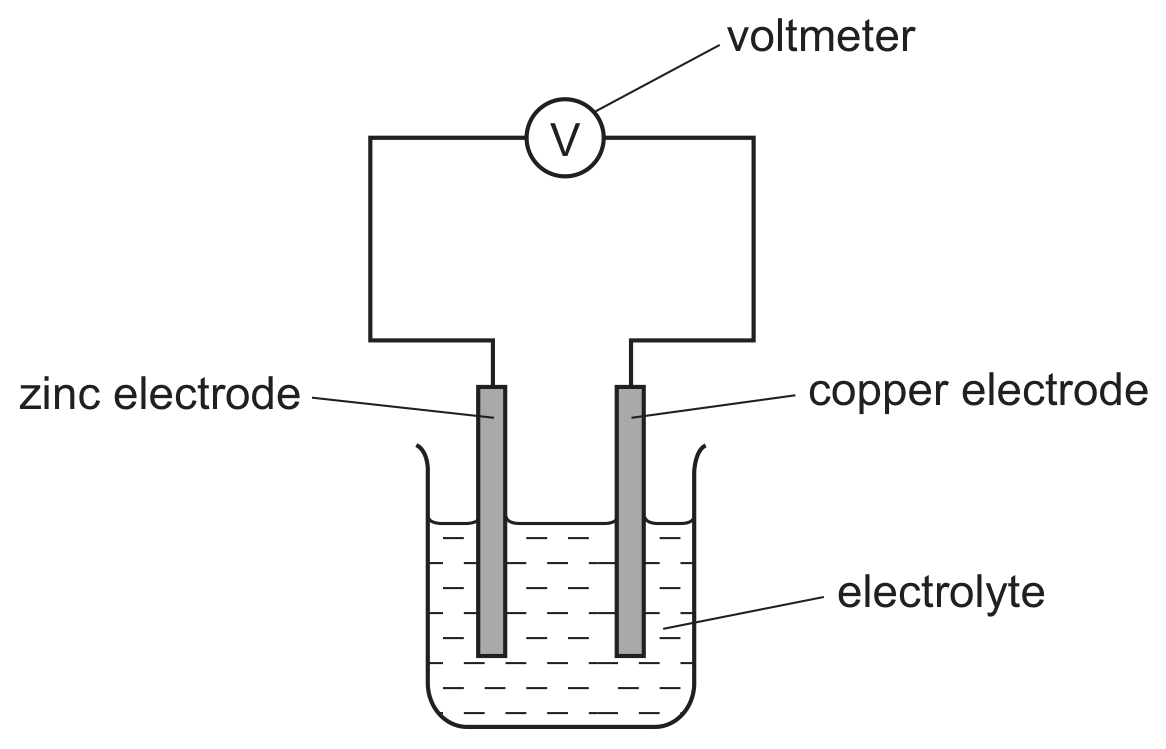
The diagram shows a simple cell.

Question image

Which statement about the process occurring when the cell is in operation is correct?

A

Cu2+\mathrm{Cu}^{2+} ions are formed in solution.

B

Electrons travel through the solution.

C The reaction ZnZn2++2e\mathrm{Zn} \rightarrow \mathrm{Zn}^{2+}+2 \mathrm{e}^{-}occurs.

D The zinc electrode increases in mass.

Question 2(d)(i)

[Maximum number: 2]

Ammonia is manufactured by the Haber process.

Ammonia, NH3\mathrm{NH}_{3}, is used to produce nitric acid, HNO3\mathrm{HNO}_{3}. This happens in a three-stage process.

Stage 1 is a redox reaction.

4NH3+5O24NO+6H2O4 \mathrm{NH}_{3}+5 \mathrm{O}_{2} \rightarrow 4 \mathrm{NO}+6 \mathrm{H}_{2} \mathrm{O}

Identify what is oxidised in stage 1.

Give a reason for your answer.
substance oxidised
reason

Question 2(b)(ii)

[Maximum number: 2]

Zinc is extracted from an ore containing zinc sulfide.

This ore is converted to zinc oxide, ZnO .

Zinc oxide is then reacted with carbon.

State what type of chemical change happens to the zinc in zinc oxide in this reaction.

Explain your answer.
chemical change
explanation

Question 13

[Maximum number: 1]

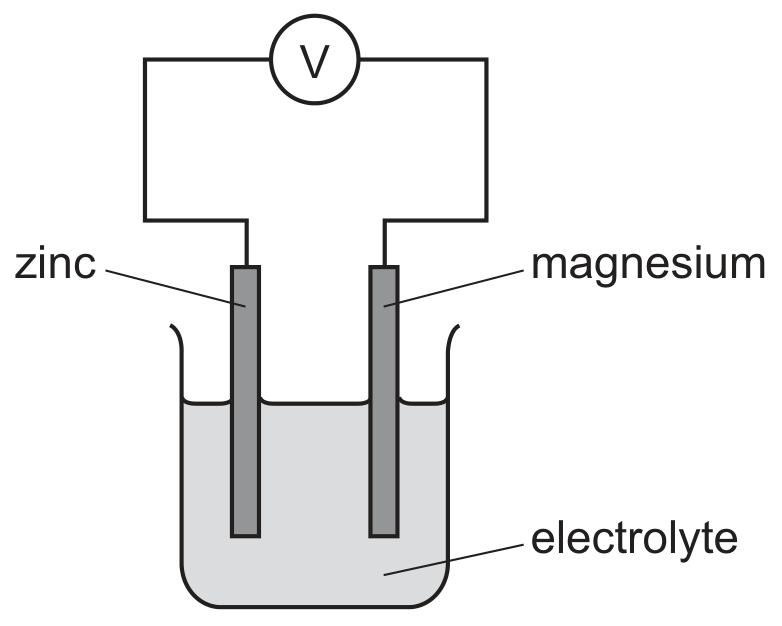
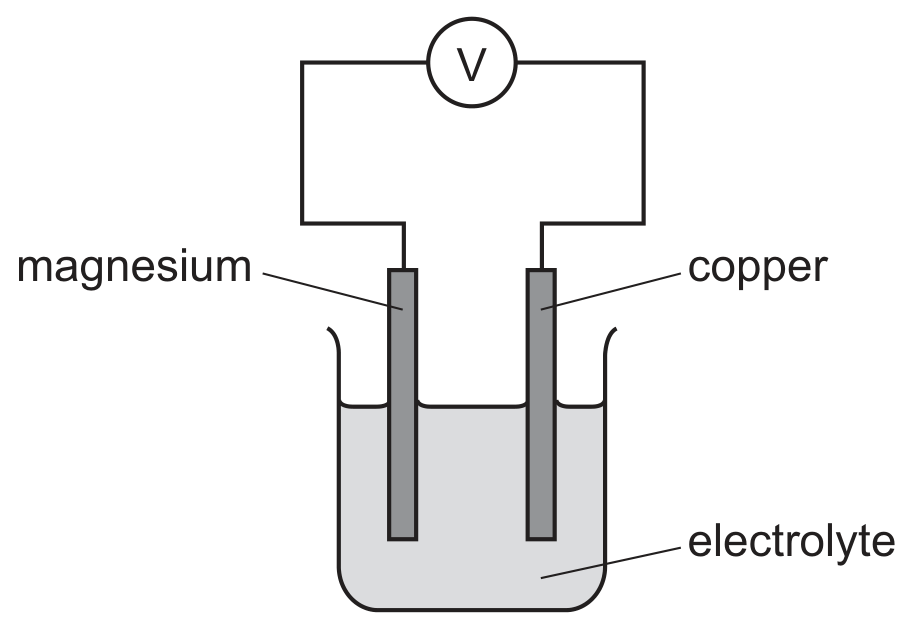
The electrical energy, or voltage, of two simple cells is measured.

cell 1

cell 1

cell 2

cell 2

statement 1 The voltage of cell 1 is greater than cell 2.
statement 2 Zinc is more reactive than copper.
statement 3 Magnesium is oxidised in both cells.
statement 4 Magnesium atoms lose electrons to form magnesium ions.
Which option is correct?

A

All the statements are correct.

B

Only statements 1 and 3 are correct.

C

Statement 2 is correct and explains statement 1.

D

Statement 4 is correct and explains statement 3.

0 selected