
EduNinja

IGCSE Chemistry Extended4.1.5—Predict the identity of the productsTopic Practice

4.1.5—Predict the identity of the products

• Predict the identity of the products at each electrode for the electrolysis of a binary compound in the molten state

Question 3(c)(ii)

[Maximum number: 2]

Potassium reacts with chlorine to form potassium chloride, KCl.

Molten potassium chloride undergoes electrolysis.

Name the products formed at the positive electrode (anode) and negative electrode (cathode) when molten potassium chloride undergoes electrolysis.
anode
cathode
Question 3(d)(i)

[Maximum number: 2]

Sodium reacts with fluorine to form sodium fluoride, NaF.

Molten sodium fluoride undergoes electrolysis.

Name the products formed at the positive electrode (anode) and the negative electrode (cathode) when molten sodium fluoride undergoes electrolysis.
anode
cathode

Question 2(f)(ii)

[Maximum number: 1]

Soluble salts can be made by adding a metal carbonate to a dilute acid.

Sodium chloride does not conduct electricity when solid, but does conduct electricity when molten.

Name the product formed at the positive electrode when electricity is passed through molten sodium chloride.

Question 4(c)(iii)

[Maximum number: 1]

Potassium reacts with bromine at room temperature to form potassium bromide.

Concentrated aqueous potassium bromide is an electrolyte.

When molten potassium bromide is electrolysed, the product at the cathode is different. Name the product at the cathode when molten potassium bromide is electrolysed.

Question 4(e)(i)

[Maximum number: 2]

Silicon(IV) oxide and sodium chloride have different types of bonding and structure.

A concentrated aqueous solution of sodium chloride is electrolysed using carbon electrodes.

Name the products formed at the electrodes.
product at the positive electrode (anode)
product at the negative electrode (cathode)

Question 4(b)(iv)

[Maximum number: 1]

This question is about lead(II) chloride, PbCl2\mathrm{PbCl}_{2}.

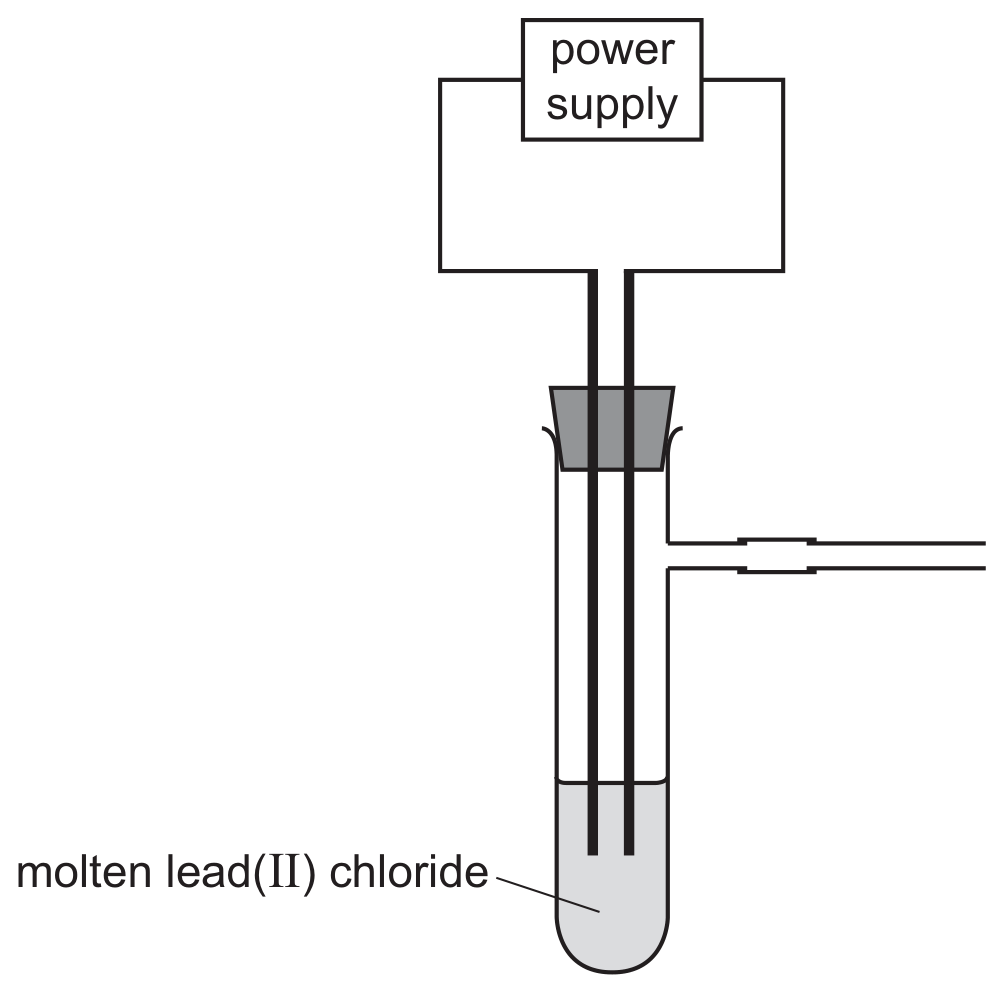
The student carries out an electrolysis experiment on molten lead(II) chloride using the apparatus shown in Fig. 4.1. Chlorine gas forms at the anode and escapes from the apparatus.

Fig. 4.1

Fig. 4.1

Describe what is observed at the cathode.

Question 4(e)(ii)

[Maximum number: 1]

This question is about chemical reactions and electricity.

Brine is concentrated aqueous sodium chloride.

Name a different substance formed when molten sodium chloride is used instead of concentrated aqueous sodium chloride.

Question 5(e)(ii)

[Maximum number: 1]

Titanium is extracted from an ore called rutile. Rutile is an impure form of titanium(IV) oxide, TiO2\mathrm{TiO}_{2}.

Magnesium cannot be produced by electrolysis of aqueous magnesium chloride using inert electrodes.

Suggest how magnesium can be produced from magnesium chloride by electrolysis.
[Total: 16]

0 selected