EduNinja

IGCSE Chemistry Extended8.4 Transition elementsTopic Practice

8.4 Transition elements

CAIE IGCSE Chemistry Extended 8.4 Transition elements question practice helps you revise this syllabus point with the course map in view. Use this page to focus on one topic, check the style of questions available, and connect each attempt back to the knowledge area it is testing.

EduNinja keeps Chemistry practice aligned to CAIE at Extended level, so you can move from topic review into exam-style question bank work without losing the syllabus structure. Start with a small set, mark the weak steps, then return to nearby topic links when a definition, graph, calculation, or explanation needs repair.

Question 1(a)(vi)

[Maximum number: 1]

Some elements are shown in the order they appear in the reactivity series. The most reactive element is at the top.
> sodium calcium magnesium aluminium zinc iron hydrogen copper

Answer the questions using the list of elements. Each element may be used once, more than once or not at all.

Identify:

a metal that forms chlorides of the type XCl2\mathrm{XCl}_{2} and XCl3\mathrm{XCl}_{3}.

Question 1(a)(iv)

[Maximum number: 1]

This question is about elements.
> aluminium
> carbon iron hydrogen oxygen silicon sodium sulfur

Answer the following questions about these elements.
Each element may be used once, more than once or not at all.

Name the element that has oxidation states of +2 and +3 .

Question 2(a)(iii)

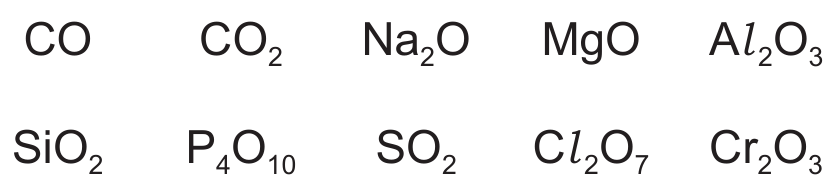
Some oxides of some elements are listed.

Table

Answer the following questions using only oxides from the list. Each oxide may be used once, more than once or not at all.

Give the formula of an oxide

which is coloured,

Question 2(a)(iii)

[Maximum number: 1]

A list of five metals is shown.

A list of five metals is shown.

\title{
copper \\ iron \\ magnesium \\ potassium \\ silver
}

All metals form positive ions.

Suggest one of the five metals in the list which is not likely to show catalytic properties.

Question 2(b)

[Maximum number: 2]

Cobalt and copper are transition elements.

One physical property of transition elements such as copper and cobalt is that they are hard. Other metals such as lithium are softer.

State two other physical properties of copper and cobalt which are significantly different from lithium.

1

2

Question 3(a)(i)

[Maximum number: 2]

Sodium is in Group I of the Periodic Table.
Describe two physical properties of sodium which are different from the physical properties of transition elements such as copper.

1

2

Question 3(c)

[Maximum number: 2]

Zinc and copper are elements next to each other in the Periodic Table.

Copper is a transition element. It can have variable oxidation states.

State two other chemical properties of transition elements which make them different from Group I elements.

1

2

Question 3(b)(i)

[Maximum number: 1]

This question is about nitrogen and some of its compounds.

Ammonia is converted into nitric acid.

The first stage of this conversion uses a catalyst and occurs at a temperature of 900C900^{\circ} \mathrm{C} and a pressure of 5 atmospheres.

4NH3( g)+5O2( g)4NO( g)+6H2O( g)4 \mathrm{NH}_{3}(\mathrm{~g})+5 \mathrm{O}_{2}(\mathrm{~g}) \rightleftharpoons 4 \mathrm{NO}(\mathrm{~g})+6 \mathrm{H}_{2} \mathrm{O}(\mathrm{~g})

The forward reaction is exothermic.

Suggest which of the following elements is most likely to be used as a catalyst. Draw a circle around your answer.

Table

Question 4(e)(i)

[Maximum number: 1]

Hydrogen iodide thermally decomposes into iodine and hydrogen. The reaction is reversible.

2HI( g) colourless gas I2( g) purple gas +H2( g) colourless gas \underset{\text { colourless gas }}{2 \mathrm{HI}(\mathrm{~g})} \rightarrow \underset{\substack{\mathrm{I}_{2}(\mathrm{~g}) \\ \text { purple gas }}}{\rightleftharpoons}+\underset{\substack{\mathrm{H}_{2}(\mathrm{~g}) \\ \text { colourless gas }}}{ }

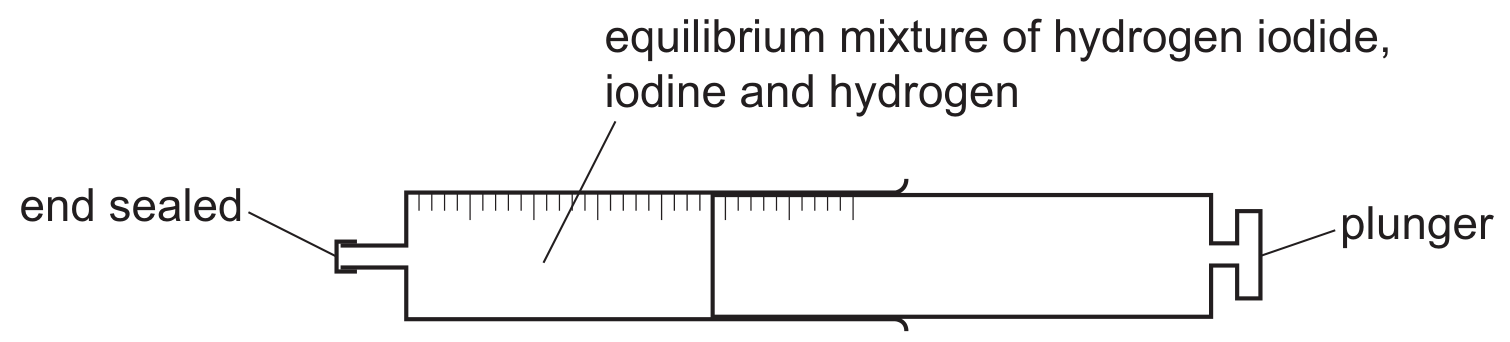
Fig. 4.1 shows a gas syringe containing a mixture of hydrogen iodide, iodine and hydrogen gases. The gas syringe is sealed and the mixture is heated to 300C300^{\circ} \mathrm{C}. The mixture of gases reaches equilibrium and is purple.

Fig. 4.1

Fig. 4.1

Methanol is manufactured by reacting carbon monoxide with hydrogen.

CO( g)+2H2( g)CH3OH( g)\mathrm{CO}(\mathrm{~g})+2 \mathrm{H}_{2}(\mathrm{~g}) \rightleftharpoons \mathrm{CH}_{3} \mathrm{OH}(\mathrm{~g})

The rate of formation of methanol increases when a catalyst is used.

Choose from the list the element that is most likely to be used as the catalyst.

Draw a circle around your chosen answer.
calcium carbon copper sodium sulfur

Question 21

Which metal has variable oxidation states?
A aluminium
B calcium
C copper
D sodium

0 selected