Question 1(c)
[Maximum number: 1]
Give the name of the process that is used:
to produce bromine from molten lead(II) bromide
 EduNinja
• Identify products and observations during electrolysis of: (a) molten lead(II) bromide (b) concentrated aqueous sodium chloride (c) dilute sulfuric acid with inert platinum/carbon electrodes
Give the name of the process that is used:
to produce bromine from molten lead(II) bromide
Name the process used to:
produce lead from molten lead(II) bromide
Potassium reacts with chlorine to form potassium chloride, KCl.
Concentrated aqueous potassium chloride undergoes electrolysis.
Name the potassium compound that remains in the solution after electrolysis.
An electrolysis experiment is done using carbon electrodes.
Hydrogen and oxygen are formed at the electrodes.
What is the electrolyte?
aqueous copper(II) sulfate
concentrated hydrochloric acid
dilute aqueous sodium chloride
molten potassium oxide
In separate experiments, electricity was passed through concentrated aqueous sodium chloride and molten lead(II) bromide.
What would happen in both experiments?
A halogen would be formed at the anode.
A metal would be formed at the cathode.
Hydrogen would be formed at the anode.
Hydrogen would be formed at the cathode.
Which substance is not produced during the electrolysis of concentrated aqueous sodium chloride?
chlorine
hydrogen
sodium
sodium hydroxide
Which substance is not produced during the electrolysis of concentrated aqueous sodium chloride?
chlorine
hydrogen
sodium
sodium hydroxide
Electrolytes can be broken down by electrolysis.
Which rows are correct for each electrolyte?
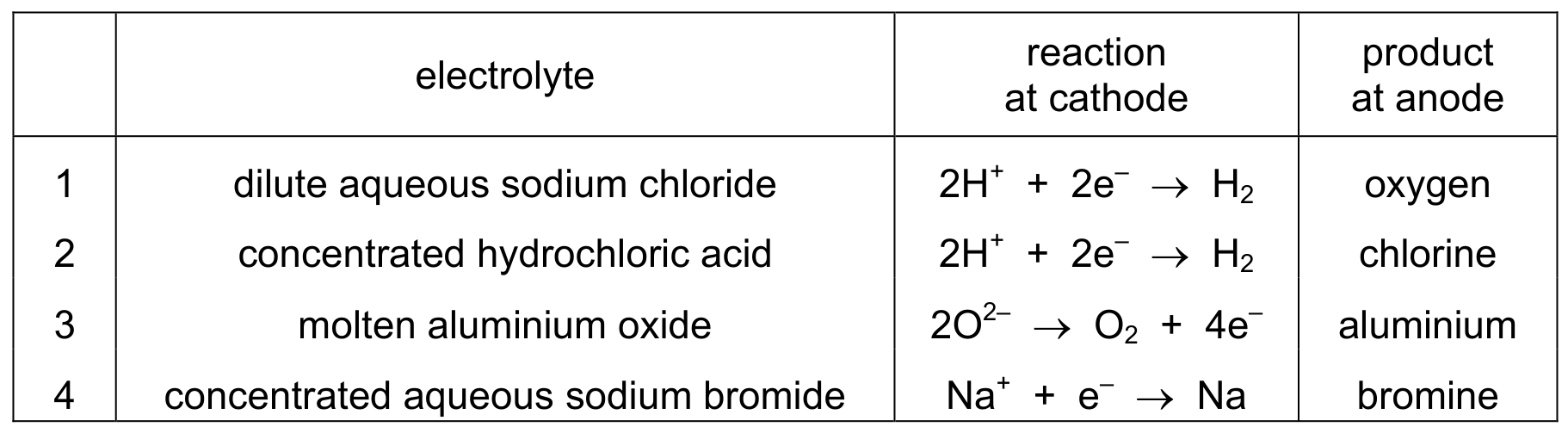
1 and 2
1 and 4
2 and 3
3 and 4
Effervescence is observed at the negative electrode (cathode) during the electrolysis of concentrated aqueous sodium chloride.
Which element is produced at the negative electrode (cathode)?
chlorine
hydrogen
oxygen
sodium
In separate experiments, electricity was passed through concentrated aqueous sodium chloride and molten lead(II) bromide.
What would happen in both experiments?
A A halogen would be formed at the anode.
B A metal would be formed at the cathode.
C Hydrogen would be formed at the anode.
D Hydrogen would be formed at the cathode.