Question 1(g)
[Maximum number: 1]
Name the process used to:
determine the volume of an acid required to neutralise a given volume of an alkali.
 EduNinja
CAIE IGCSE Chemistry Extended 12.2 Acid–base titrations question practice helps you revise this syllabus point with the course map in view. Use this page to focus on one topic, check the style of questions available, and connect each attempt back to the knowledge area it is testing.
EduNinja keeps Chemistry practice aligned to CAIE at Extended level, so you can move from topic review into exam-style question bank work without losing the syllabus structure. Start with a small set, mark the weak steps, then return to nearby topic links when a definition, graph, calculation, or explanation needs repair.
Name the process used to:
determine the volume of an acid required to neutralise a given volume of an alkali.
Which piece of apparatus is used to measure variable quantities of liquid in a titration?
Potassium is a Group I element.
Aqueous potassium hydroxide reacts with a dilute acid to produce aqueous potassium chloride, KCl(aq), which is a salt.
Name the experimental technique used when salts are made by reacting a dilute acid with an aqueous alkali.
Calcium hydroxide, , is slightly soluble in water.
A sample of limewater is placed in a conical flask. The concentration of in the limewater is determined by titration with dilute hydrochloric acid, HCl .
Name the item of apparatus used to measure the volume of acid in this titration.
As well as limewater and dilute hydrochloric acid, state what other type of substance must be added to the conical flask.
This question is about sodium and compounds of sodium.
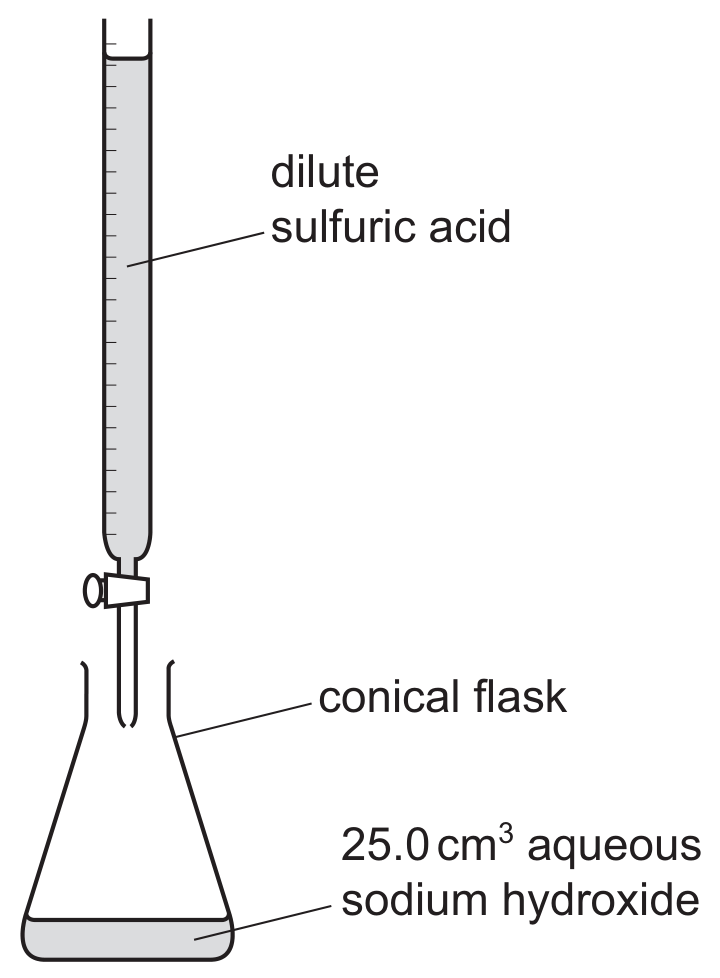
A student determines the concentration of a solution of dilute sulfuric acid, , by titration with aqueous sodium hydroxide, NaOH .
step of is transferred into a conical flask.
step 2 Three drops of methyl orange indicator are added to the conical flask.
step 3 A burette is filled with .
step 4 The acid in the burette is added to the conical flask until the indicator changes colour. The volume of acid is recorded. This process is known as titration.
step 5 The titration is repeated several times until a suitable number of results is obtained.
State the colour change of the methyl orange indicator in step 4. from to
State how the student decides that a suitable number of results have been obtained.
What is used to identify the end-point of an acid-base titration?
balance
measuring cylinder
indicator
volumetric pipette
Dilute sulfuric acid and aqueous sodium hydroxide can be used to prepare sodium sulfate crystals using a method that involves titration.
Suggest why universal indicator is not suitable for this titration.
Name an indicator that can be used in this titration.
of dilute sulfuric acid neutralises of aqueous sodium hydroxide. At the end of the titration the conical flask contains aqueous sodium sulfate with the dissolved indicator as an impurity.
Dilute hydrochloric acid is titrated into a conical flask containing sodium hydroxide solution and a few drops of methyl orange indicator.
Which piece of apparatus is used to add the hydrochloric acid?
beaker
burette
measuring cylinder
pipette
An acid-base titration is described.
- of dilute aqueous alkali is put into a conical flask.
- Indicator is added to the flask.
- Dilute acid is added to the aqueous alkali until the indicator changes colour.
- The volume of acid used is then recorded.
Which use of apparatus is correct?
The of aqueous alkali is measured using a volumetric pipette.
The of aqueous alkali is measured using the lines on the conical flask.
The volume of acid is measured using a measuring cylinder.
The volume of acid is measured using a volumetric pipette.
The concentration of acids and alkalis can be determined by titration.
Which pieces of equipment are needed to perform a titration?
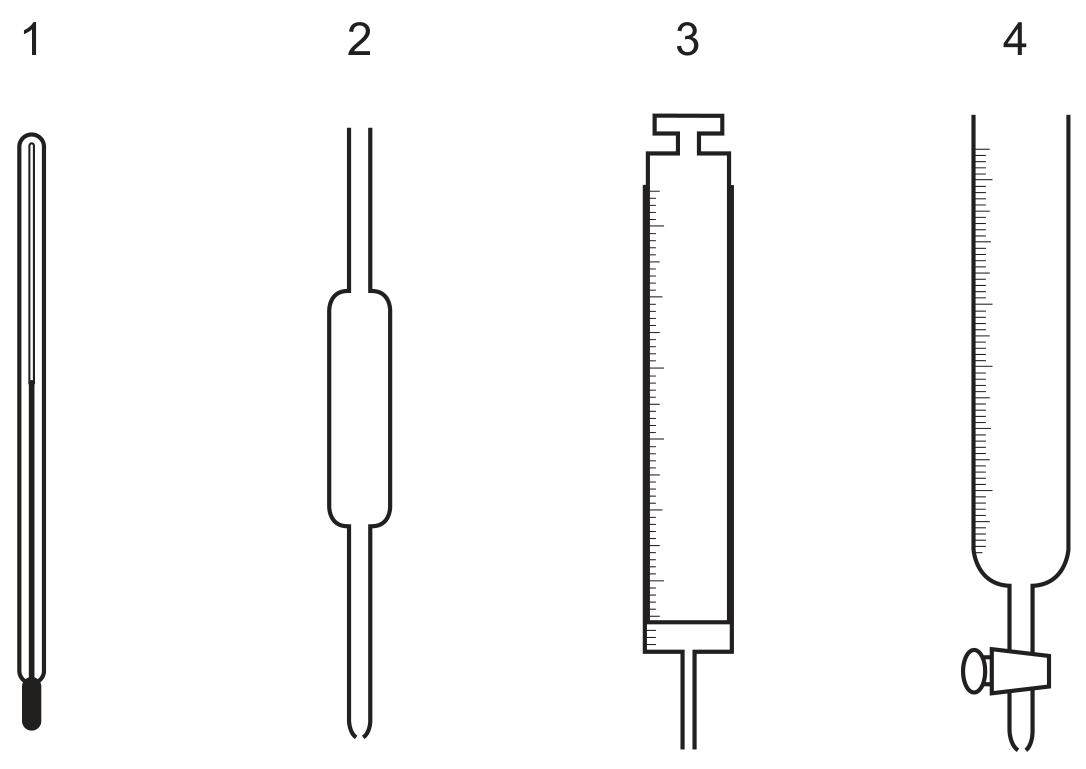
1 and 2
1 and 3
2 and 3
2 and 4