Question 1(e)
[Maximum number: 1]
Give the name of the process that is used:
to separate a mixture of coloured dyes.
 EduNinja
CAIE IGCSE Chemistry Extended 12.3 Chromatography question practice helps you revise this syllabus point with the course map in view. Use this page to focus on one topic, check the style of questions available, and connect each attempt back to the knowledge area it is testing.
EduNinja keeps Chemistry practice aligned to CAIE at Extended level, so you can move from topic review into exam-style question bank work without losing the syllabus structure. Start with a small set, mark the weak steps, then return to nearby topic links when a definition, graph, calculation, or explanation needs repair.
Give the name of the process that is used:
to separate a mixture of coloured dyes.
Amino acids are colourless and can be separated and identified by chromatography.
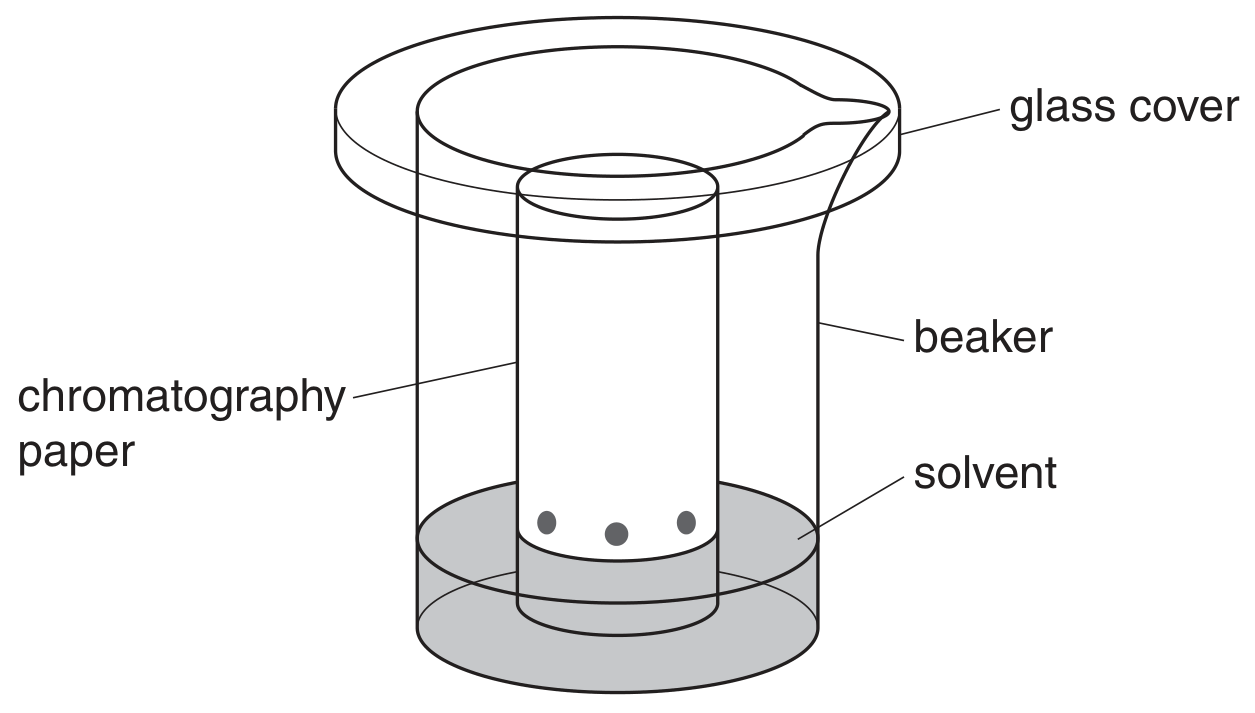
What additional apparatus is required to identify the amino acids present in a mixture?
a locating agent
a ruler
a ruler and a locating agent
neither a ruler or a locating agent
Give the name of the process that:
is used to separate a mixture of amino acids.
Give the name of the process that is used:
to separate a mixture of amino acids.
State the name of the process that is used to
separate the individual dyes in ink,
Give the name of the process that is used:
to separate the products of hydrolysis of long chain carbohydrates
Name the process used to:
identify the components of a mixture of soluble coloured substances
Amino acids are colourless and can be separated and identified by chromatography.
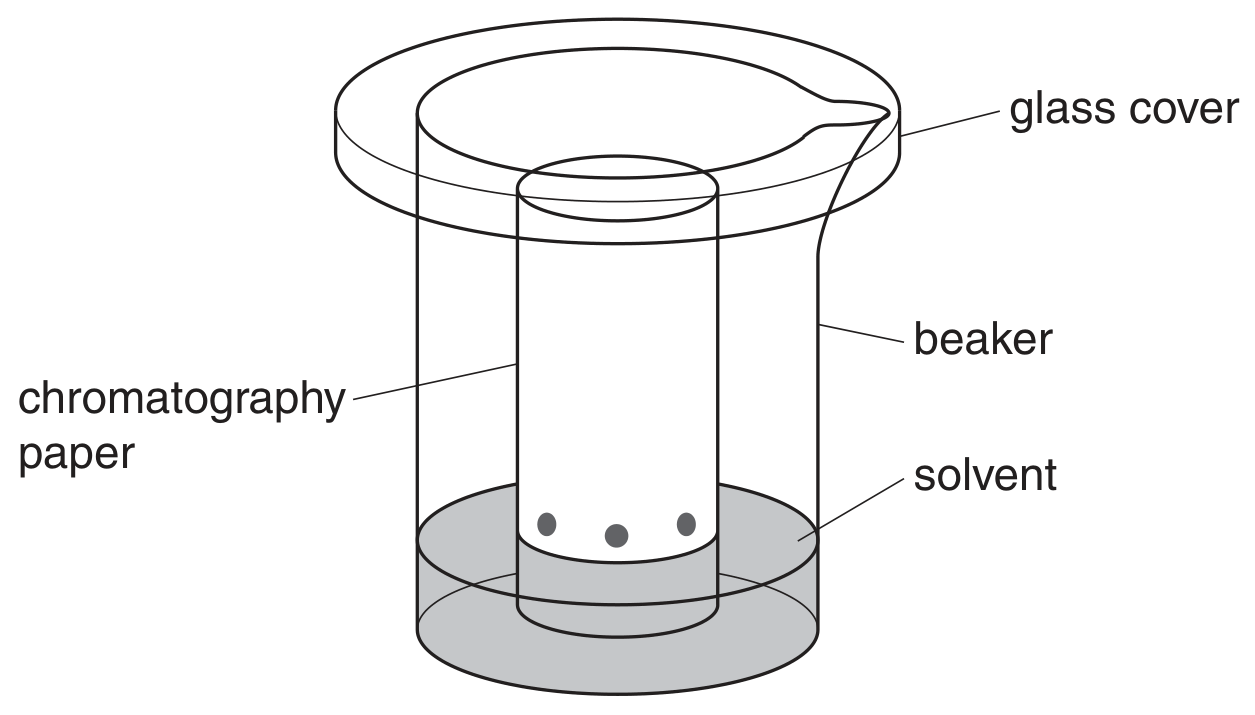
What additional apparatus is required to identify the amino acids present in a mixture?
A a locating agent
B a ruler
C a ruler and a locating agent
D neither a ruler or a locating agent
Paper chromatography is done in the same way with three different mixtures of dyes. Each mixture contains at least one of the dyes W, X, Y and Z.
The values of the dyes in the three mixtures are shown.
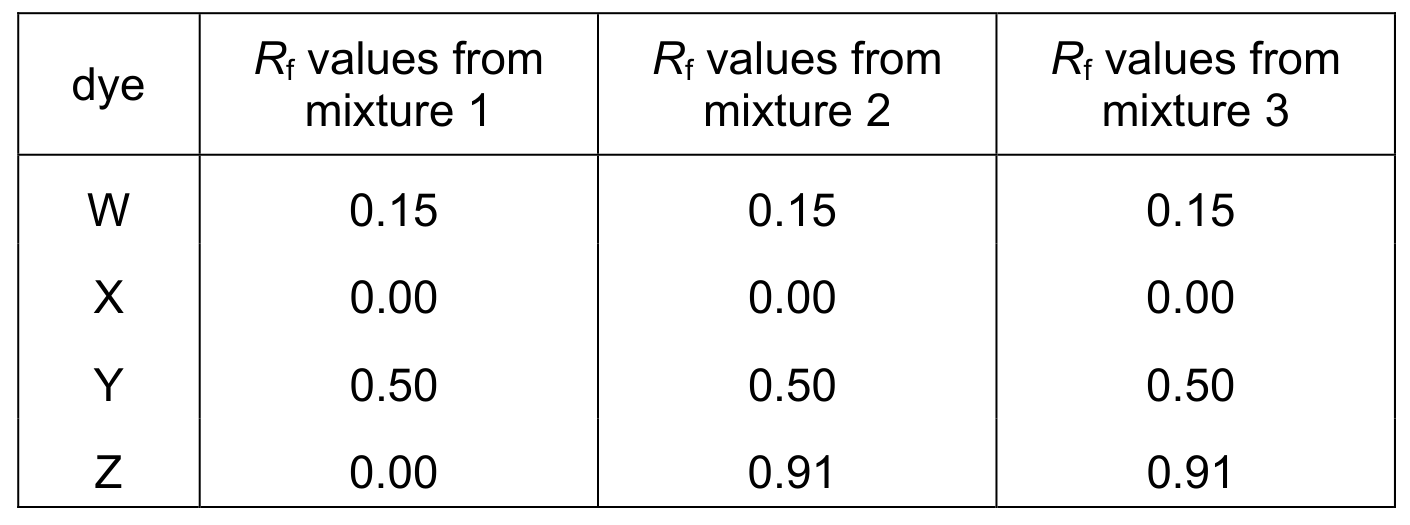
Which conclusion is correct?
Dye W is nearest the solvent front and is present only in mixture 1 and mixture 3.
Dye X has travelled furthest up the chromatography paper.
Dye Y is the only dye present in all three mixtures.
Dye Z is nearest the solvent front and is found in only two of the mixtures.
A chromatography experiment is carried out to analyse the pigments present in four different types of leaf. The student carrying out the experiment forgot to complete his table of results, which is shown.
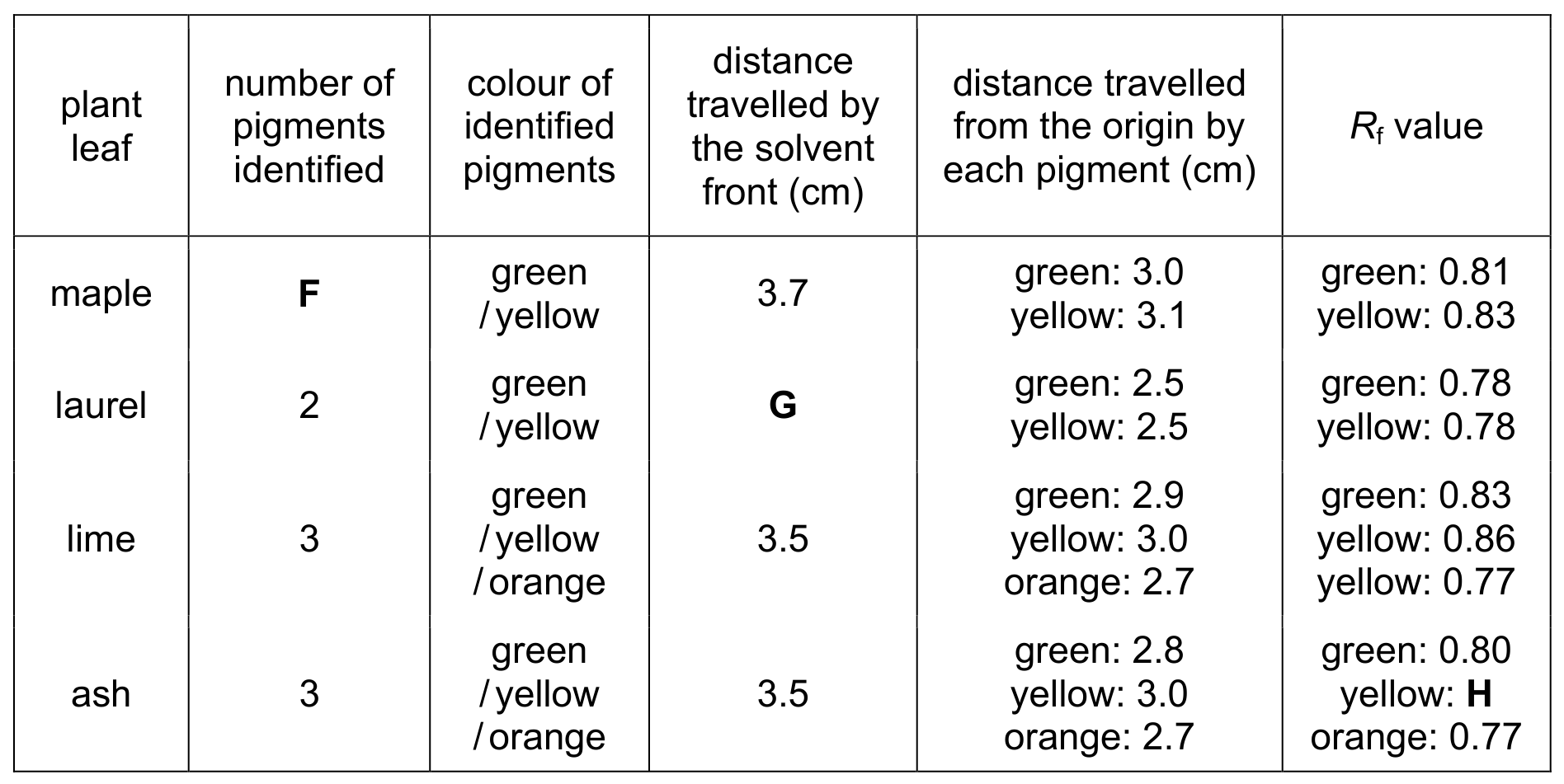
Which row identifies the values of F, G and H ?
F
G
H
2
3.2
0.80
3
3.5
0.83
2
3.2
0.86
3
3.5
0.78