EduNinja

IGCSE Chemistry Extended11.3 FuelsTopic Practice

11.3 Fuels

CAIE IGCSE Chemistry Extended 11.3 Fuels question practice helps you revise this syllabus point with the course map in view. Use this page to focus on one topic, check the style of questions available, and connect each attempt back to the knowledge area it is testing.

EduNinja keeps Chemistry practice aligned to CAIE at Extended level, so you can move from topic review into exam-style question bank work without losing the syllabus structure. Start with a small set, mark the weak steps, then return to nearby topic links when a definition, graph, calculation, or explanation needs repair.

Question 1

Question 1(b)

(a)

Petroleum can be separated into useful substances using the apparatus shown.
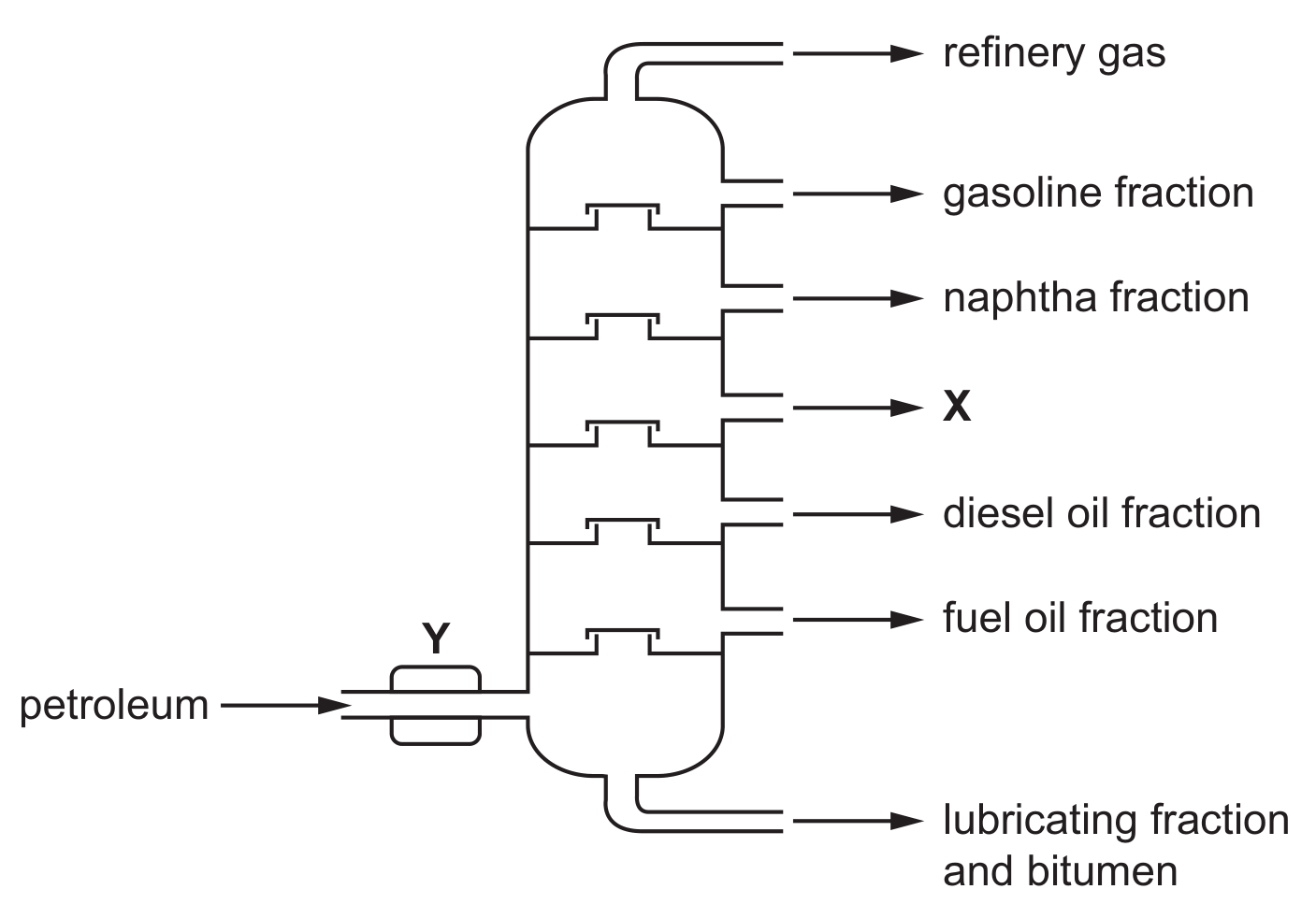
Question image
[ 5 ]

Question 1(b)(i)

(i)

Name the fraction which is the most viscous.

[ 1 ]

Question 1(b)(ii)

(ii)

Name the fraction with the smallest molecules.

[ 1 ]

Question 1(b)(iii)

(iii)

Name the fraction which has the weakest attractive forces between molecules.

[ 1 ]

Question 1(b)(iv)

(iv)

Fraction X is used as jet fuel.

Name fraction X.

[ 1 ]

Question 1(b)(v)

(v)

What happens at point Y on the diagram?

[ 1 ]
Question 1(a)(i)

[Maximum number: 1]

State one gas which:

is the main constituent of natural gas

Question 1

[Maximum number: 9]

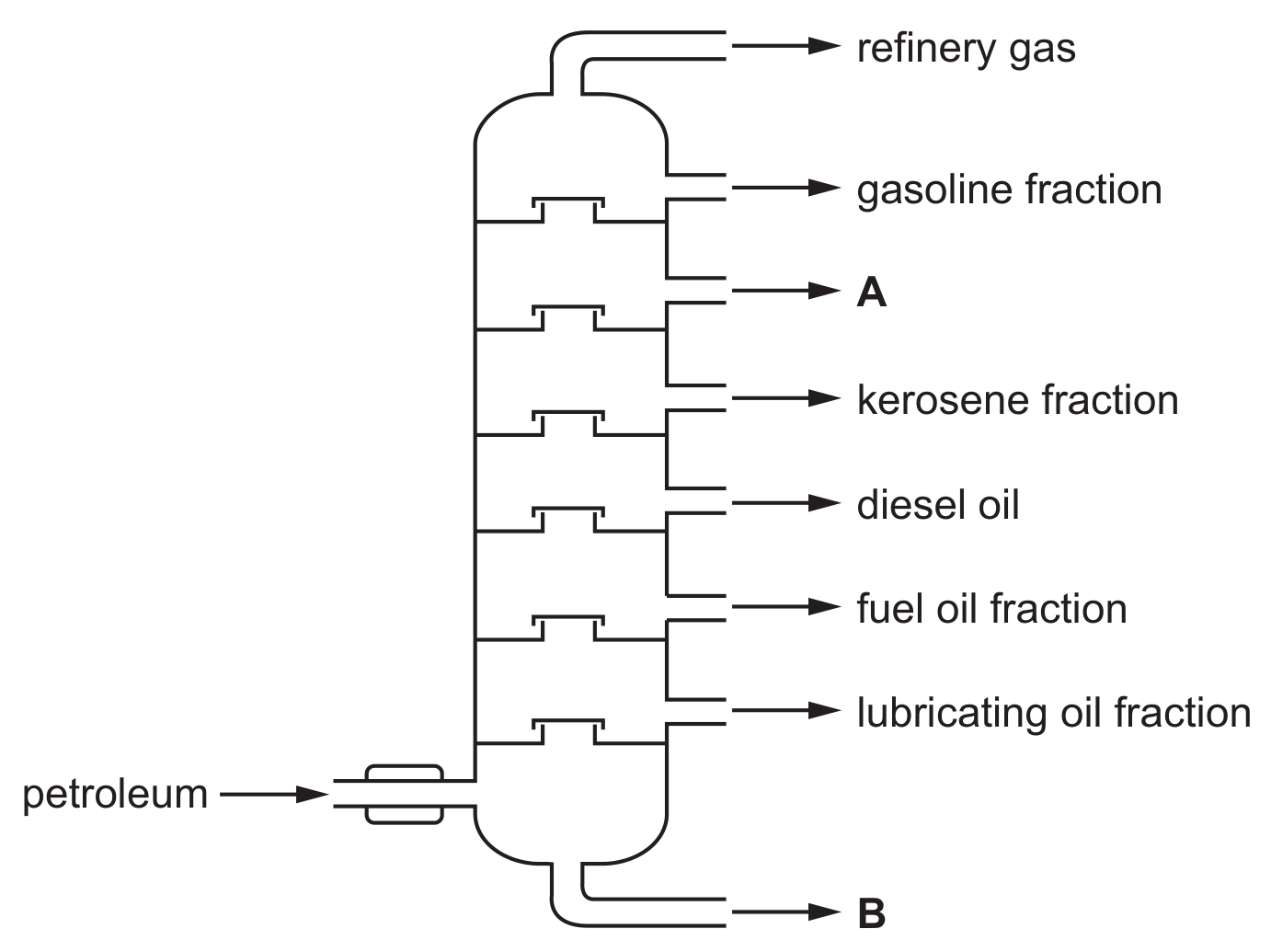
Petroleum is a useful natural resource.

The diagram shows how petroleum can be separated into useful substances.

Question image

Question 1(a)

(a)

What is the name of the separation process shown in the diagram?

[ 2 ]

Question 1(b)

(b)

Name the fraction leaving at:

A

B

[ 2 ]

Question 1(c)

(c)

Refinery gas is a mixture of hydrocarbons.

One refinery gas is butane, C4H10\mathrm{C}_{4} \mathrm{H}_{10}.

[ 2 ]

Question 1(c)(i)

(i)

Suggest the names of two other refinery gases. and

[ 2 ]

Question 1(d)

(d)

Gasoline and kerosene are both fuels. They have different properties.

[ 3 ]

Question 1(d)(i)

(i)

Describe the differences in the properties given. viscosity of the fuel flammability of the fuel

[ 2 ]

Question 1(d)(ii)

(ii)

What difference in the molecules of gasoline and kerosene causes these differences in properties?

[ 1 ]

Question 1(a)

[Maximum number: 1]

The names of eight substances are given.

Table

Answer the following questions about these substances.
Each substance may be used once, more than once or not at all.
State which substance is:

the main constituent of natural gas

Question 1(d)

[Maximum number: 1]

Give the name of the process that is used:

to separate the components of petroleum

Question 1(a)(vi)

[Maximum number: 2]

This question is about gases.

The following substances are gases at room temperature.

Table

Identify, by letter:

two gases which are found in refinery gas. [2]

Question 1(c)

[Maximum number: 1]

The following formulae represent different substances.
A
Ag
CaCO3\mathrm{CaCO}_{3}CH4\mathrm{CH}_{4}Cl2\mathrm{Cl}_{2}
Cu
SO2\mathrm{SO}_{2}

Answer the following questions using only these substances.
Each substance may be used once, more than once or not at all.
State which substance is:

the main constituent of natural gas

Question 11

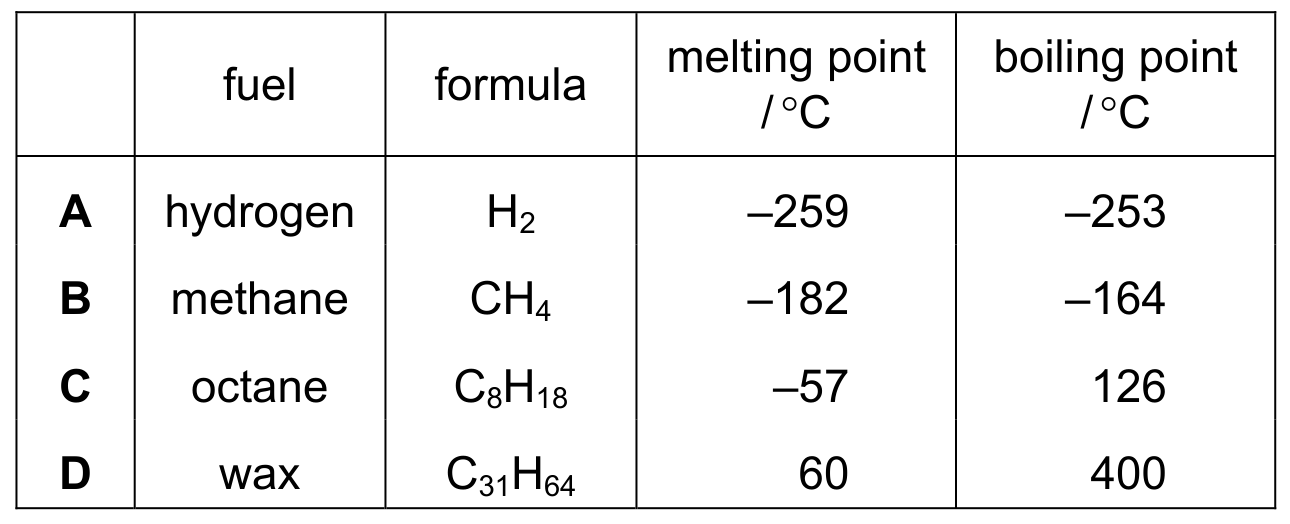
Some properties of four fuels are shown in the table.
Which fuel is a gas at room temperature and makes two products when it burns in a plentiful supply of air?

Table

Question 11

[Maximum number: 1]

Heat energy is produced when hydrocarbons burn in air.
Which equations represent this statement?

1C2H5OH+3O22CO2+3H2O1 \mathrm{C}_{2} \mathrm{H}_{5} \mathrm{OH}+3 \mathrm{O}_{2} \rightarrow 2 \mathrm{CO}_{2}+3 \mathrm{H}_{2} \mathrm{O}

2C2H4+3O22CO2+2H2O2 \mathrm{C}_{2} \mathrm{H}_{4}+3 \mathrm{O}_{2} \rightarrow 2 \mathrm{CO}_{2}+2 \mathrm{H}_{2} \mathrm{O}

3CH4+2O2CO2+2H2O3 \mathrm{CH}_{4}+2 \mathrm{O}_{2} \rightarrow \mathrm{CO}_{2}+2 \mathrm{H}_{2} \mathrm{O}
A

1, 2 and 3

B

1 and 2 only

C

1 and 3 only

D

2 and 3 only

Question 12

[Maximum number: 1]

Some properties of four fuels are shown.
Which fuel is a gas at room temperature and makes two products when it burns in a plentiful supply of air?

fuel

formula

melting point
1C1{ }^{\circ} \mathrm{C}

boiling point
1C1{ }^{\circ} \mathrm{C}

hydrogen

H2\mathrm{H}_{2}

-259

-253

methane

CH4\mathrm{CH}_{4}

-182

-164

octane

C8H18\mathrm{C}_{8} \mathrm{H}_{18}

-57

126

wax

C31H64\mathrm{C}_{31} \mathrm{H}_{64}

60

400

0 selected