Question 1(e)
[Maximum number: 1]
The following table gives information about six substances.
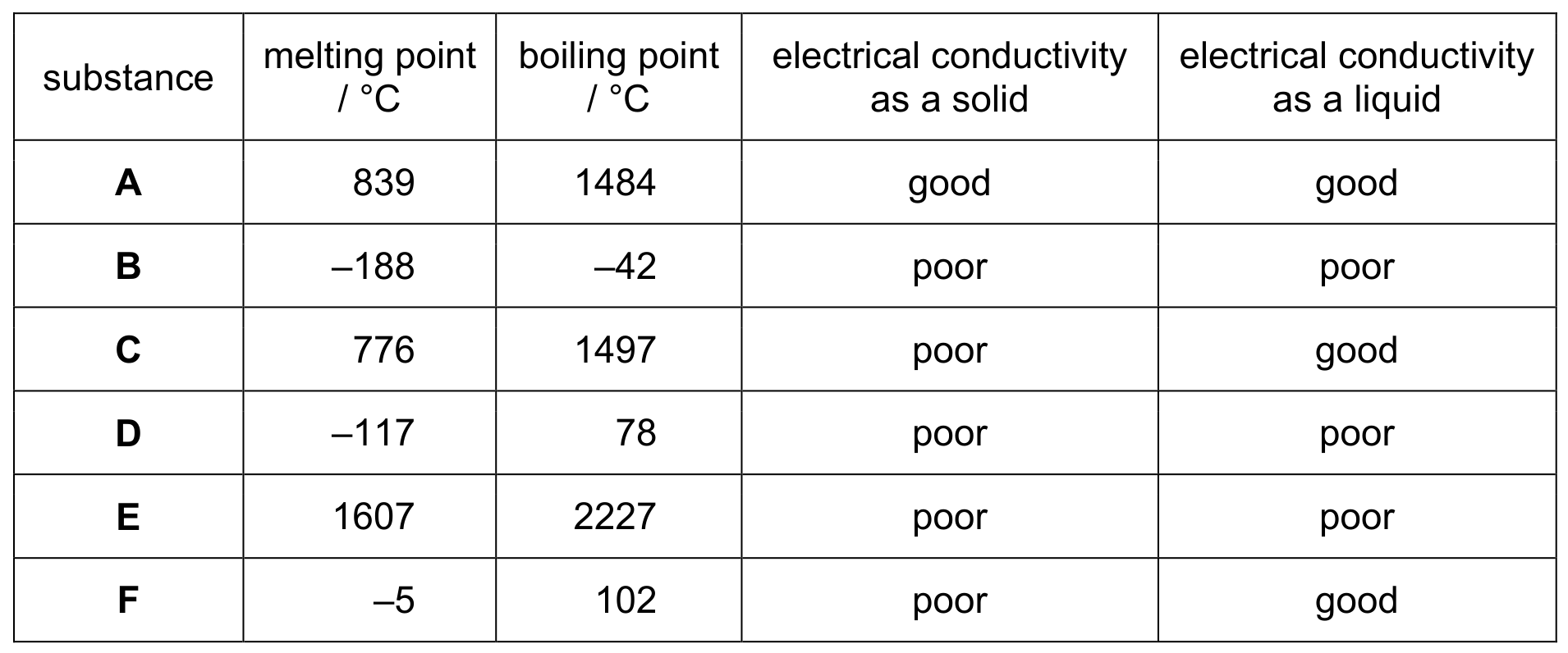
Which substance could be sodium chloride?
 EduNinja
• Describe properties of ionic compounds: (a) high melting points and boiling points (b) good electrical conductivity when aqueous or molten and poor when solid
The following table gives information about six substances.
Which substance could be sodium chloride?
The following table gives information about six substances.
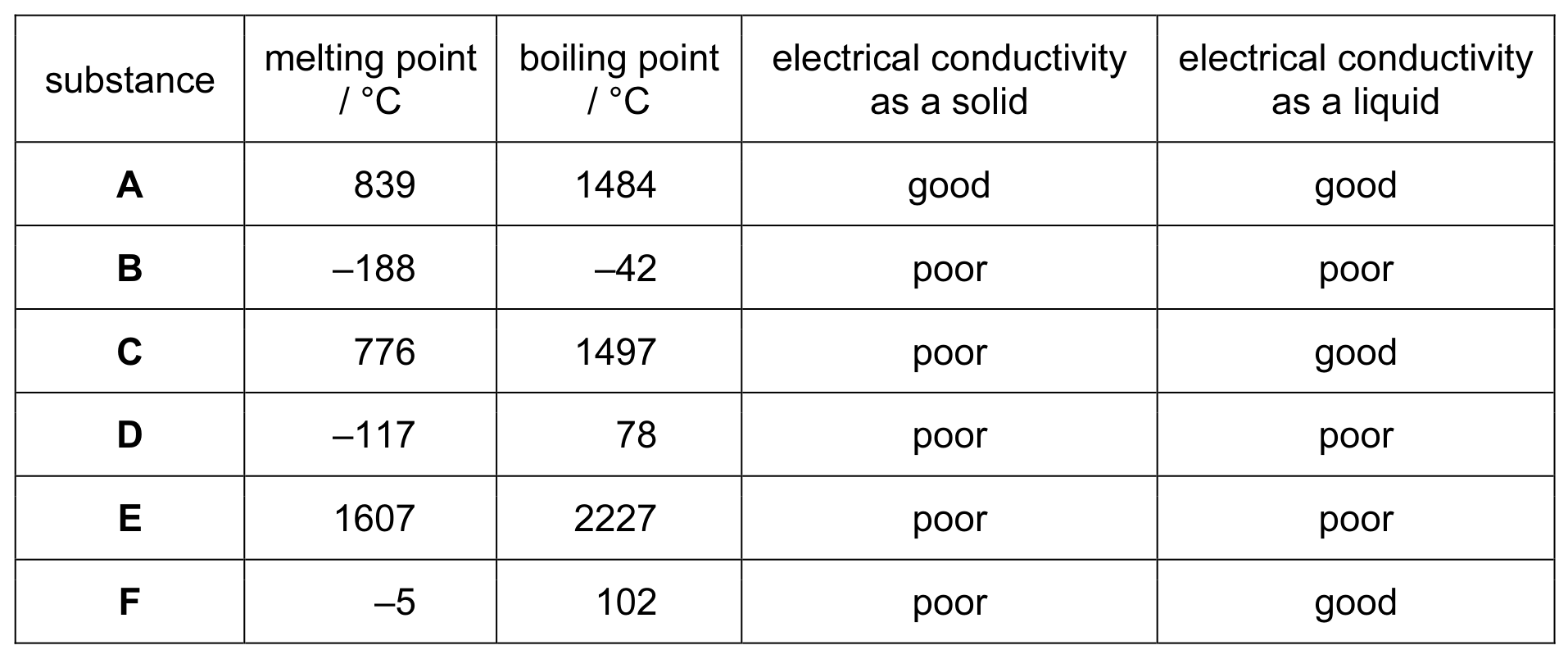
Which substance could be sodium chloride?
The table shows the melting points, boiling points and electrical conductivities of six substances, D, E, F, G, H and I.
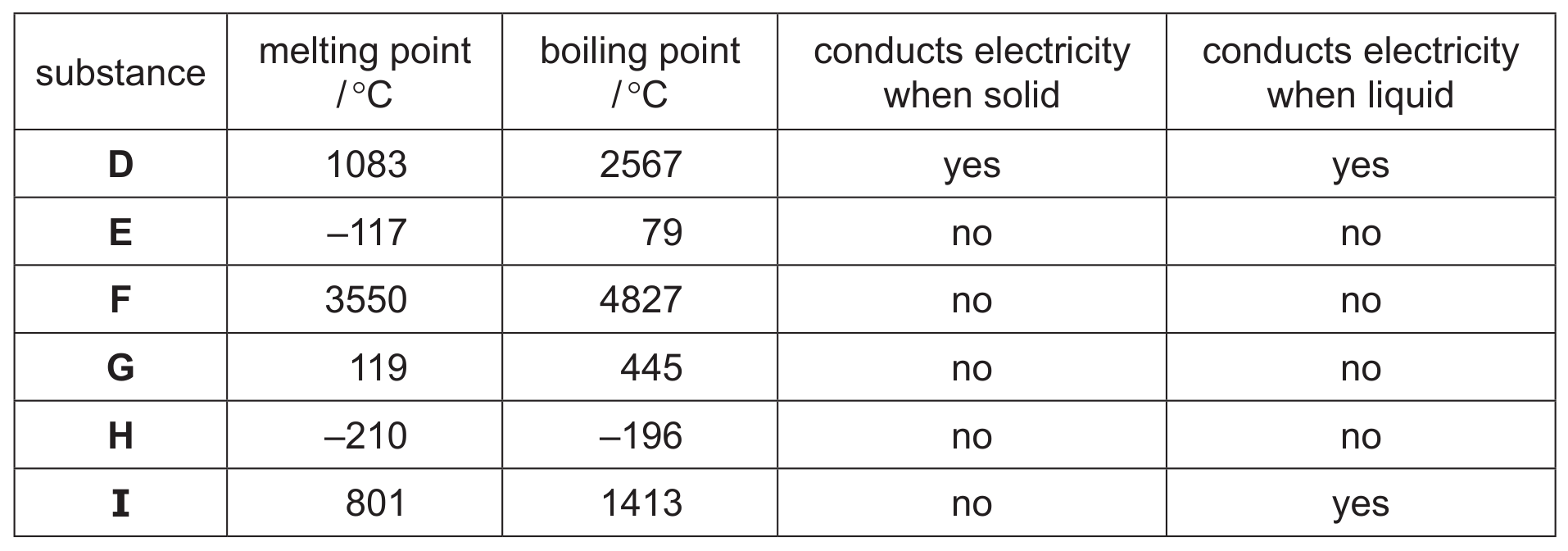
Identify the substance, D, E, F, G, H or I, which is an ionic solid. Give a reason for your choice. substance
reason
The table shows the melting points, boiling points and electrical conductivities of six substances D, E, F, G, H and I.
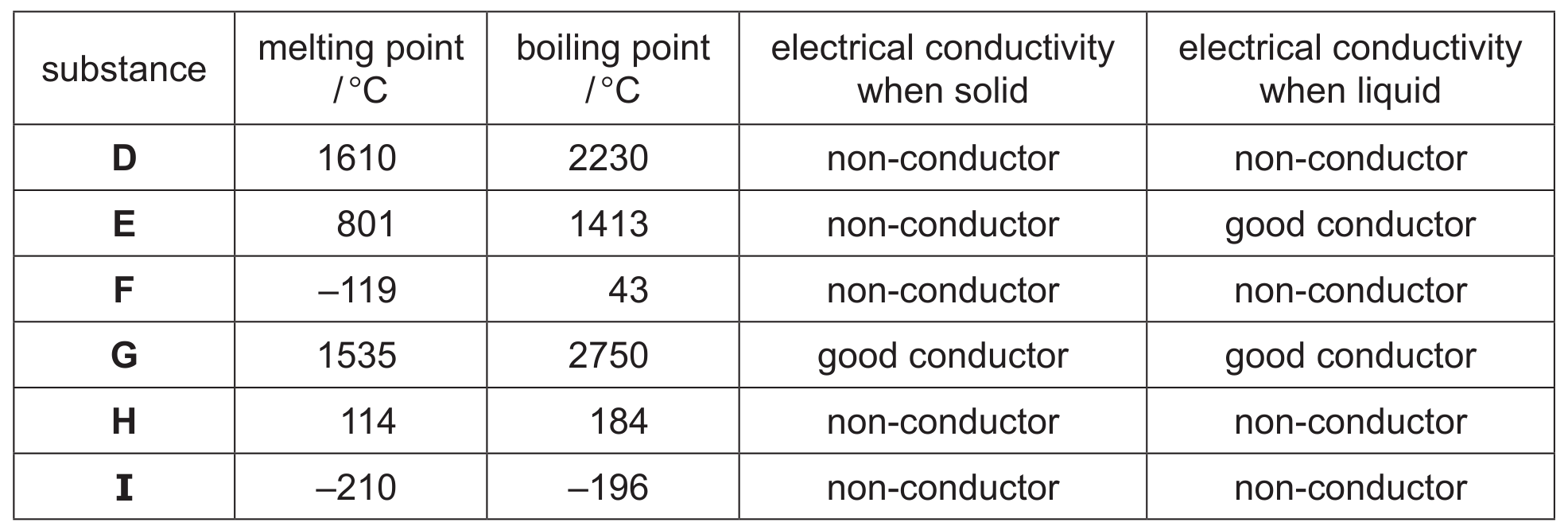
Choose substances from the table which match the following descriptions. Each substance may be used once, more than once or not at all.
Which substance is an ionic solid? Give one reason for your answer.
substance
reason
Which statement describes a property of potassium iodide?
A It is insoluble in water.
B It is a volatile substance.
C It has a low melting point.
D It conducts electricity when molten.
Lithium chloride is an ionic compound and silicon(IV) oxide is a covalent compound.
Which statement about both compounds is correct?
They are not soluble in water.
They conduct electricity when melted.
They do not conduct electricity in solid form.
They have low melting points.
Which statements about potassium bromide are correct?
1 It has a high melting point.
2 It dissolves in water.
3 It conducts electricity when solid.
1 and 2
1 and 3
2 and 3
3 only
Information about four substances E, F, G and H is shown.
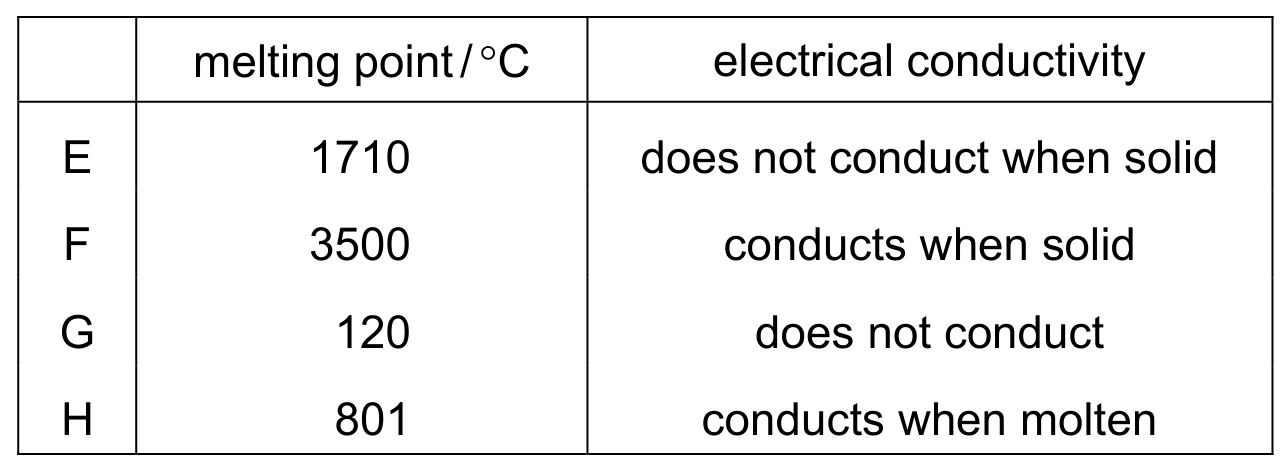
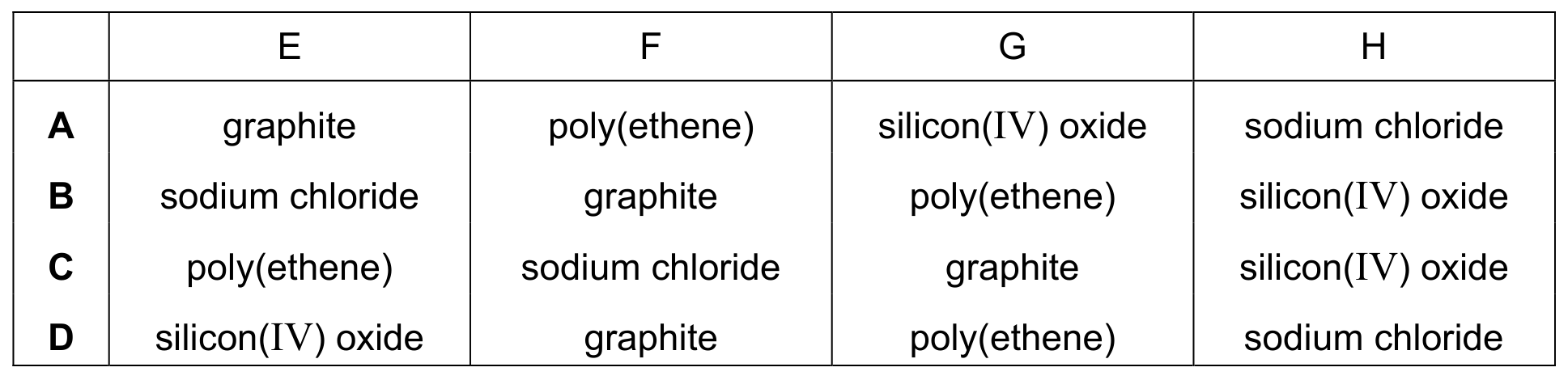
E, F, G and H are graphite, poly(ethene), sodium chloride and silicon(IV) oxide but not in that order.
What are E, F, G and H ?
Magnesium, calcium and strontium are Group II elements.
Magnesium reacts with chlorine to form magnesium chloride, . Magnesium chloride is an ionic compound.
Give three physical properties that are typical of ionic compounds such as .
1
2
3
Caesium fluoride is an ionic compound.
Which statements about caesium fluoride are correct?
1 It conducts electricity when solid.
2 It has a high melting point.
3 It is soluble in water.
4 It is highly volatile.
A 1 and 2
B 1 and 4
C 2 and 3
D 3 and 4