EduNinja

IB Physics SLC.4 Standing waves and resonanceQuestion Bank

Question A2

[Maximum number: 5]

A2. This question is about standing (stationary) waves.
(a) State one way in which a standing wave differs from a travelling (progressive) wave.
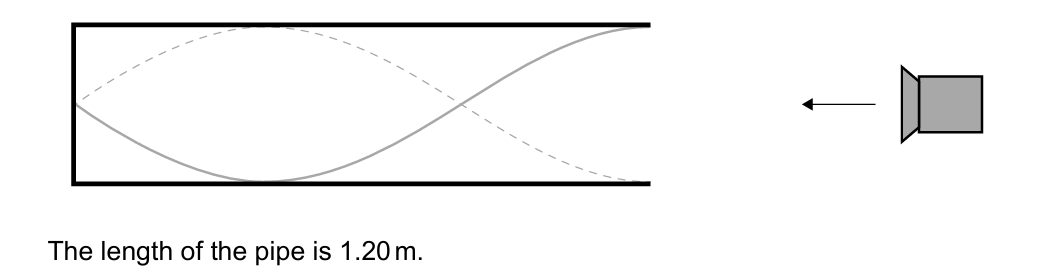
(b) A loudspeaker connected to a signal generator is placed in front of the open end of a tube.

Question image

The frequency of the sound is slowly increased from zero. At a frequency of 92.0 Hz the first large increase in the intensity of the sound is heard.
(i) On the diagram above, draw a representation of the wave in the tube for the frequency of 92.0 Hz .
(ii) The length of the tube is 0.910 m . Determine the speed of sound in the tube.
(c) The frequency of sound is continuously increased above 92.0 Hz .

Calculate the frequency at which the next large increase in the intensity of the sound is heard.

Question A2

[Maximum number: 6]

A2. This question is about standing waves on strings.
(a) A string is fixed at one end and the other free end is moved up and down. Explain how a standing wave can be formed on the string.
(b) The diagram shows a string vibrating in its fundamental (first harmonic) mode. Both ends of the string are fixed.

Question image

(i) Label an antinode on the diagram.
(ii) The length of the string is 0.85 m and its fundamental frequency is 73 Hz . Calculate the speed of the waves on the string.
(iii) Sketch how the string will appear if it is vibrated at a frequency three times that of the fundamental frequency.
(iv) State the speed of the wave when the string is vibrated at a frequency three times that of the fundamental frequency.

Question 2

[Maximum number: 2]

This question is about standing (stationary) waves.

The diagram shows an arrangement used to produce a standing (stationary) wave on a stretched string of length 2.4 m . A standing wave with five loops appears when the frequency of the oscillator is set to 150 Hz , as shown below.

Question image

Question 2(a)

(a)

State the name given to point X on the string.

[ 1 ]

Question 2(b)

Question 2(b)(ii)

(b)
(i)

Calculate the frequency of the oscillator that would produce a standing wave with two loops on this string.

[ 1 ]

Question 2

[Maximum number: 4]

This question is about standing (stationary) waves.

The diagram shows a tube that is open at both ends.
-A

Point A shows the position of one air molecule in the tube. A standing sound wave (not shown in the diagram) is set up in the tube.

The graph shows the variation of displacement s with time t for the molecule at point A.

Question image

Question 2(b)

(a)

The standing wave in the tube corresponds to the fourth harmonic. The speed of sound in the tube is 340 m s1340 \mathrm{~m} \mathrm{~s}^{-1}. Using the graph, determine the length of the tube.

[ 3 ]

Question 2(c)

(b)

The tube is now closed at one end and the first harmonic is sounded. Outline why the tube that is open at both ends produces a first harmonic with a wavelength shorter than the first harmonic of the tube that is closed at one end.

[ 1 ]

Question 2

[Maximum number: 3]

This question is about sound waves.

A whistle on a steam train consists of a pipe that is open at one end and closed at the other. The sounding length of the whistle is 0.27 m and the steam pressure in the whistle is so great that the third harmonic of the pipe is sounding. The speed of sound in air is 340 ms1340 \mathrm{~ms}^{-1}.

Question 2(a)

Question 2(a)(i)

(a)
(i)

Show that there must be a node at a distance of 0.18 m from the closed end of the pipe.

[ 1 ]

Question 2(a)(ii)

(ii)

Calculate the frequency of the whistle sound.

[ 2 ]

Question 2

[Maximum number: 4]

This question is about standing (stationary) waves in a tube.

Question 2(a)

(a)

A thin tube is immersed in a container of water. A length L of the tube extends above the surface of water.

Question image

A tuning fork is sounded above the tube. For particular values of L, a standing wave is established in the tube.

[ 4 ]

Question 2(a)(i)

(i)

Explain how a standing wave is formed in this tube.

[ 2 ]

Question 2(a)(ii)

(ii)

The frequency of the tuning fork is 256 Hz . The smallest length L for which a standing wave is established in the tube is 33.0 cm . Estimate the speed of sound in the tube.

[ 2 ]

Question A2

Question A2(a)

(a)

State one difference between a standing wave and a travelling wave.

[ 1 ]

Question A2(b)

(b)

A string fixed at both ends oscillates in its fundamental (first harmonic) mode. The diagram shows the displacement of the string at time t=0. Point M is the point at the middle of the string.

Question image

At t=0 point M is moving upwards. The frequency of oscillation is 250 Hz . On the diagram, draw

[ 2 ]

Question A2(b)(ii)

(i)

a line to show the position of the string at a time of 2.0 ms .

[ 2 ]

Question A2(c)

(c)

Describe how the string in (b) was made to oscillate in its fundamental mode.

[ 1 ]

Question A2(d)

(d)

State the frequency of oscillation of the string when it oscillates in its second harmonic.

[ 1 ]

Question 2

[Maximum number: 5]

This question is about standing waves and the Doppler effect.
The horn of a train can be modeled as a pipe with one open end and one closed end. The speed of sound in air is 330 m s1330 \mathrm{~m} \mathrm{~s}^{-1}.

Question image

Question 2(a)

(a)

On leaving the station, the train blows its horn. Both the first harmonic (fundamental) and the next highest harmonic are produced by the horn. The difference in frequency between the harmonics emitted by the horn is measured as 820 Hz .

[ 5 ]

Question 2(a)(i)

(i)

Deduce that the length of the horn is about 0.20 m .

[ 3 ]

Question 2(a)(ii)

(ii)

Show that the frequency of the first harmonic is about 410 Hz .

[ 2 ]

Question A3

[Maximum number: 5]

This question is about standing waves in a vibrating string.
A guitar string vibrates at 330 Hz in its fundamental mode.

Question A3(a)

(a)

Describe the formation of standing waves in a string fixed at both ends.

[ 2 ]

Question A3(b)

(b)

The length of the string is 0.64 m . Calculate the velocity of the wave in the string.

[ 3 ]

Question 3

[Maximum number: 2]

The solid line in the graph shows the variation with distance x of the displacement y of a travelling wave at t=0. The dotted line shows the wave 0.20 ms later. The period of the wave is longer than 0.20 ms .

Question image

Question 3(c)

(a)

One end of a string is attached to an oscillator and the other is fixed to a wall. When the frequency of the oscillator is 360 Hz the standing wave shown is formed on the string.

Question image

Point X (not shown) is a point on the string at a distance of 10 cm from the oscillator.

[ 2 ]

Question 3(c)(i)

(i)

State the number of all other points on the string that have the same amplitude and phase as X.

[ 1 ]

Question 3(c)(ii)

(ii)

The frequency of the oscillator is reduced to 120 Hz . On the diagram, draw the standing wave that will be formed on the string.

Question image
[ 1 ]
0 selected