IB Physics SL E: Nuclear and Quantum Physics Question Bank

Practise analysing atomic structure, photons, matter waves, radioactive decay, nuclear reactions and fundamental particles through energy, momentum, probability and experimental…

Syllabus
First assessment 2025
Topic
Level
SL

E. Nuclear and quantum physics question 1

[Maximum number: 9]

This question is in two parts. Part 1 is about the nuclear model of the atom and radioactive decay. Part 2 is about waves.

Part 1 Nuclear model of the atom and radioactive decay

Question (a)

(a)

Outline how the evidence supplied by the Geiger-Marsden experiment supports the nuclear model of the atom.

[ 4 ]

Question (b)

(b)

The nuclide radium-226 (88226Ra)\left({ }_{88}^{226} \mathrm{Ra}\right) decays into an isotope of radon (Rn) by the emission of an alpha particle and a gamma-ray photon.

[ 5 ]

Question (i)

(i)

State what is meant by the terms nuclide and isotope.

Nuclide:
Isotope:

[ 2 ]

Question (ii)

(ii)

Construct the nuclear equation for the decay of radium-226.

88226Ra....Rn+....He+....γ{ }_{88}^{226} \mathrm{Ra} \rightarrow{ }_{\ldots \ldots \ldots \ldots . .}^{\ldots \ldots \ldots . .} \mathrm{Rn}+{ }_{\ldots \ldots \ldots . .}^{\ldots \ldots \ldots . .} \mathrm{He}+{ }_{\ldots \ldots \ldots . .}^{\ldots \ldots \ldots . .} \gamma
[ 3 ]

E. Nuclear and quantum physics question 2

[Maximum number: 9]

This section consists of three questions: B1, B2 and B3.

Question (a)

(a)

The isotope tritium (hydrogen-3) has a radioactive half-life of 12 days.

[ 2 ]

Question (i)

(i)

State what is meant by the term isotope.

[ 1 ]

Question (ii)

(ii)

Define radioactive half-life.

[ 1 ]

Question (b)

(b)

Tritium may be produced by bombarding a nucleus of the isotope lithium-7 with a high-energy neutron. The reaction equation for this interaction is

37Li+01n13H+Z4X+01n.{ }_{3}^{7} \mathrm{Li}+{ }_{0}^{1} \mathrm{n} \rightarrow{ }_{1}^{3} \mathrm{H}+{ }_{Z}^{4} \mathrm{X}+{ }_{0}^{1} \mathrm{n} .
[ 3 ]

Question (i)

(i)

Identify the proton number Z of X.

Z=
[ 1 ]

Question (ii)

(ii)

Use the following data to show that the minimum energy that a neutron must have to initiate the reaction in (b)(i) is about 2.5 MeV .

 Rest mass of lithium-7 nucleus =7.0160u Rest mass of tritium nucleus =3.0161u Rest mass of X nucleus =4.0026u\begin{array}{ll} \text { Rest mass of lithium-7 nucleus } & =7.0160 \mathrm{u} \\ \text { Rest mass of tritium nucleus } & =3.0161 \mathrm{u} \\ \text { Rest mass of X nucleus } & =4.0026 \mathrm{u} \end{array}
[ 2 ]

Question (c)

(c)

A nucleus of tritium decays to a nucleus of helium-3. Identify the particles X and Y in the nuclear reaction equation for this decay.

13H23He+X+Y{ }_{1}^{3} \mathrm{H} \rightarrow{ }_{2}^{3} \mathrm{He}+\mathrm{X}+\mathrm{Y}

X:
Y:

[ 2 ]

Question (d)

(d)

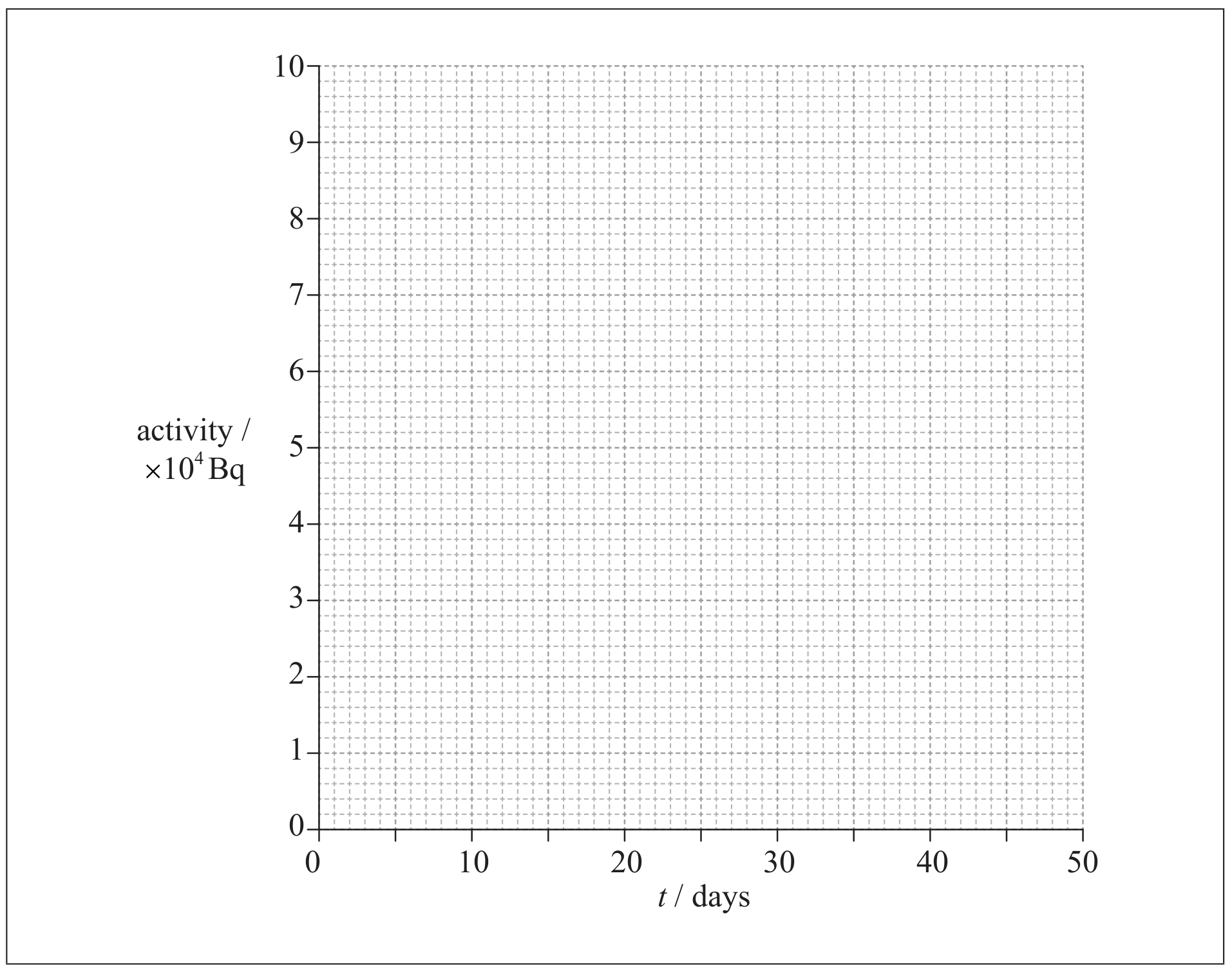
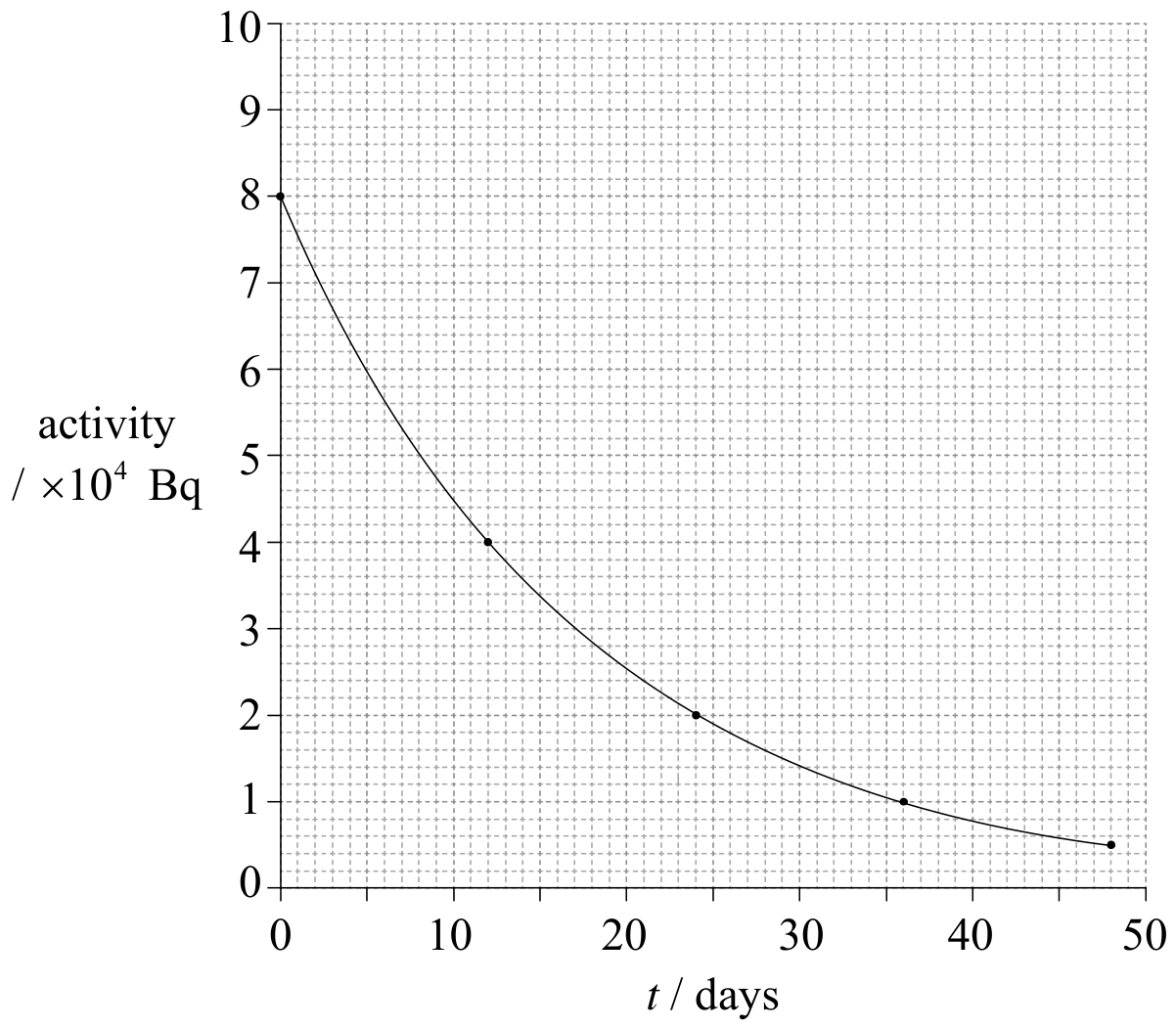
A sample of tritium has an activity of 8.0×10⁴ Bq8.0 \times 10^{4} \mathrm{~Bq} at time t=0. The half-life of tritium is 12 days.

[ 2 ]

Question (i)

(i)

Using the axes below, construct a graph to show how the activity of the sample varies with time from t=0 to t=48 days.

Figure for Question (i) — IB Physics SL
[ 2 ]

E. Nuclear and quantum physics question 3

[Maximum number: 6]

This question is in two parts. Part 1 is about energy resources. Part 2 is about thermal physics.
Part 1 Energy resources
Electricity can be generated using nuclear fission, by burning fossil fuels or using pump storage hydroelectric schemes.

Question (a)

(a)

In a nuclear reactor, outline the purpose of the

[ 3 ]

Question (i)

(i)

heat exchanger.

[ 1 ]

Question (ii)

(ii)

moderator.

[ 2 ]

Question (b)

(b)

Fission of one uranium-235 nucleus releases 203 MeV .

[ 3 ]

Question (i)

(i)

Determine the maximum amount of energy, in joule, released by 1.0 g of uranium-235 as a result of fission.

[ 3 ]

E. Nuclear and quantum physics question 4

[Maximum number: 7]

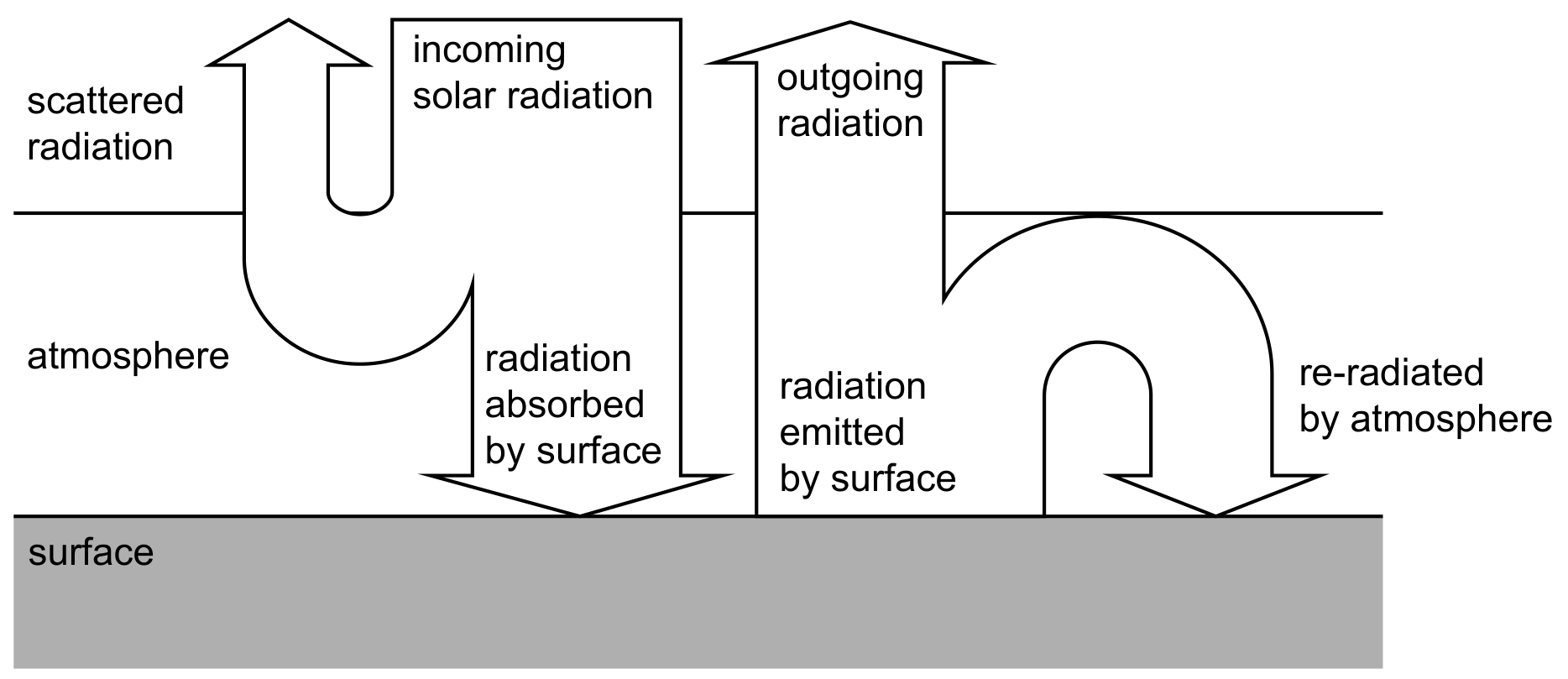
The diagram shows a simplified energy-balance model for the Earth surface–atmosphere system.

Figure for Question E. Nuclear and quantum physics question 4 — IB Physics SL

The following data are given:

 Average albedo of Earth =0.30 Average global temperature of the surface =288 K Average Earth-Sun distance =1.5×10¹¹ m\begin{aligned} \text { Average albedo of Earth } & =0.30 \\ \text { Average global temperature of the surface } & =288 \mathrm{~K} \\ \text { Average Earth-Sun distance } & =1.5 \times 10^{11} \mathrm{~m} \end{aligned}

Question (a)

(a)

The primary energy source of the Sun is the proton-proton (p-p) chain of fusion reactions. Four protons and two electrons produce a helium nucleus together with neutrinos and gamma photons. The overall reaction is:

411p+210e24He+200ve+4γ4{ }_{1}^{1} \mathrm{p}+2{ }_{-1}^{0} \mathrm{e} \rightarrow{ }_{2}^{4} \mathrm{He}+2{ }_{0}^{0} v_{e}+4 \gamma
[ 6 ]

Question (i)

(i)

The mass of the helium nucleus is 4.001506 u . Calculate, in MeV , the energy released in the reaction.

[ 2 ]

Question (ii)

(ii)

Outline the role of fusion reactions in maintaining a stable radius of the Sun.

[ 2 ]

Question (iii)

(iii)

Outline how the presence of helium in the Sun can be confirmed empirically.

[ 2 ]

Question (b)

(b)

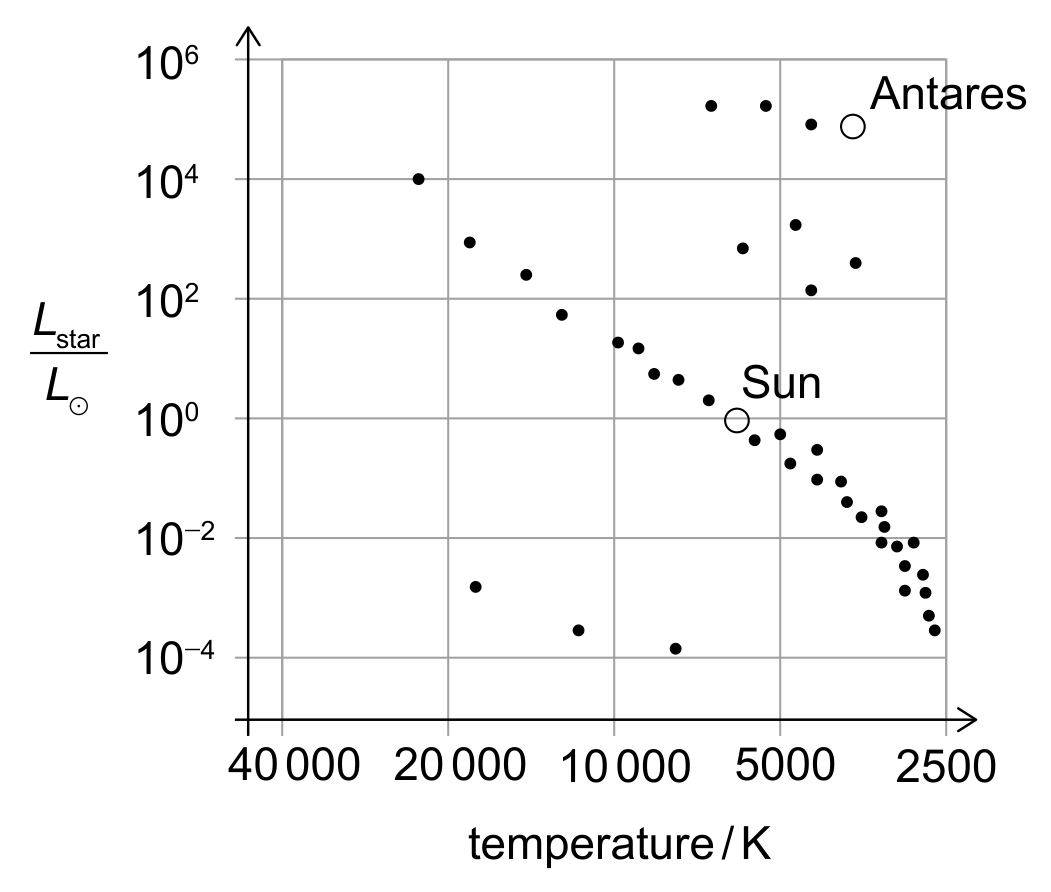
The positions of the Sun and the star Antares are shown in the Hertzsprung-Russell (HR) diagram.

Figure for Question (b) — IB Physics SL
[ 1 ]

Question (i)

(i)

State the star type of Antares.

[ 1 ]

E. Nuclear and quantum physics question 5

[Maximum number: 10]

This question is in two parts. Part 1 is about renewable energy. Part 2 is about nuclear energy and radioactivity.

A small coastal community decides to use a wind farm consisting of five identical wind turbines to generate part of its energy. At the proposed site, the average wind speed is 8.5 m s18.5 \mathrm{~m} \mathrm{~s}^{-1} and the density of air is 1.3 kg m31.3 \mathrm{~kg} \mathrm{~m}^{-3}. The maximum power required from the wind farm is 0.75 MW . Each turbine has an efficiency of 30 %.

Question (a)

(a)

State what is meant by the binding energy of a nucleus.

[ 1 ]

Question (b)

(b)

On the axes, sketch a graph showing the variation of nucleon number with the binding energy per nucleon.

[ 2 ]

Question (c)

(c)

Explain, with reference to your graph, why energy is released during fission of U-235.

[ 3 ]

Question (d)

(d)

U-235 (92235U)\left({ }_{92}^{235} \mathrm{U}\right) can undergo alpha decay to form an isotope of thorium (Th).

[ 4 ]

Question (i)

(i)

State the nuclear equation for this decay.

[ 1 ]

Question (ii)

(ii)

Define the term radioactive half-life.

[ 1 ]

Question (iii)

(iii)

A sample of rock contains a mass of 5.6 mg of U-235 at the present day.

The half-life of U-235 is 7.0×1087.0 \times 10^{8} years. Calculate the initial mass of the U-235 if the rock sample was formed 2.1×1092.1 \times 10^{9} years ago.

[ 2 ]
All question bank results loaded