EduNinja

IB Physics SLC.5 Doppler effectQuestion Bank

Question A3

[Maximum number: 7]

A3. This question is about the Doppler effect.
(a) Describe the Doppler effect.
(b) A spectral line from a source on Earth has a frequency of 4.672×10¹⁴ Hz4.672 \times 10^{14} \mathrm{~Hz}. When this same line is observed from a distant galaxy it is found to have shifted to 4.669×10¹⁴ Hz4.669 \times 10^{14} \mathrm{~Hz}.
(i) State the direction of the motion of the galaxy relative to Earth.

(ii) Deduce the speed of the galaxy relative to Earth.

Question 2

[Maximum number: 3]

Graph 1 shows the variation of particle displacement d with position x for a travelling sound wave.

Graph 1

Graph 1

Graph 2 shows the variation of particle displacement d with time t for the same travelling sound wave.

Graph 2

Graph 2

Question 2(b)

Question 2(b)(i)

(a)
(i)

Explain which frequency is emitted by source A.

[ 1 ]

Question 2(b)(ii)

(ii)

The spectrum of light received from a galaxy shows a peak at a wavelength of 659.0 nm . The peak corresponds to an atomic transition in the hydrogen atom that emits a wavelength of 656.1 nm when observed in a laboratory on Earth.

Calculate the velocity of the galaxy with respect to Earth.

[ 2 ]

Question 2

[Maximum number: 2]

This question is about the Doppler effect.

Question 2(a)

(a)

Describe what is meant by the Doppler effect as it relates to sound.

[ 2 ]

Question 2

[Maximum number: 4]

This question is about the Doppler effect.

Question 2(a)

(a)

Describe what is meant by the Doppler effect.

[ 2 ]

Question 2(b)

(b)

A child on a carousel (merry-go-round) moves with a speed of 6.5 m s16.5 \mathrm{~m} \mathrm{~s}^{-1} along a horizontal circular path ABCD A. A stationary observer is at a large distance from the carousel.

Question image

The child blows a whistle while moving from position B to position D . The whistle emits sound of frequency 850 Hz . The speed of sound in air is 330 m s1330 \mathrm{~m} \mathrm{~s}^{-1}.

[ 2 ]

Question 2(b)(ii)

(i)

Describe the variation of the frequency of the sound heard by the observer.

[ 2 ]

Question A2

[Maximum number: 3]

This question is about radio telescopes.
A distant galaxy emits radio waves of frequency 6.0×10⁹ Hz6.0 \times 10^{9} \mathrm{~Hz} and is moving with speed 6.0×10⁶ m s16.0 \times 10^{6} \mathrm{~m} \mathrm{~s}^{-1} directly away from an observer on Earth.

Question A2(a)

(a)

Determine the wavelength of the radio wave as measured by the observer on Earth.

[ 3 ]

Question A2

[Maximum number: 3]

This question is about the Doppler effect in sound.

Question A2(a)

(a)

A fire engine is travelling at a constant velocity towards a stationary observer. Its siren emits a note of constant frequency. As the engine passes close to the observer, the frequency of the note perceived by the observer decreases. Explain this decrease in terms of the wavefronts of the note emitted by the siren.

[ 3 ]

Question 3

[Maximum number: 2]

This question is about the Doppler effect.

Georgia carries out an experiment to measure the speed of mosquitoes. She sets up a microphone to record the sounds of passing mosquitoes.

Question image

One mosquito is moving in a straight line with constant speed and passes very close to the microphone as seen in the diagram. The mosquito produces a sound of constant frequency. The speed of sound in air is 340 m s1340 \mathrm{~m} \mathrm{~s}^{-1}.

Question 3(a)

(a)

The maximum frequency recorded is 751 Hz and the minimum frequency recorded is 749 Hz . Explain this observation.

[ 2 ]

Question 2

[Maximum number: 2]

This question is about standing waves and the Doppler effect.
The horn of a train can be modeled as a pipe with one open end and one closed end. The speed of sound in air is 330 m s1330 \mathrm{~m} \mathrm{~s}^{-1}.

Question image

Question 2(b)

Question 2(b)(i)

(a)
(i)

Describe what is meant by the Doppler effect.

[ 2 ]

Question 3

[Maximum number: 4]

This question is about the Doppler effect.

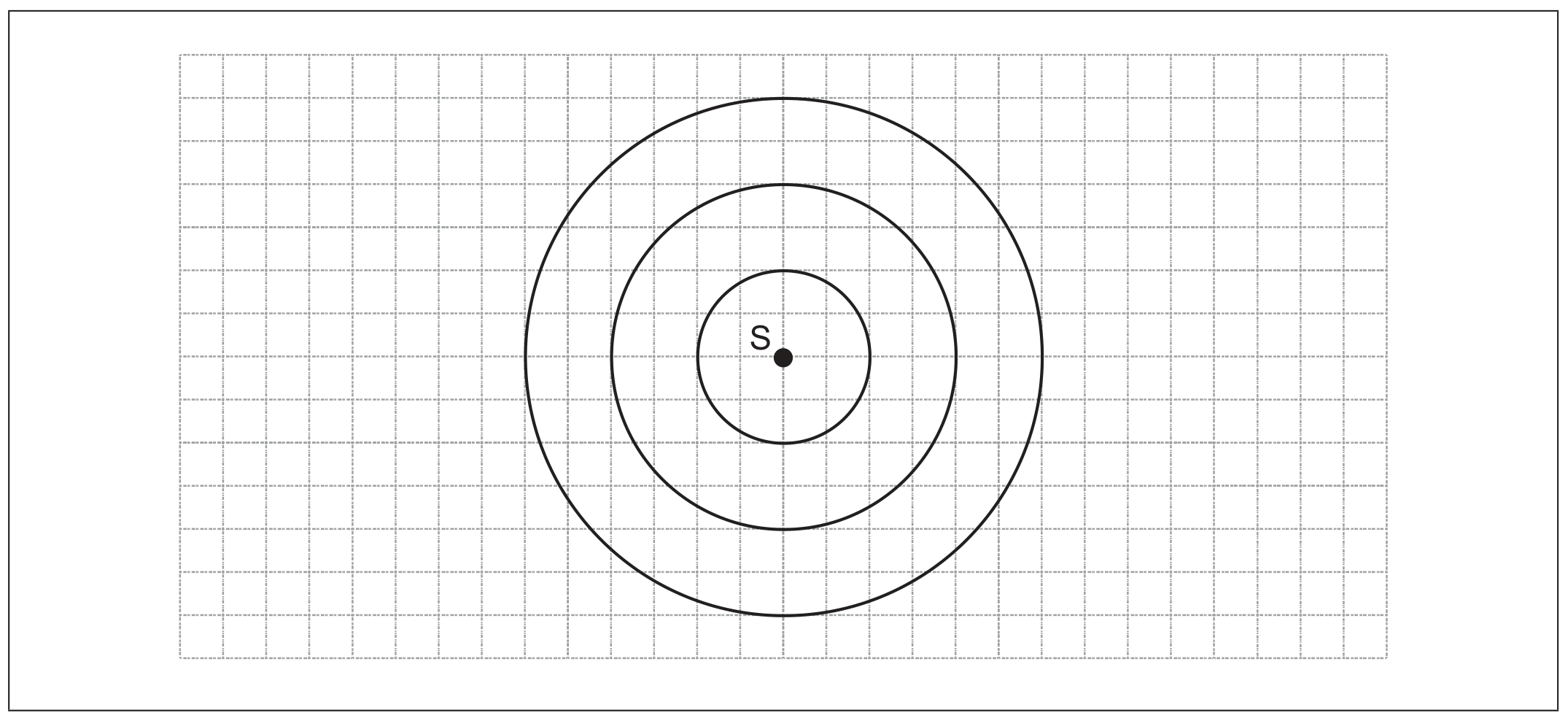
The diagram shows wavefronts in air produced by a stationary source S of sound.
The distance between successive wavefronts is equal to the wavelength of the sound.
The speed of sound is c.
Question image

Question 3(a)

(a)

On the diagram, sketch three successive waveforts produced when S is moving to the left at a speed of 0.5 c.

[ 2 ]

Question 3(b)

(b)

A source of X-rays rotates on a turntable. Radiation of wavelength 7.5 nm is emitted by the source and undergoes a maximum shift of 0.50 fm . The distance between the source and the detector is large in comparison to the diameter of the turntable.

Question image
[ 2 ]

Question 3(b)(i)

(i)

Determine the speed of a point on the edge of the turntable.

[ 2 ]

Question A3

[Maximum number: 1]

This question is about the Doppler effect.

Question A3(a)

(a)

Describe what is meant by the Doppler effect.

[ 1 ]
0 selected