IB Physics SL C: Wave Behaviour Question Bank

Practise analysing oscillations and travelling or standing waves through graphs, phase, energy, interference, diffraction, resonance and electromagnetic-wave behaviour.

Syllabus
First assessment 2025
Topic
Level
SL

C. Wave behaviour question 1

[Maximum number: 13]

This question is in two parts. Part 1 is about a thermistor circuit. Part 2 is about vibrations and waves.
Part 1 Thermistor circuit
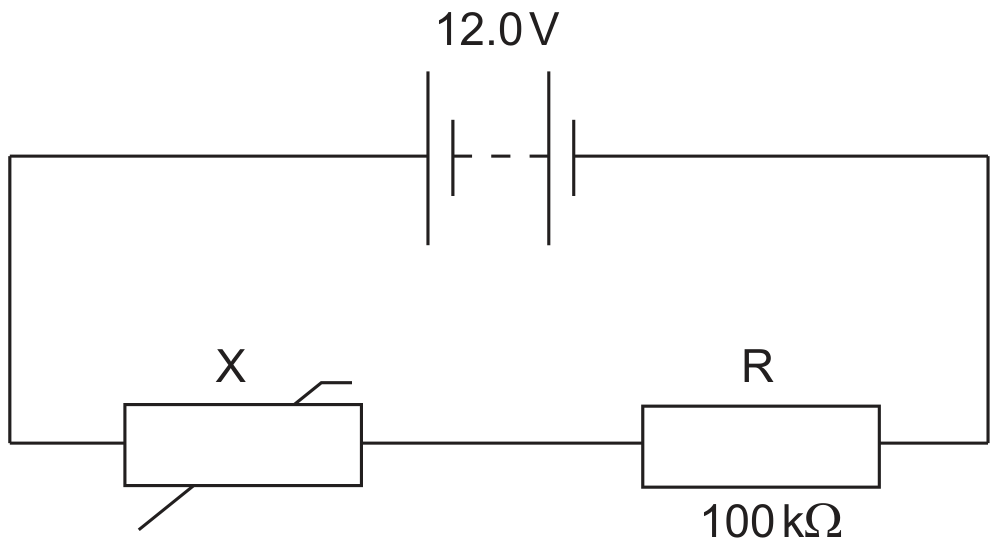
The circuit shows a negative temperature coefficient (NTC) thermistor X and a 100kΩ100 \mathrm{k} \Omega fixed resistor R connected across a battery.

Figure for Question C. Wave behaviour question 1 — IB Physics SL

The battery has an electromotive force (emf) of 12.0 V and negligible internal resistance.

Question (a)

(a)

Define simple harmonic motion (SHM).

[ 2 ]

Question (b)

(b)

D has mass 6.5×10³ kg6.5 \times 10^{-3} \mathrm{~kg} and vibrates with amplitude 0.85 mm .

[ 4 ]

Question (i)

(i)

Calculate the maximum acceleration of D .

[ 2 ]

Question (ii)

(ii)

Determine the total energy of D .

[ 2 ]

Question (c)

(c)

The sound waves from the loudspeaker travel in air with speed 330 m s1330 \mathrm{~m} \mathrm{~s}^{-1}.

[ 4 ]

Question (i)

(i)

Calculate the wavelength of the sound waves.

[ 1 ]

Question (ii)

(ii)

Describe the characteristics of sound waves in air.

[ 3 ]

Question (d)

(d)

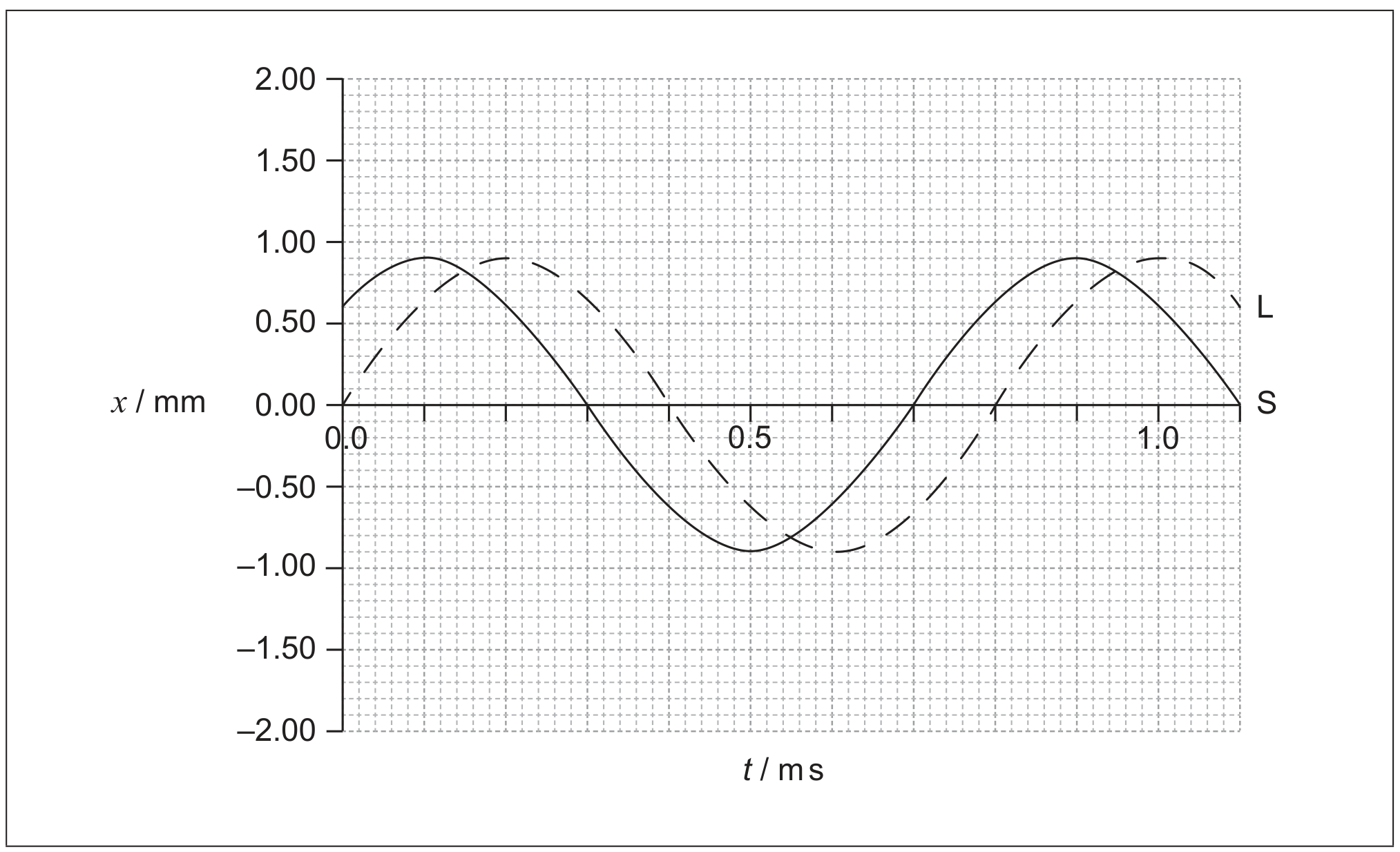
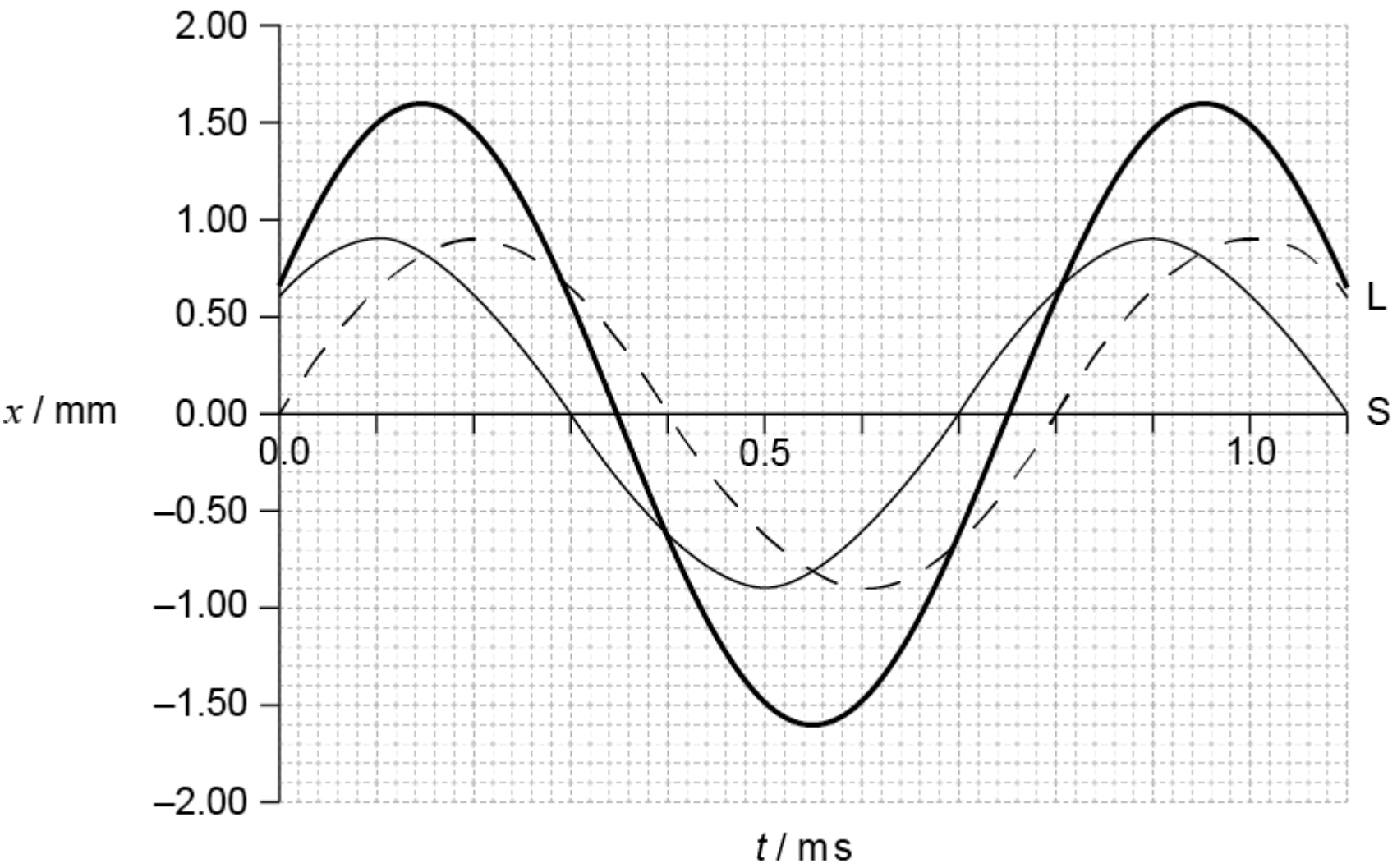
A second loudspeaker S emits the same frequency as L but vibrates out of phase with L . The graph below shows the variation with time t of the displacement x of the waves emitted by S and L .

Figure for Question (d) — IB Physics SL
[ 3 ]

Question (i)

(i)

On the graph, sketch the variation with t of x for the wave formed by the superposition of the two waves. be marked.

[ 3 ]

C. Wave behaviour question 2

[Maximum number: 11]

Question (a)

(a)

Outline what is meant by a travelling wave.

[ 2 ]

Question (b)

(b)

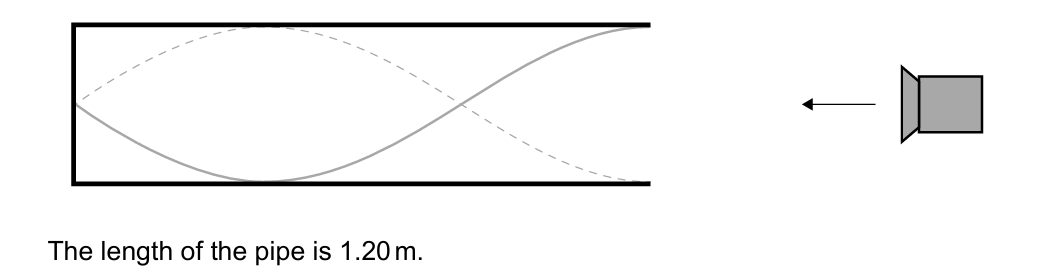
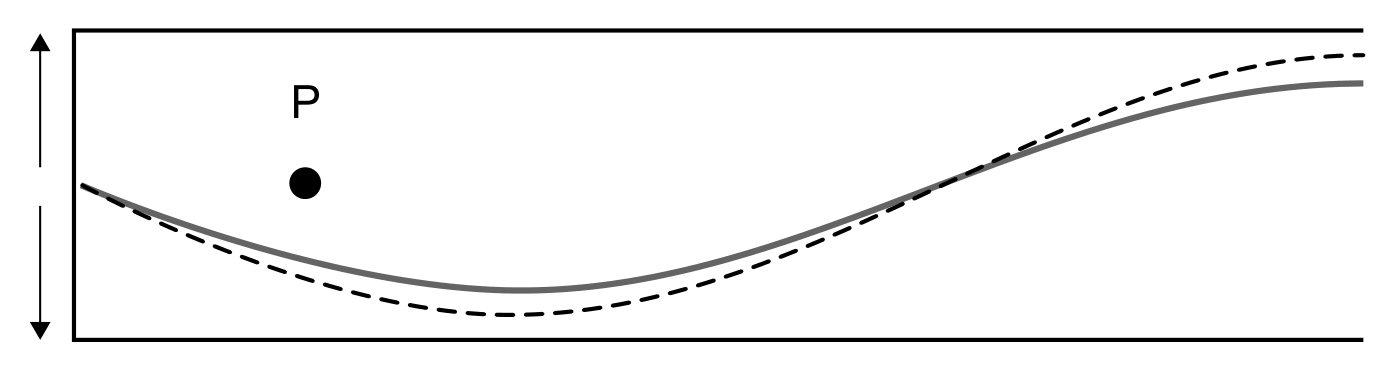
A loudspeaker emits sound of frequency 210 Hz into a pipe with one open and one closed end. The diagram shows a representation of the standing wave established in the pipe.

Figure for Question (b) — IB Physics SL
[ 5 ]

Question (i)

(i)

Outline how the standing wave is formed in the pipe.

[ 2 ]

Question (ii)

(ii)

Determine the wavelength of the wave.

[ 1 ]

Question (iii)

(iii)

Calculate the speed of sound in the pipe stating the answer to an appropriate number of significant figures.

[ 2 ]

Question (c)

(c)

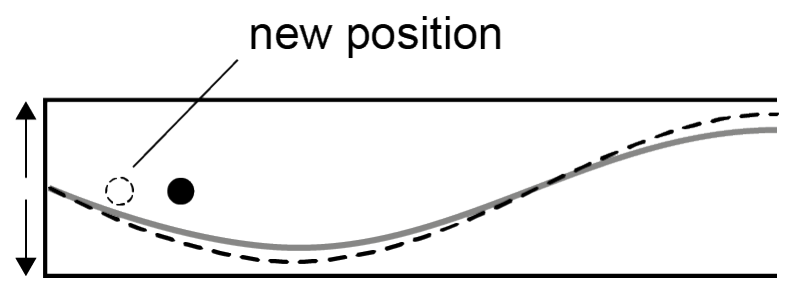
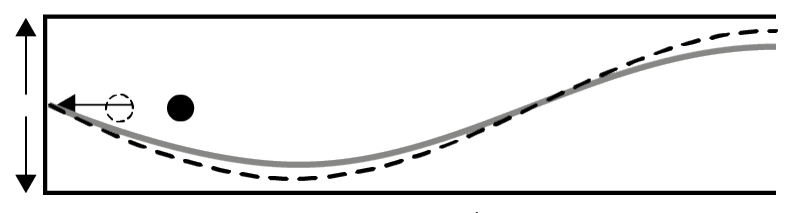
The solid line represents the standing wave at time t and the dotted line represents the standing wave at an instant later. The dot is the equilibrium position of a particle P in the pipe. The up arrow indicates displacements to the right and the down arrow displacements to the left.

Figure for Question (c) — IB Physics SL

On the diagram, draw

[ 2 ]

Question (i)

(i)

a dot to indicate the approximate position of P at time t,

[ 1 ]

Question (ii)

(ii)

an arrow to indicate the velocity of P at time t.

[ 1 ]

Question (d)

(d)

The frequency of sound is reduced to 140 Hz . Explain why a standing wave will not be formed in the pipe.

[ 2 ]

C. Wave behaviour question 3

[Maximum number: 3]

A group of students is investigating refraction in a semi-circular glass block.

Light from a ray box enters the curved side of the block. The light passes through the block and leaves, refracted, at P .

Question (a)

(a)

Outline how the students can ensure that the light is not deflected at the curved surface.

[ 1 ]

Question (b)

(b)

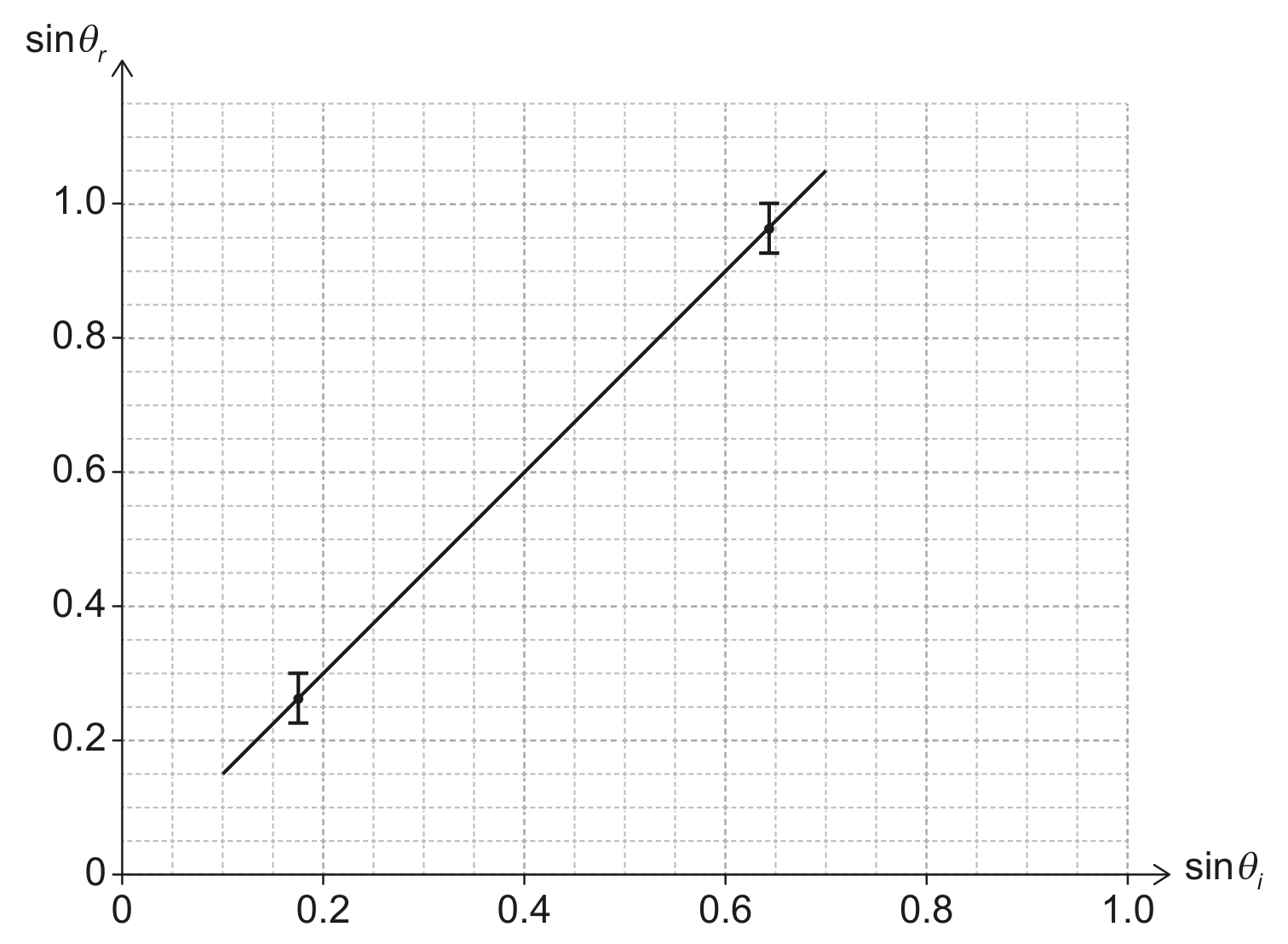
They plot a graph of the variation with the sine of θi\theta_{i} of the sine of θr\theta_{r}.
They add uncertainty bars for sinθr\sin \theta_{r} for the first and last data point and draw the best-fit line.

Figure for Question (b) — IB Physics SL
[ 2 ]

Question (i)

(i)

Determine the value of the refractive index of the glass with its absolute uncertainty.

[ 2 ]

C. Wave behaviour question 4

[Maximum number: 2]

This question is about the Doppler effect.

Georgia carries out an experiment to measure the speed of mosquitoes. She sets up a microphone to record the sounds of passing mosquitoes.

Figure for Question C. Wave behaviour question 4 — IB Physics SL

One mosquito is moving in a straight line with constant speed and passes very close to the microphone as seen in the diagram. The mosquito produces a sound of constant frequency. The speed of sound in air is 340 m s1340 \mathrm{~m} \mathrm{~s}^{-1}.

The maximum frequency recorded is 751 Hz and the minimum frequency recorded is 749 Hz . Explain this observation.

All question bank results loaded