IB Physics SL D: Fields Question Bank

Practise modelling gravitational, electric and magnetic interactions through field strength, potential, energy, flux and particle motion, using diagrams and vector calculations.

Syllabus
First assessment 2025
Topic
Level
SL

D. Fields question 1

[Maximum number: 3]

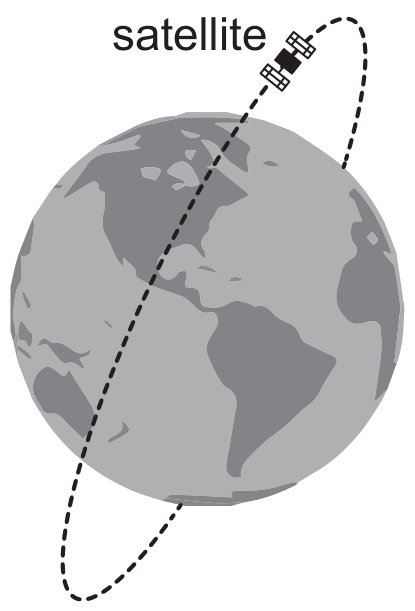
A satellite powered by solar cells directed towards the Sun is in a polar orbit about the Earth.

Figure for Question D. Fields question 1 — IB Physics SL

The satellite is orbiting the Earth at a distance of 6600 km from the centre of the Earth.

Determine the orbital period for the satellite.

Mass of Earth =6.0×1024 kg=6.0 \times 10^{24} \mathrm{~kg}

D. Fields question 2

[Maximum number: 5]

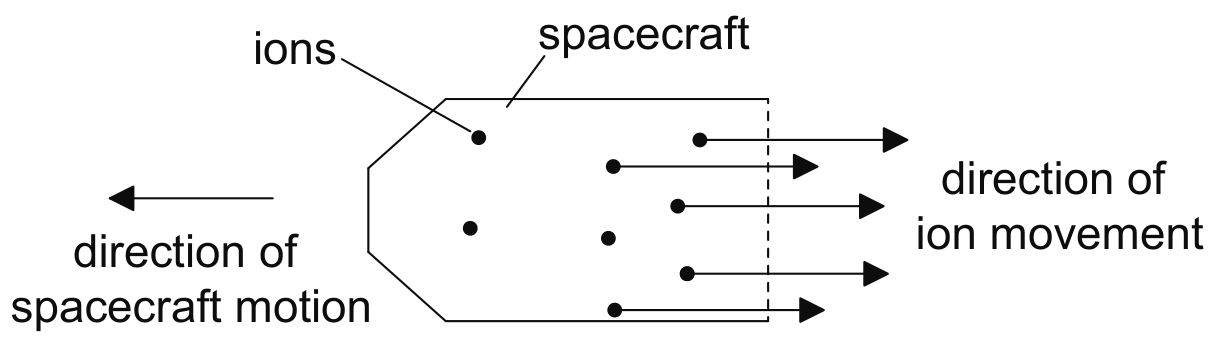
Ion-thrust engines can power spacecraft. In this type of engine, ions are created in a chamber and expelled from the spacecraft. The spacecraft is in outer space when the propulsion system is turned on. The spacecraft starts from rest.

Figure for Question D. Fields question 2 — IB Physics SL

The mass of ions ejected each second is 6.6×10⁶ kg6.6 \times 10^{-6} \mathrm{~kg} and the speed of each ion is 5.2×10⁴ m s15.2 \times 10^{4} \mathrm{~m} \mathrm{~s}^{-1}. The initial total mass of the spacecraft and its fuel is 740 kg . Assume that the ions travel away from the spacecraft parallel to its direction of motion.

Question (a)

(a)

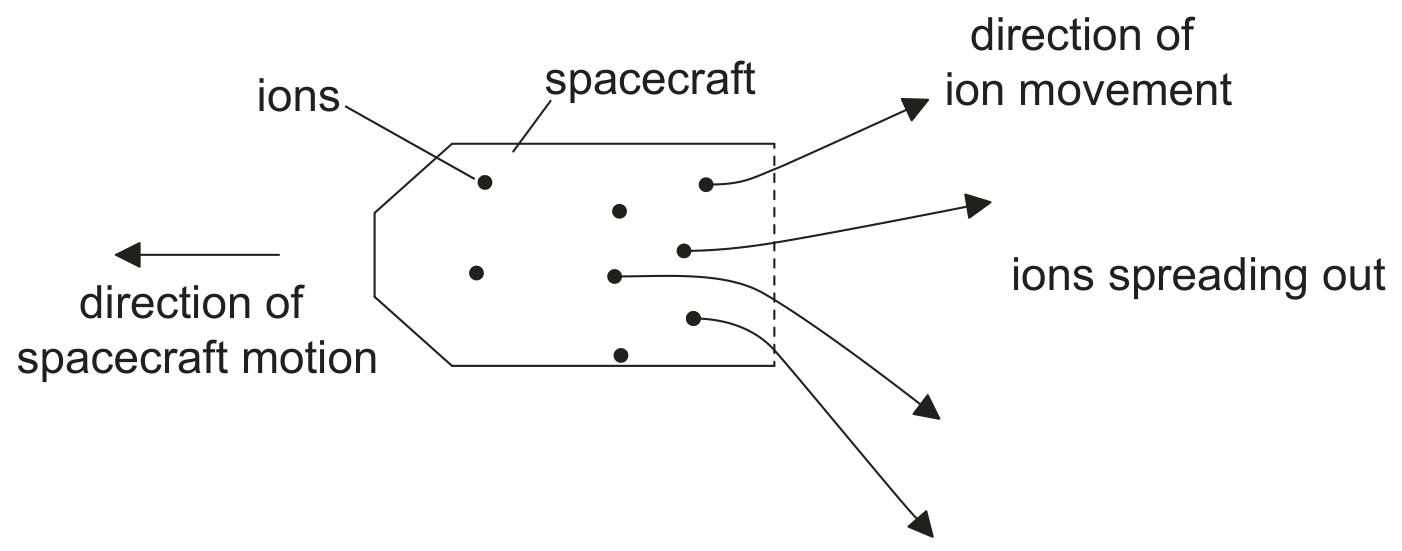
In practice, the ions leave the spacecraft at a range of angles as shown.

Figure for Question (a) — IB Physics SL
[ 2 ]

Question (i)

(i)

Outline why the ions are likely to spread out.

[ 2 ]

Question (b)

(b)

On arrival at the planet, the spacecraft goes into orbit as it comes into the gravitational field of the planet.

[ 3 ]

Question (i)

(i)

Outline what is meant by the gravitational field strength at a point.

[ 2 ]

Question (ii)

(ii)

Newton's law of gravitation applies to point masses. Suggest why the law can be applied to a satellite orbiting a spherical planet of uniform density.

[ 1 ]

D. Fields question 3

[Maximum number: 5]

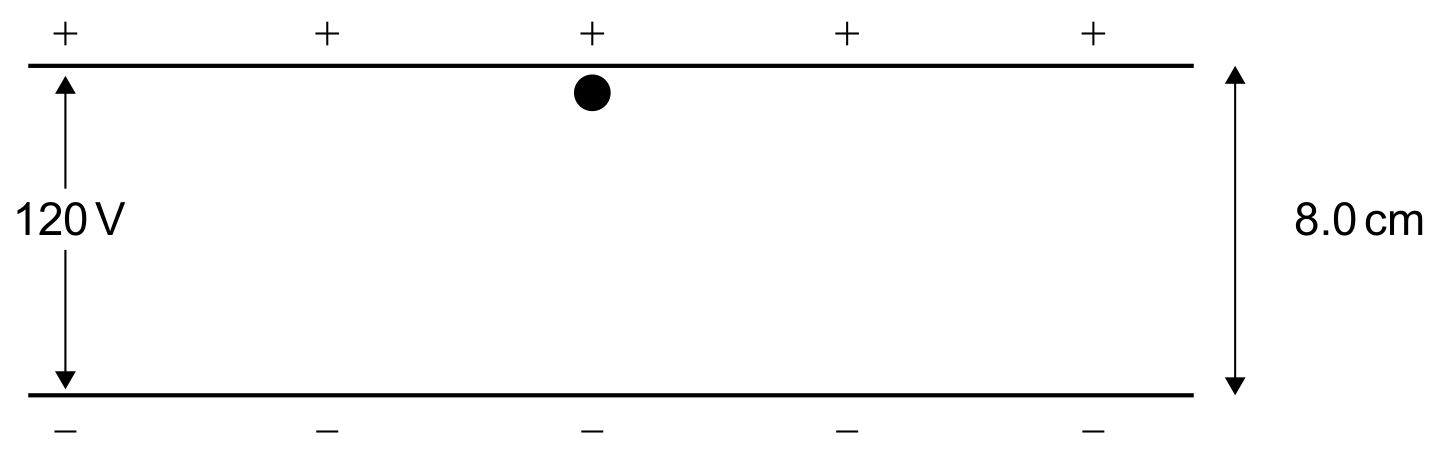
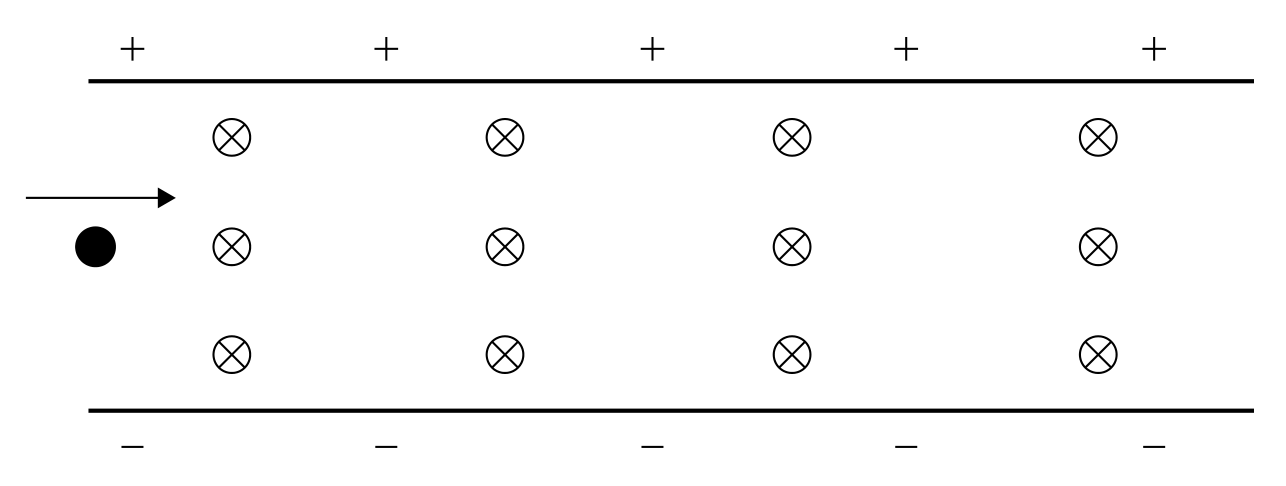
Two oppositely charged parallel plates are a distance 8.0 cm apart. The potential difference between the plates is 120 V . An alpha particle is placed on the positively charged plate and released from rest. Gravity is ignored.

Figure for Question D. Fields question 3 — IB Physics SL

Question (a)

(a)

Calculate the electric field between the plates.

[ 1 ]

Question (b)

(b)

Show that the acceleration of the alpha particle is about 7×10¹⁰ ms27 \times 10^{10} \mathrm{~ms}^{-2}.

[ 2 ]

Question (c)

(c)

A magnetic field directed into the plane of the page is now established between the plates. An alpha particle enters the region between the plates with a horizontal speed of 5.0×10⁵ m s15.0 \times 10^{5} \mathrm{~m} \mathrm{~s}^{-1}. The particle is not deflected.

Figure for Question (c) — IB Physics SL

Calculate the magnitude of the magnetic field.

[ 2 ]

D. Fields question 4

[Maximum number: 8]

Question (a)

(a)

State Newton's universal law of gravitation.

[ 3 ]

Question (b)

(b)

Deduce that the gravitational field strength g at the surface of a spherical planet of uniform density is given by

g=GMR2g=\frac{G M}{R^{2}}

where M is the mass of the planet, R is its radius and G is the gravitational constant. You can assume that spherical objects of uniform density act as point masses.

[ 2 ]

Question (c)

(c)

The gravitational field strength at the surface of Mars gMg_{\mathrm{M}} is related to the gravitational field strength at the surface of the Earth gEg_{\mathrm{E}} by

gM=0.38×gEg_{\mathrm{M}}=0.38 \times g_{\mathrm{E}}

The radius of Mars RMR_{\mathrm{M}} is related to the radius of the Earth RER_{\mathrm{E}} by

RM=0.53×RER_{\mathrm{M}}=0.53 \times R_{\mathrm{E}}

Determine the mass of Mars MMM_{\mathrm{M}} in terms of the mass of the Earth MEM_{\mathrm{E}}.

[ 2 ]

Question (d)

(d)

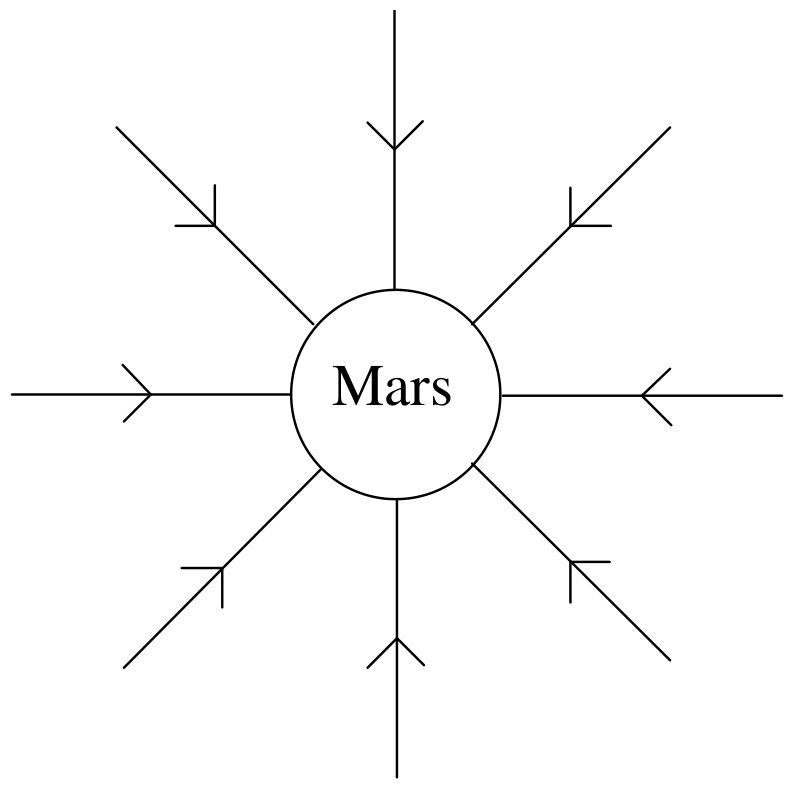
On the diagram below, draw lines to represent the gravitational field around the planet Mars.
Mars

[ 1 ]

D. Fields question 5

[Maximum number: 8]

Question (a)

(a)

Define electric field strength.

[ 2 ]

Question (b)

(b)

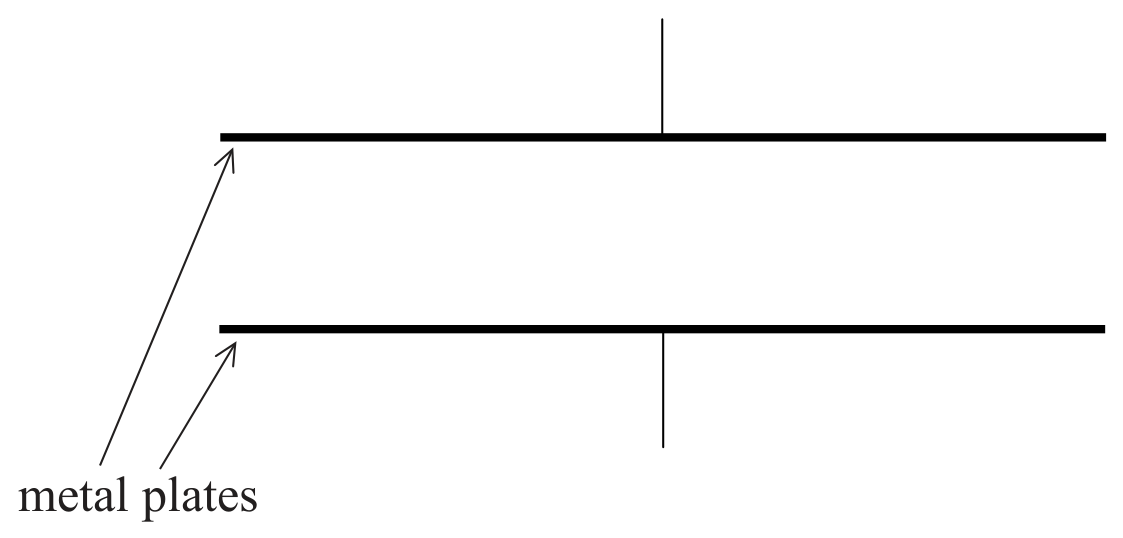
The diagram shows a pair of horizontal metal plates. Electrons can be deflected vertically using an electric field between the plates.

Figure for Question (b) — IB Physics SL
[ 4 ]

Question (i)

(i)

Draw the shape and direction of the electric field between the plates on the diagram.

[ 2 ]

Question (ii)

(ii)

Calculate the force on an electron between the plates when the electric field strength has a value of 2.5×10³NC12.5 \times 10^{3} \mathrm{NC}^{-1}.

[ 2 ]

Question (c)

(c)

The diagram shows two isolated electrons, X and Y , initially at rest in a vacuum. The initial separation of the electrons is 5.0 mm . The electrons subsequently move apart in the directions shown.

Figure for Question (c) — IB Physics SL
[ 2 ]

Question (i)

(i)

Show that the initial electric force acting on each electron due to the other electron is approximately 9×1024 N9 \times 10^{-24} \mathrm{~N}.

[ 2 ]

D. Fields question 6

[Maximum number: 5]

Question (a)

(a)

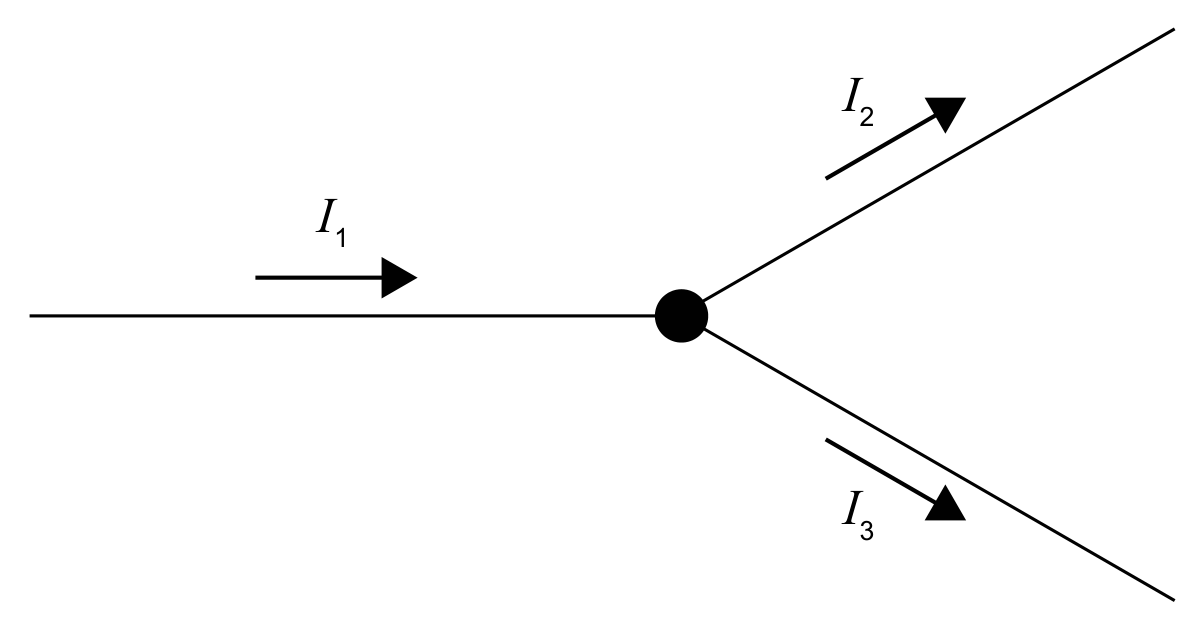
The diagram shows a junction in a circuit.

Figure for Question (a) — IB Physics SL

The currents in the three wires are related by I1=I2+I3I_{1}=I_{2}+I_{3}.
State the fundamental law of Physics from which this relation is derived.

[ 1 ]

Question (b)

(b)

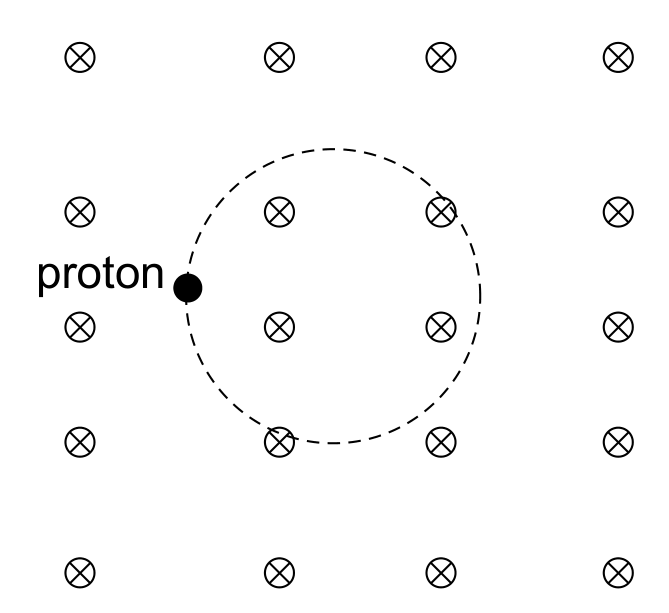
A proton moves on a circular path in a region of uniform magnetic field of magnetic flux density B that is directed into the plane of the page.

Figure for Question (b) — IB Physics SL
[ 4 ]

Question (i)

(i)

On the diagram, draw an arrow to indicate the velocity of the proton at the position shown.

[ 1 ]

Question (ii)

(ii)

Show that the frequency of revolution of the proton is given by f=eB2πmpf=\frac{e B}{2 \pi m_{\mathrm{p}}}.

[ 3 ]
All question bank results loaded