IB Physics SL B: The Particulate Nature of Matter

Practise modelling thermal, gas, greenhouse, circuit and thermodynamic behaviour through particles, energy transfer, probability, radiation and conservation principles.

Syllabus
First assessment 2025
Topic
Level
SL

B. The particulate nature of matter question 1

[Maximum number: 8]

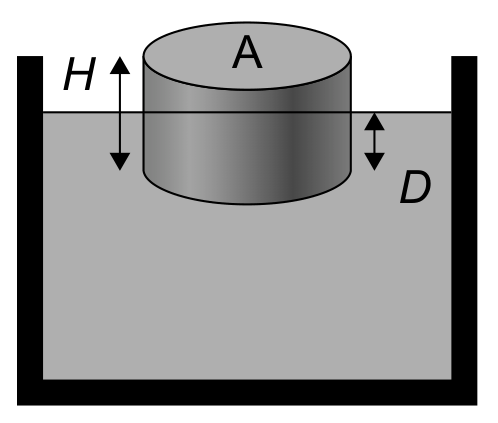
A cylindrical cork of height H and cross-sectional area A is floating stationary in water. Its depth below the water surface is D.

Figure for Question B. The particulate nature of matter question 1 — IB Physics SL

Question (a)

(a)

Explain why the density of most substances in a solid state is larger than its density in a liquid state.

Water shows an anomaly with respect to what is stated in (c)(i).
Graph 1 shows the variation with temperature of the density of water between 100C-100^{\circ} \mathrm{C} and 100C100^{\circ} \mathrm{C}. Graph 2 shows the same graph enlarged for the range 0 to 10C10^{\circ} \mathrm{C}.

[ 2 ]

Question (b)

(b)

On a winter day, the surface of a lake is frozen. The temperature of the air above the lake is 6.0C-6.0^{\circ} \mathrm{C}. The layer of ice frozen on the surface of the lake has a thickness of 1.9 cm .

[ 6 ]

Question (i)

(i)

The thermal conductivity of ice is 2.3Wm1 K12.3 \mathrm{Wm}^{-1} \mathrm{~K}^{-1}. Calculate the rate per unit area at which thermal energy leaves the lake by conduction through the ice layer.

[ 2 ]

Question (ii)

(ii)

The depth of water below the ice is 22 m and its average initial temperature is 2.0C2.0^{\circ} \mathrm{C}. Estimate the minimum thermal energy per unit area that must be removed to freeze all the water in the lake.

The following data are available:

 Specific heat capacity of water =4.2×10³Jkg1 K1 Latent heat of fusion of water =3.3×10⁵Jkg1ρwater =1000 kg m3\begin{aligned} \text { Specific heat capacity of water } & =4.2 \times 10^{3} \mathrm{Jkg}^{-1} \mathrm{~K}^{-1} \\ \text { Latent heat of fusion of water } & =3.3 \times 10^{5} \mathrm{Jkg}^{-1} \\ \rho_{\text {water }} & =1000 \mathrm{~kg} \mathrm{~m}^{-3} \end{aligned}

Layers of ice on lakes do not grow thicker than a small percentage of the lake's depth even when the exterior temperature remains constant below the freezing point for some time.

[ 3 ]

Question (iii)

(iii)

Explain how the rate calculated in (e)(i) changes as the layer of ice grows thicker.

[ 1 ]

B. The particulate nature of matter question 2

[Maximum number: 1]

In an energy-balance climate model, the power of the incoming radiation over an area A is PiP_{\mathrm{i}} and the power of the outgoing radiation over the same area is PoP_{\mathrm{o}}. The surface heat capacity is CsC_{\mathrm{s}}. What is the time taken to increase the temperature of the area by θ\theta ?

A

(PiPo)Csθ\frac{\left(P_{\mathrm{i}}-P_{\mathrm{o}}\right)}{C_{\mathrm{s}} \theta}

B

Csθ(PiPo)\frac{C_{\mathrm{s}} \theta}{\left(P_{\mathrm{i}}-P_{\mathrm{o}}\right)}

C

ACsθ(PiPo)\frac{A C_{\mathrm{s}} \theta}{\left(P_{\mathrm{i}}-P_{\mathrm{o}}\right)}

D

A(PiPo)Csθ\frac{A\left(P_{\mathrm{i}}-P_{\mathrm{o}}\right)}{C_{\mathrm{s}} \theta}

B. The particulate nature of matter question 3

[Maximum number: 9]

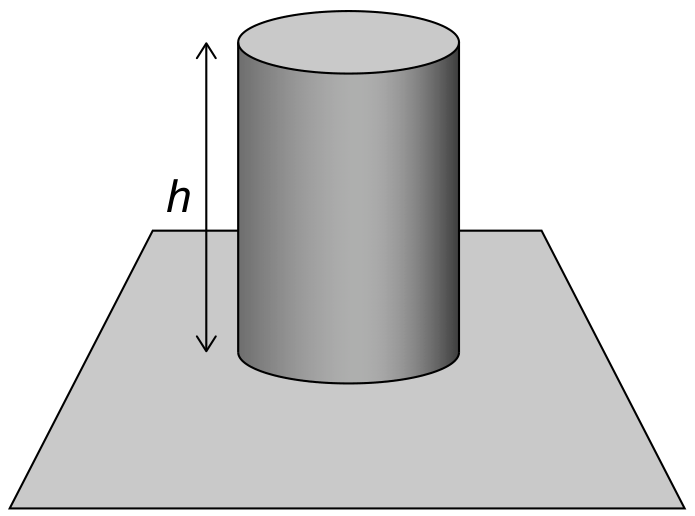
A solid cylinder of height h and density ρ\rho rests on a flat surface.

Figure for Question B. The particulate nature of matter question 3 — IB Physics SL

Question (a)

(a)

Show that the pressure pCp_{\mathrm{C}} exerted by the cylinder on the surface is given by pC=ρghp_{\mathrm{C}}=\rho g h.

[ 2 ]

Question (b)

(b)

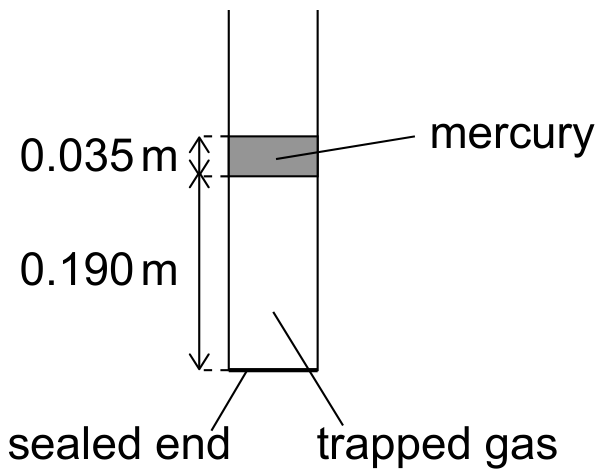
A tube of constant circular cross-section, sealed at one end, contains an ideal gas trapped by a cylinder of mercury of length 0.035 m . The whole arrangement is in the Earth's atmosphere. The density of mercury is 1.36×10⁴ kg m31.36 \times 10^{4} \mathrm{~kg} \mathrm{~m}^{-3}.

Figure for Question (b) — IB Physics SL

When the mercury is above the gas column the length of the gas column is 0.190 m .

[ 7 ]

Question (i)

(i)

Show that (po+pm)×0.190=nRTA\left(p_{\mathrm{o}}+p_{\mathrm{m}}\right) \times 0.190=\frac{n R T}{A} where
po=p_{\mathrm{o}}= atmospheric pressure
pm=p_{\mathrm{m}}= pressure due to the mercury column
T= temperature of the trapped gas
n= number of moles of the trapped gas
A= cross-sectional area of the tube.

[ 2 ]

Question (ii)

(ii)

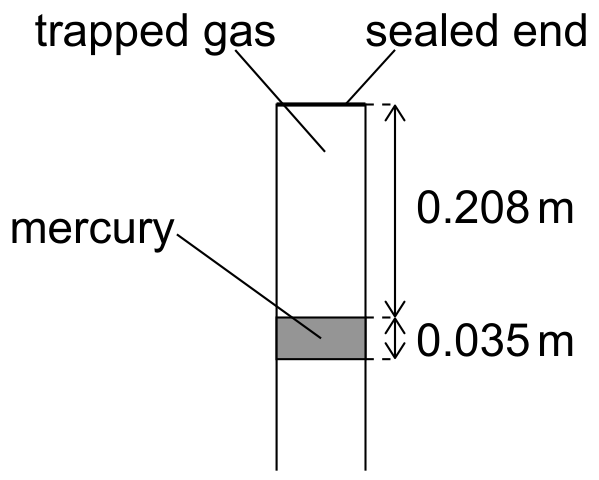
The tube is slowly rotated until the gas column is above the mercury.

Figure for Question (ii) — IB Physics SL

The length of the gas column is now 0.208 m . The temperature of the trapped gas does not change during the process.

Determine the atmospheric pressure. Give a suitable unit for your answer.

[ 4 ]

Question (iii)

(iii)

Outline why the gas particles in the tube hit the mercury surface less often after the tube has been rotated.

[ 1 ]

B. The particulate nature of matter question 4

[Maximum number: 8]

This question is in two parts. Part 1 is about a thermistor circuit. Part 2 is about vibrations and waves.
Part 1 Thermistor circuit
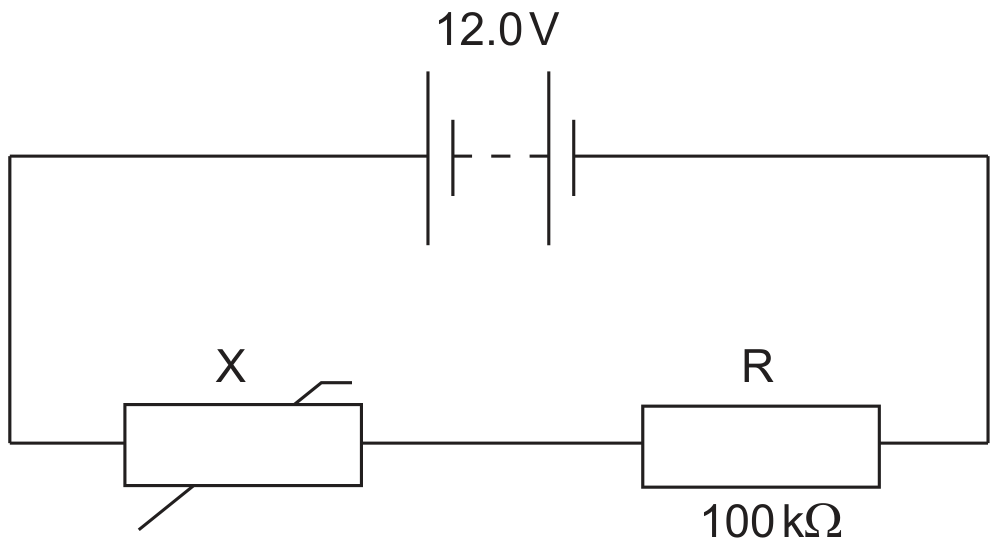
The circuit shows a negative temperature coefficient (NTC) thermistor X and a 100kΩ100 \mathrm{k} \Omega fixed resistor R connected across a battery.

Figure for Question B. The particulate nature of matter question 4 — IB Physics SL

The battery has an electromotive force (emf) of 12.0 V and negligible internal resistance.

Question (a)

(a)

Define electromotive force (emf).

[ 1 ]

Question (b)

(b)

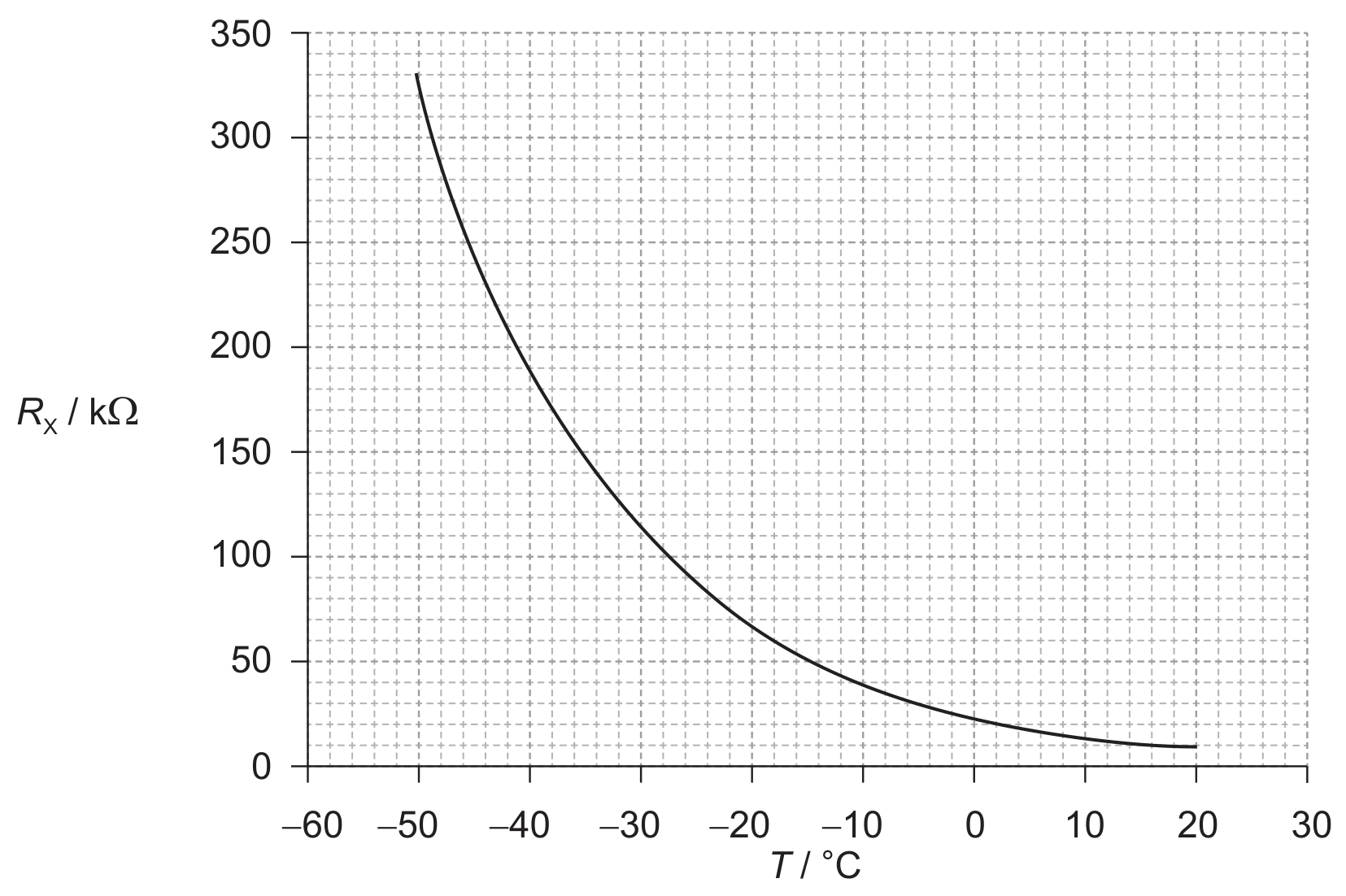
The graph below shows the variation with temperature T of the resistance RxR_{\mathrm{x}} of the thermistor.

Figure for Question (b) — IB Physics SL
[ 7 ]

Question (i)

(i)

Determine the temperature of X when the potential difference across R is 4.5 V .

[ 4 ]

Question (ii)

(ii)

State the range of temperatures for which the change in the resistance of the thermistor is most sensitive to changes in temperature.

[ 1 ]

Question (iii)

(iii)

State and explain the effect of a decrease in temperature on the ratio

 voltage across X voltage across R\frac{\text { voltage across } \mathrm{X}}{\text { voltage across } \mathrm{R}}

Part 2 Vibrations and waves

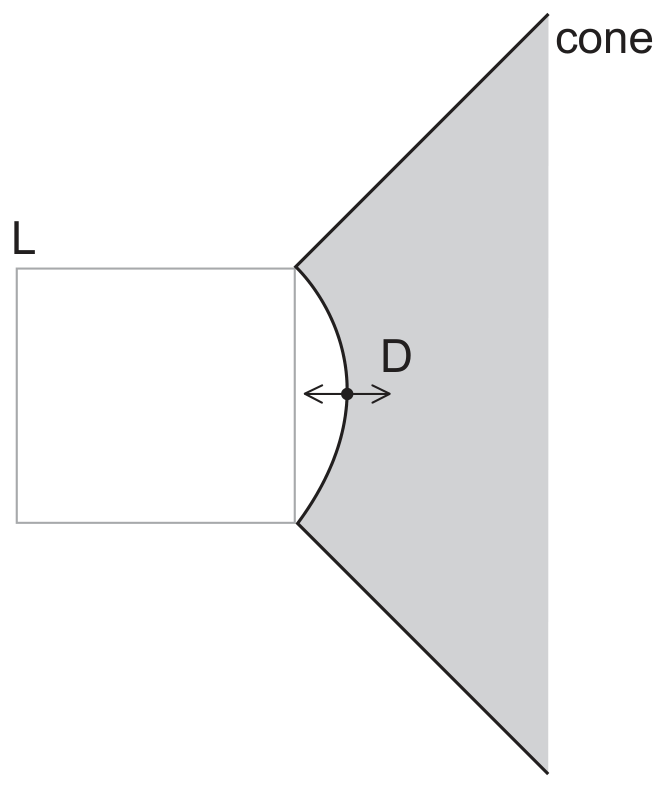
The cone and dust cap D of a loudspeaker L vibrates with a frequency of 1.25 kHz with simple harmonic motion (SHM).

Figure for Question (iii) — IB Physics SL
[ 2 ]

B. The particulate nature of matter question 5

[Maximum number: 2]

This question is about a tidal power station.

A tidal power station is built for a coastal town. Sea water is stored in a tidal basin behind a dam at high tide and released in a controlled manner between high tides, so that it passes through turbines to generate electricity.

The following data are available.

Table for Question B. The particulate nature of matter question 5 — IB Physics SL

Show that the mass of sea water released between successive high and low tides is about 2.8×10⁸ kg2.8 \times 10^{8} \mathrm{~kg}.

B. The particulate nature of matter question 6

[Maximum number: 10]

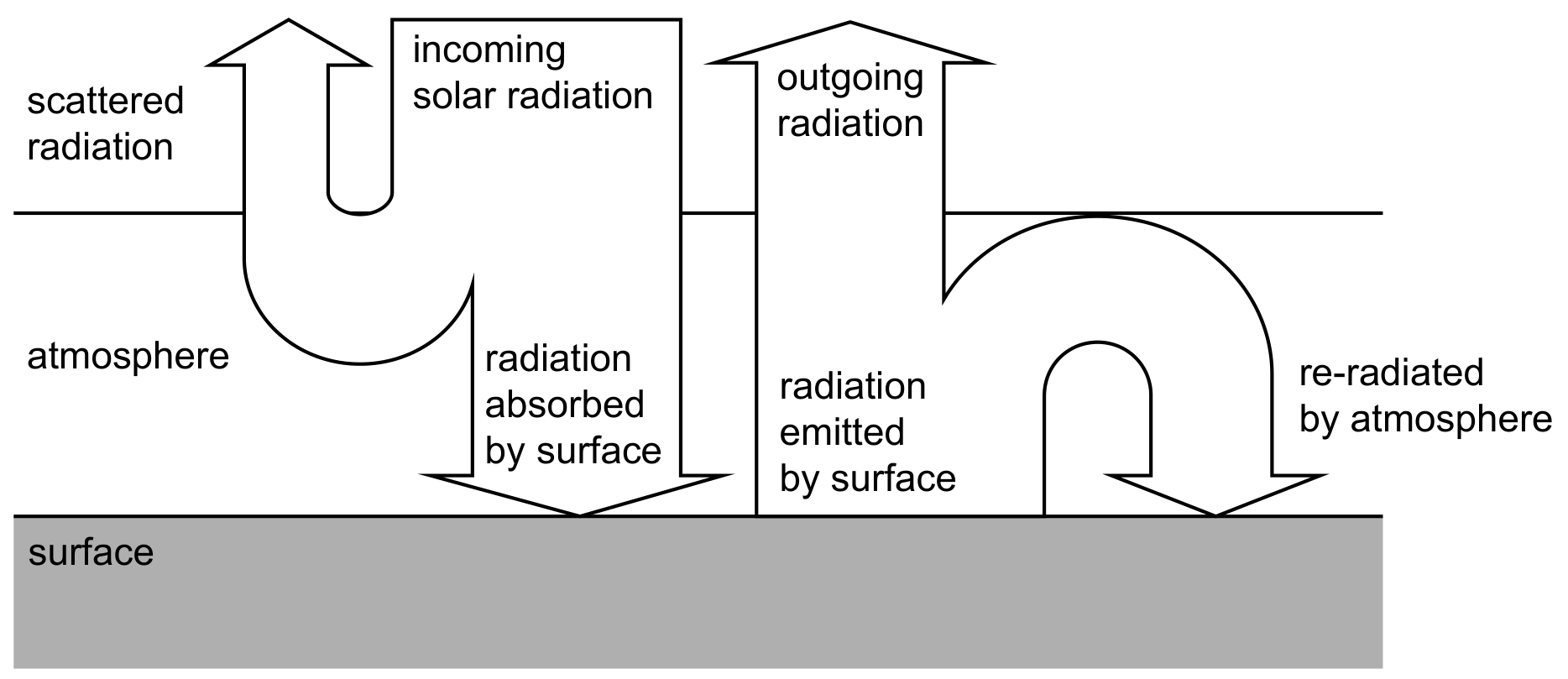
The diagram shows a simplified energy-balance model for the Earth surface–atmosphere system.

Figure for Question B. The particulate nature of matter question 6 — IB Physics SL

The following data are given:

 Average albedo of Earth =0.30 Average global temperature of the surface =288 K Average Earth-Sun distance =1.5×10¹¹ m\begin{aligned} \text { Average albedo of Earth } & =0.30 \\ \text { Average global temperature of the surface } & =288 \mathrm{~K} \\ \text { Average Earth-Sun distance } & =1.5 \times 10^{11} \mathrm{~m} \end{aligned}

Question (a)

(a)

State what is meant by the solar constant.

[ 1 ]

Question (b)

(b)

Outline the physical mechanism by which some of the radiation emitted by the surface is absorbed by greenhouse gases in the atmosphere and re-radiated towards the surface.

[ 2 ]

Question (c)

(c)

Show that the average global intensity of radiation absorbed by the surface is about 240Wm2240 \mathrm{Wm}^{-2}.

[ 2 ]

Question (d)

(d)

Determine the average intensity re-radiated by the atmosphere towards the surface. Assume that the emissivity of the surface is 0.90 .

[ 3 ]

Question (e)

(e)

Show, with reference to the solar constant, that the total power radiated by the Sun is about 4×1026 W4 \times 10^{26} \mathrm{~W}.

[ 2 ]
All question bank results loaded