IB Physics SL S Skills in Physics Question Bank

Practise broad physics skills by choosing instruments, handling units and uncertainties, and interpreting graphs, measurements and simple technology contexts.

Syllabus
First assessment 2025
Topic
Level
SL

S Skills in Physics question 1

[Maximum number: 2]

This question is about mobile phones.

The number of mobile phones has grown rapidly in recent years. Discuss environmental issues associated with this rapid increase.

S Skills in Physics question 2

[Maximum number: 5]

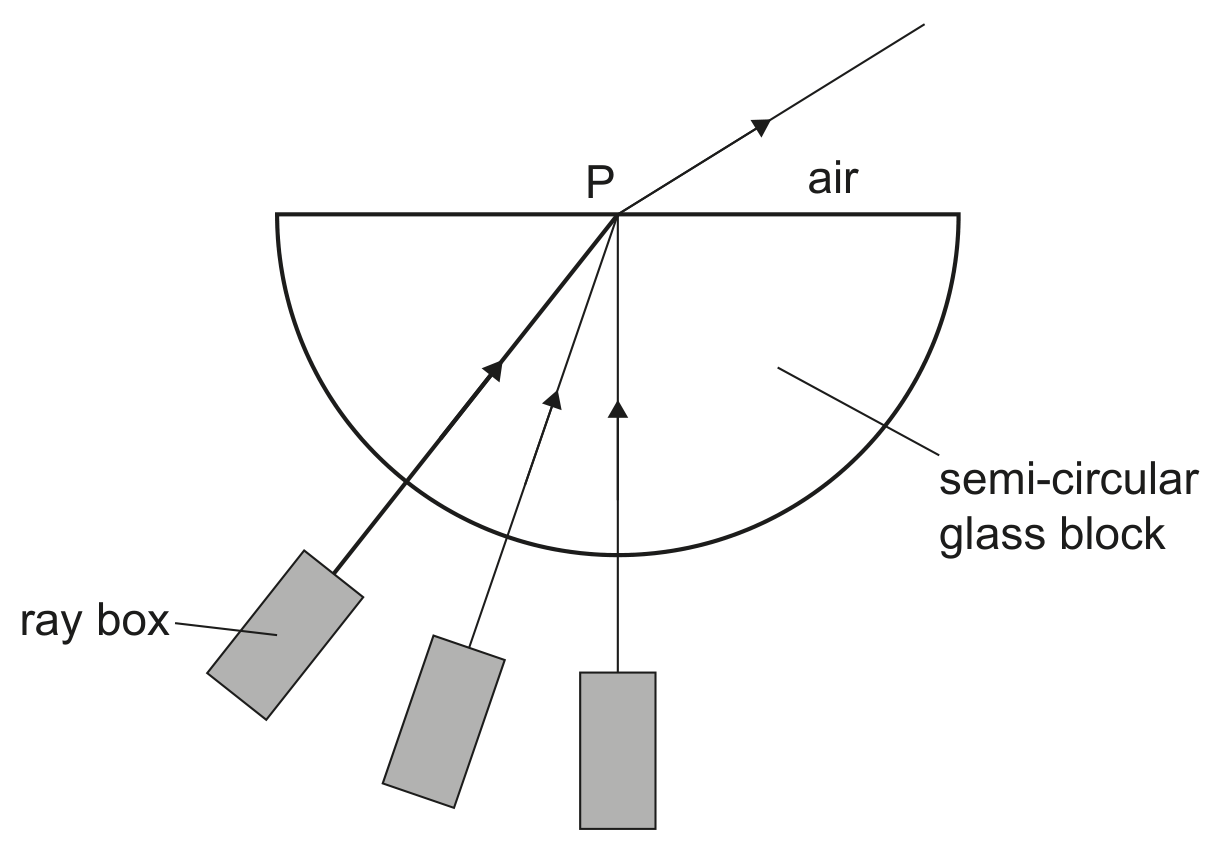
A group of students is investigating refraction in a semi-circular glass block.

Light from a ray box enters the curved side of the block. The light passes through the block and leaves, refracted, at P .

Question (a)

(a)

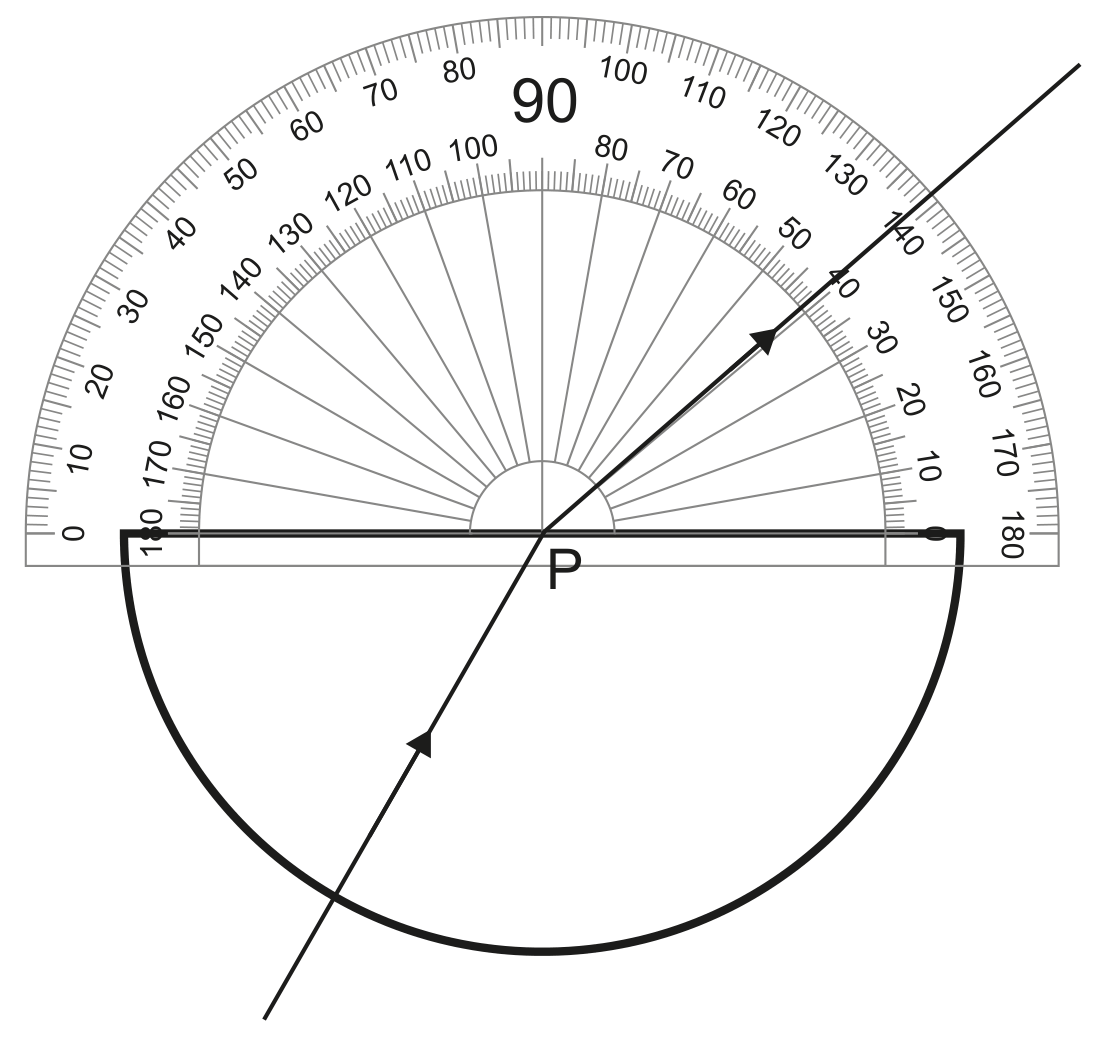
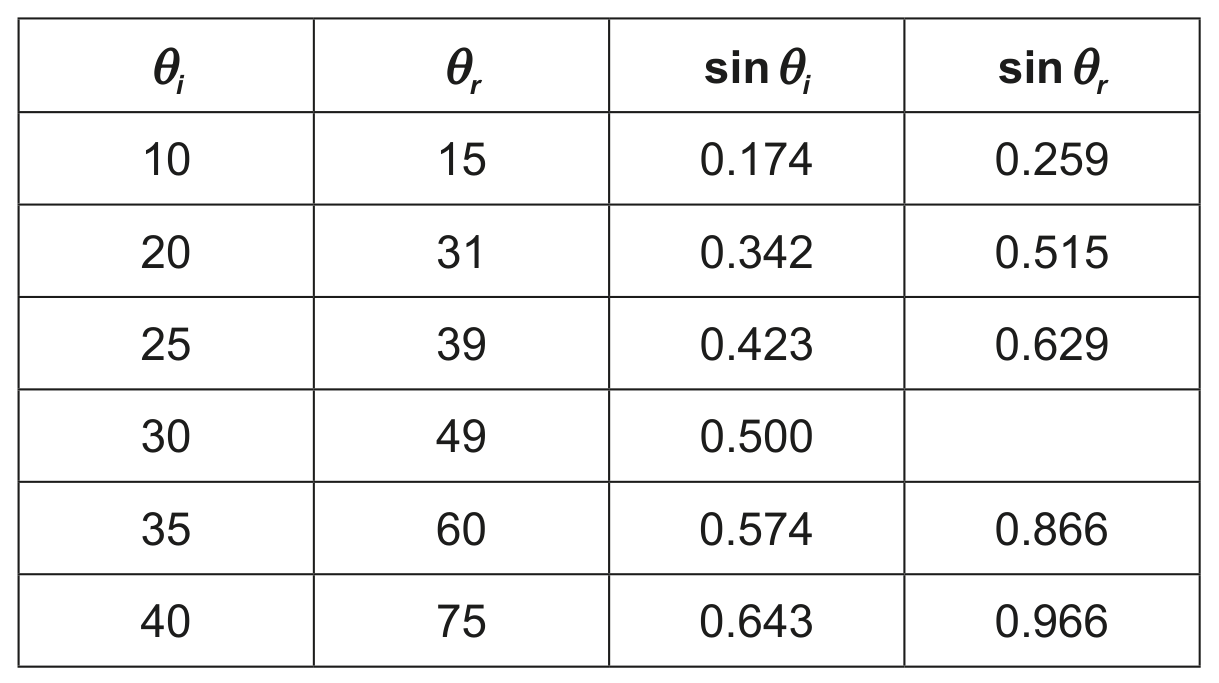
The students vary the position of the ray box to obtain data to determine the refractive index of the glass. They use a protractor to collect values for the angles of incidence θi\theta_{i} and refraction θr\theta_{r} at P and record them on a table.

Figure for Question (a) — IB Physics SL
[ 2 ]

Question (i)

(i)

One of their measurements is shown. State θr\theta_{r} for this measurement.

Figure for Question (i) — IB Physics SL
[ 1 ]

Question (ii)

(ii)

Complete the table.

Table for Question (ii) — IB Physics SL
[ 1 ]

Question (b)

(b)

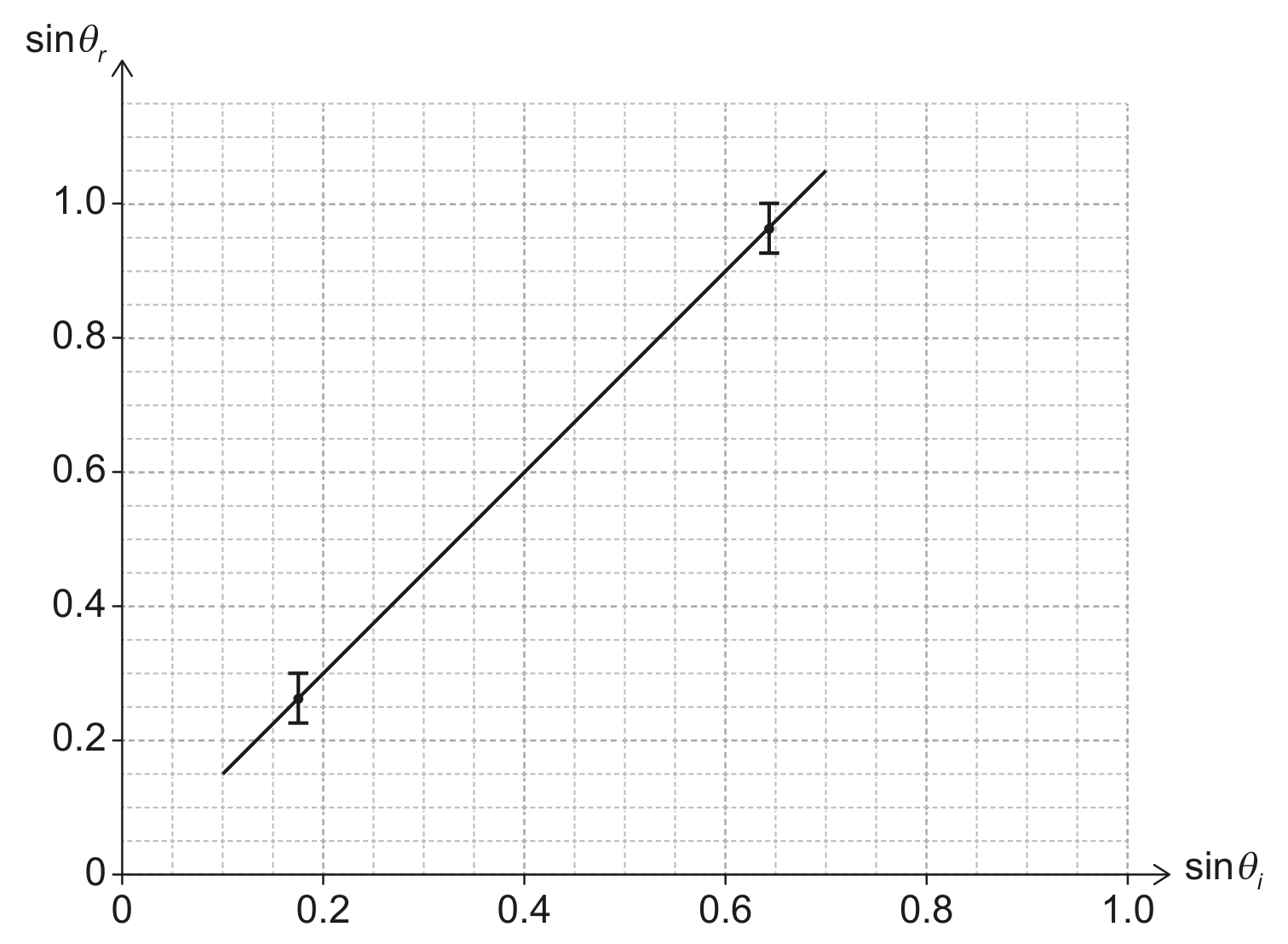
They plot a graph of the variation with the sine of θi\theta_{i} of the sine of θr\theta_{r}.
They add uncertainty bars for sinθr\sin \theta_{r} for the first and last data point and draw the best-fit line.

Figure for Question (b) — IB Physics SL
[ 3 ]

Question (i)

(i)

Determine the gradient of the students' best-fit line.

[ 2 ]

Question (ii)

(ii)

Draw on the students' graph the line of maximum gradient.

[ 1 ]

S Skills in Physics question 3

[Maximum number: 4]

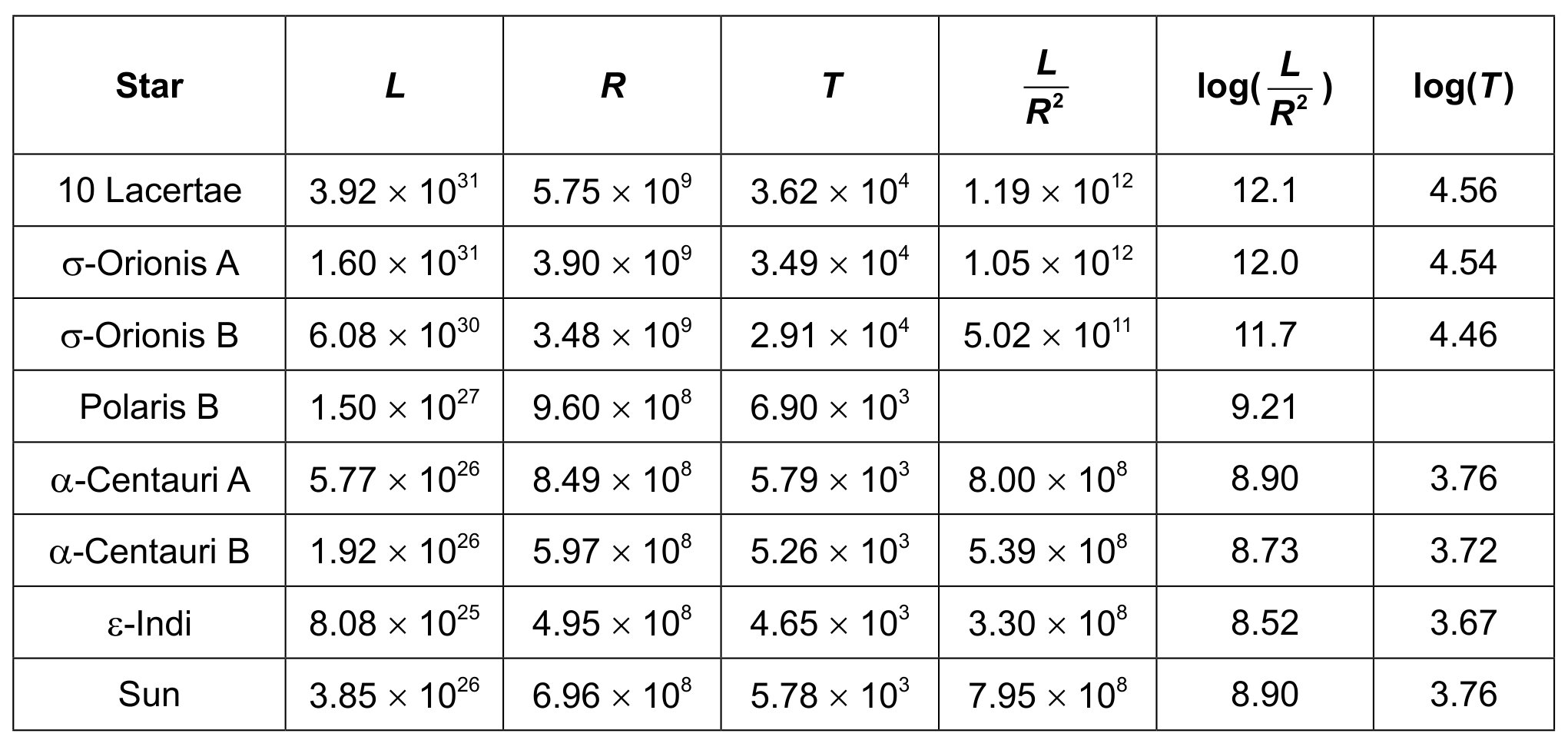
A student investigates whether the Stefan-Boltzmann law, L=4πσR2T4L=4 \pi \sigma R^{2} T^{4}, applies to stars.
L= luminosity of the star, in W
σ=\sigma= Stefan-Boltzmann constant
R= radius of the star, in m
T= surface temperature of the star, in K
To verify the law, they obtain values from databases and manipulate the data as shown.

Table for Question S Skills in Physics question 3 — IB Physics SL

Question (a)

(a)

Complete the table with the missing values for Polaris B.

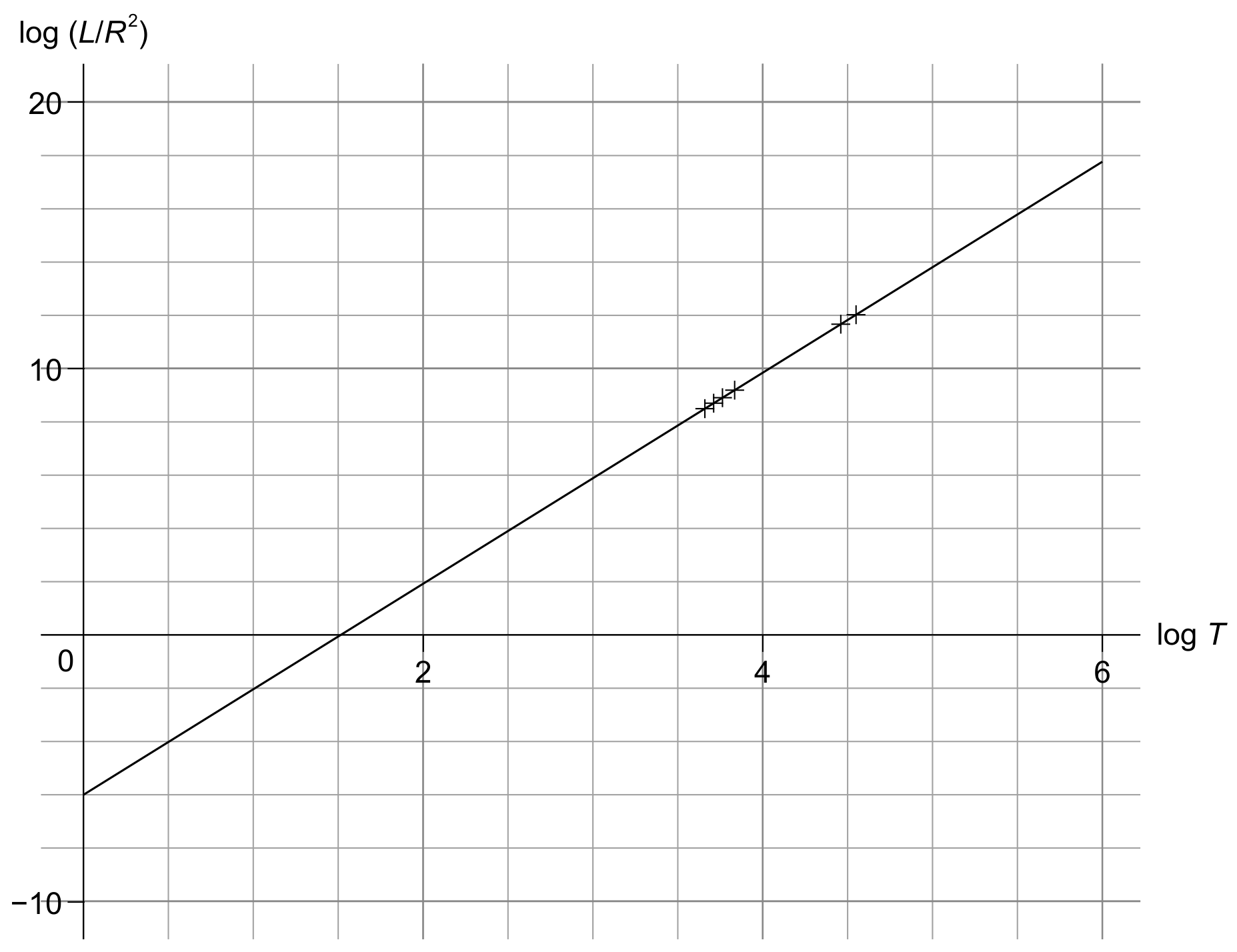
The student plots the variation with logT\log T of log(LR2)\log \left(\frac{L}{R^{2}}\right) and draws the line of best fit.

Figure for Question (a) — IB Physics SL

The student uses a GDC (graphical display calculator) to determine the equation of the line of best fit as y=3.99 x-6.15.

[ 2 ]

Question (b)

(b)

Outline a conclusion for the investigation.

[ 1 ]

Question (c)

(c)

Suggest a possible improvement of the investigation, related to the range of the surface temperatures of the stars selected.

[ 1 ]

S Skills in Physics question 4

[Maximum number: 12]

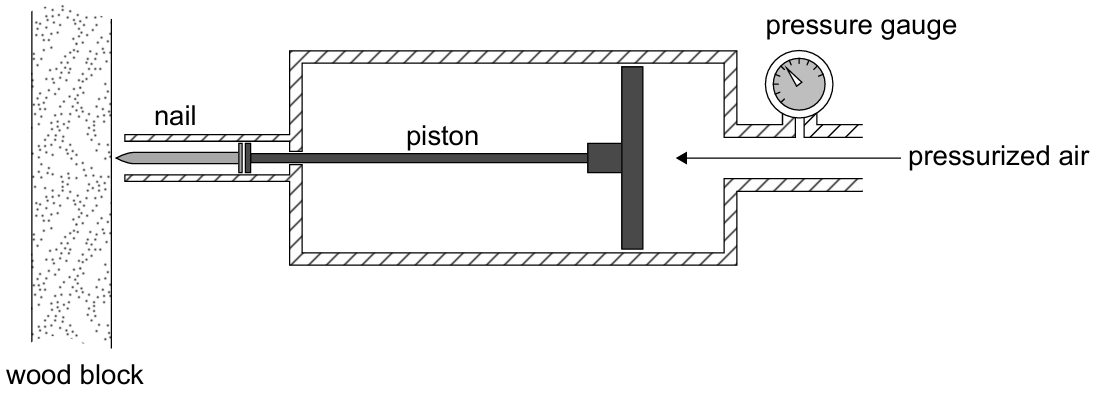
A group of students uses pressurized air to move a piston that forces a nail into a block of wood. A gauge is used to measure the pressure P of compressed air above atmospheric pressure. The nail enters the wood perpendicular to its surface.

Figure for Question S Skills in Physics question 4 — IB Physics SL

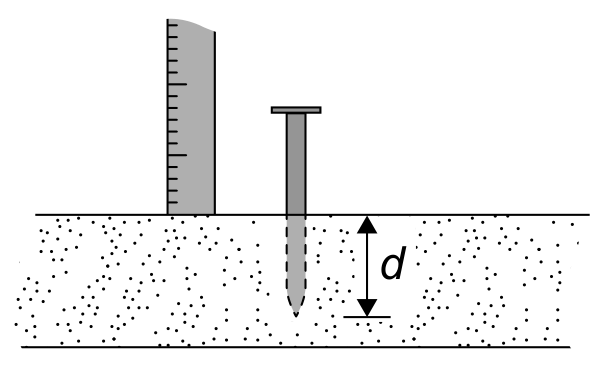
The students use a ruler to measure the length of the nail which remains above the surface of the wood as shown. The depth of the nail inside the wood is d. All necessary length measurements are recorded using a ruler with uncertainty ±1 mm\pm 1 \mathrm{~mm}.

Figure for Question S Skills in Physics question 4 — IB Physics SL

Question (a)

(a)

Describe one consideration that must be made when placing the ruler to ensure that the length of the nail remaining above the surface of the wood is measured accurately.

[ 1 ]

Question (b)

(b)

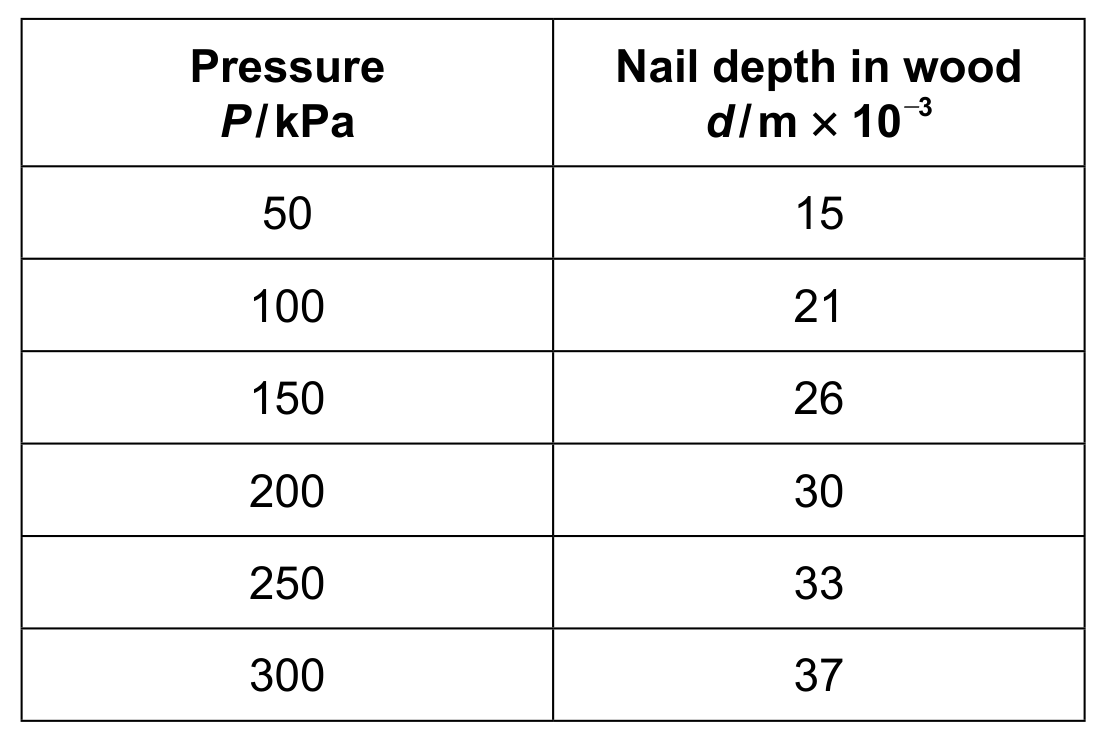
The students systematically increase the pressure and calculate d.

Table for Question (b) — IB Physics SL
[ 4 ]

Question (i)

(i)

Outline how the students determined the value of d.

[ 1 ]

Question (ii)

(ii)

State the absolute uncertainty of d.

[ 1 ]

Question (iii)

(iii)

By using two sets of data in the table, show that the relationship between d and P is not directly proportional.

[ 2 ]

Question (c)

(c)

The students suggest the following relationship between d and P :

d=kPd=k \sqrt{P}

where k is a constant.
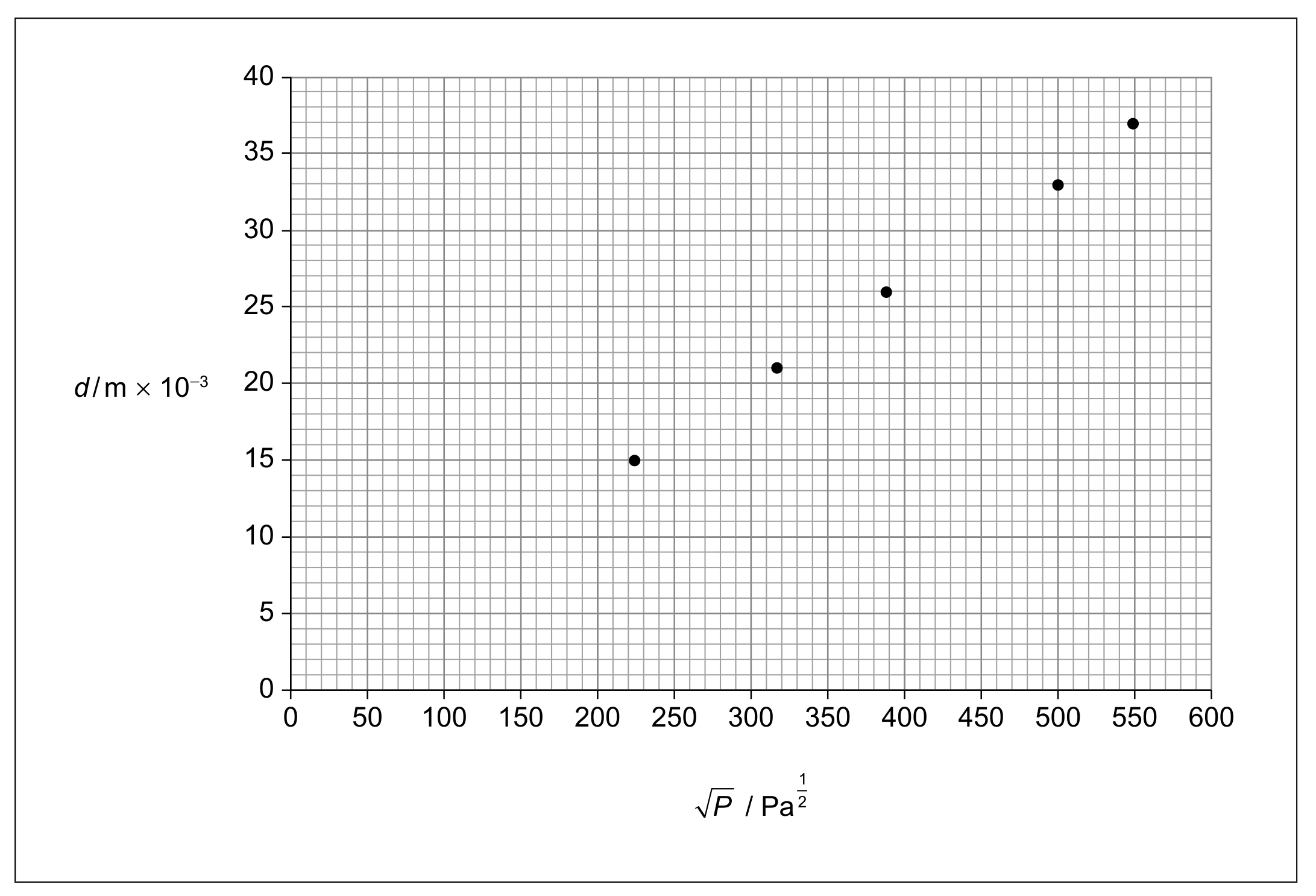
To verify the relationship, the variation of d with P\sqrt{P} is plotted.
One data point is missing.

Figure for Question (c) — IB Physics SL
[ 6 ]

Question (i)

(i)

Determine the coordinates of the missing point using the original data set and plot it on the graph.

[ 1 ]

Question (ii)

(ii)

The percentage uncertainty in P is ±8%\pm 8 \%. Determine the uncertainty for P\sqrt{P} when d=33 mmd=33 \mathrm{~mm} and draw the uncertainty bar for this data point on the graph.

[ 3 ]

Question (iii)

(iii)

The SI units of k can be expressed as kg12 mx sy\mathrm{kg}^{-\frac{1}{2}} \mathrm{~m}^{x} \mathrm{~s}^{y}. Determine the values of x and y.

[ 2 ]

Question (d)

(d)

The students collect only one value of d for each value of P. Suggest why this is a poor method.

[ 1 ]

S Skills in Physics question 5

[Maximum number: 3]

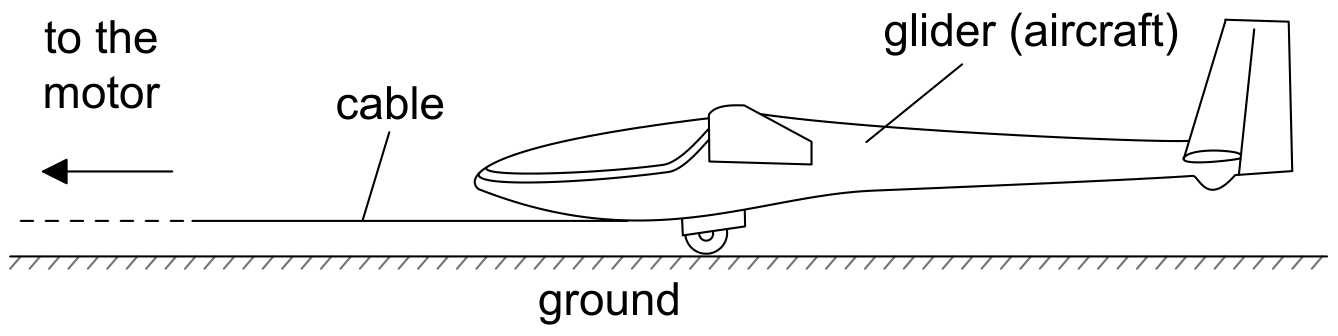
A glider is an aircraft with no engine. To be launched, a glider is uniformly accelerated from rest by a cable pulled by a motor that exerts a horizontal force on the glider throughout the launch.

Figure for Question S Skills in Physics question 5 — IB Physics SL

At a particular instant in the flight the glider is losing 1.00 m of vertical height for every 6.00 m that it goes forward horizontally. At this instant, the horizontal speed of the glider is 12.5 m s112.5 \mathrm{~m} \mathrm{~s}^{-1}. Calculate the velocity of the glider. Give your answer to an appropriate number of significant figures.

All question bank results loaded