Question 1
What is the order of magnitude of the wavelength of visible light?
EduNinjaWhat is the order of magnitude of the wavelength of visible light?
10−10 m
10−7 m
10−4 m
10−1 m
This question is about standing (stationary) waves in a tube.
The diagram shows an enlarged view of the tube shown in (a). X, Y and Z are three molecules of air in the tube.

The length L is 33.0 cm .
State the direction of oscillation of molecule Y .
This question is about standing (stationary) waves.
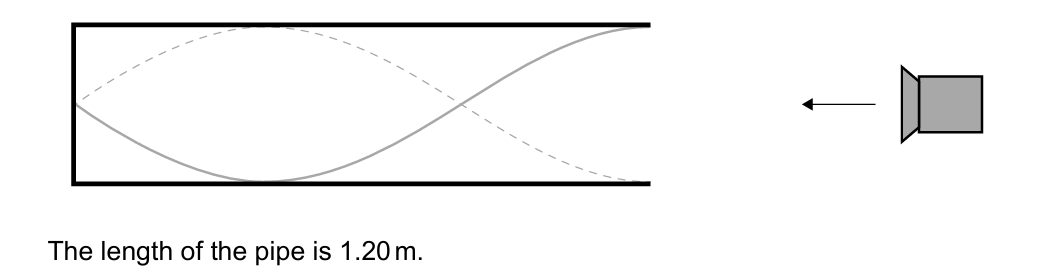
The diagram shows a tube that is open at both ends.
-A
Point A shows the position of one air molecule in the tube. A standing sound wave (not shown in the diagram) is set up in the tube.
The graph shows the variation of displacement s with time t for the molecule at point A.

Outline whether the standing wave is transverse or longitudinal.
This question is about standing (stationary) waves.
The diagram shows an arrangement used to produce a standing (stationary) wave on a stretched string of length 2.4 m . A standing wave with five loops appears when the frequency of the oscillator is set to 150 Hz , as shown below.

Calculate the speed of the wave along the string.
Graph 1 shows the variation of particle displacement d with position x for a travelling sound wave.

Graph 1
Graph 2 shows the variation of particle displacement d with time t for the same travelling sound wave.

Graph 2
State the wavelength and the period of the sound wave.
A transverse wave of period 20 ms travels through a medium. The graph shows the variation of particle displacement with distance for the wave.

What is the average speed of the particle motion and the direction of particle motion relative to the direction of the wave travel during one cycle?
Average speed of particle / ms−1
Direction of particle motion
8
parallel
8
perpendicular
10
parallel
10
perpendicular
A rocket moving with speed v relative to the ground emits a flash of light in the backward direction.

An observer in the rocket measures the speed of the flash of light to be c.
State the speed of the flash of light according to an observer on the ground using
Maxwell's theory of electromagnetism.
The solid line in the graph shows the variation with distance x of the displacement y of a travelling wave at t=0. The dotted line shows the wave 0.20 ms later. The period of the wave is longer than 0.20 ms .

Calculate, in ms−1, the speed for this wave.
Calculate, in Hz, the frequency for this wave.
The graph shows how the displacement of a wave varies with the position x along the wave. The wave travels towards positive x.
At the instant shown, which point along the wave has the maximum positive velocity?

A transverse travelling wave is moving through a medium. The graph shows, for one instant, the variation with distance of the displacement of particles in the medium.

The frequency of the wave is 25 Hz and the speed of the wave is 100 m s−1. What is correct for this wave?
The particles at X and Y are in phase.
The velocity of the particle at X is a maximum.
The horizontal distance between X and Z is 3.0 m .
The velocity of the particle at Y is 100 m s−1.