EduNinja

IB Physics SLC.1 Simple harmonic motionQuestion Bank

Question A2

Question A2(b)

(a)

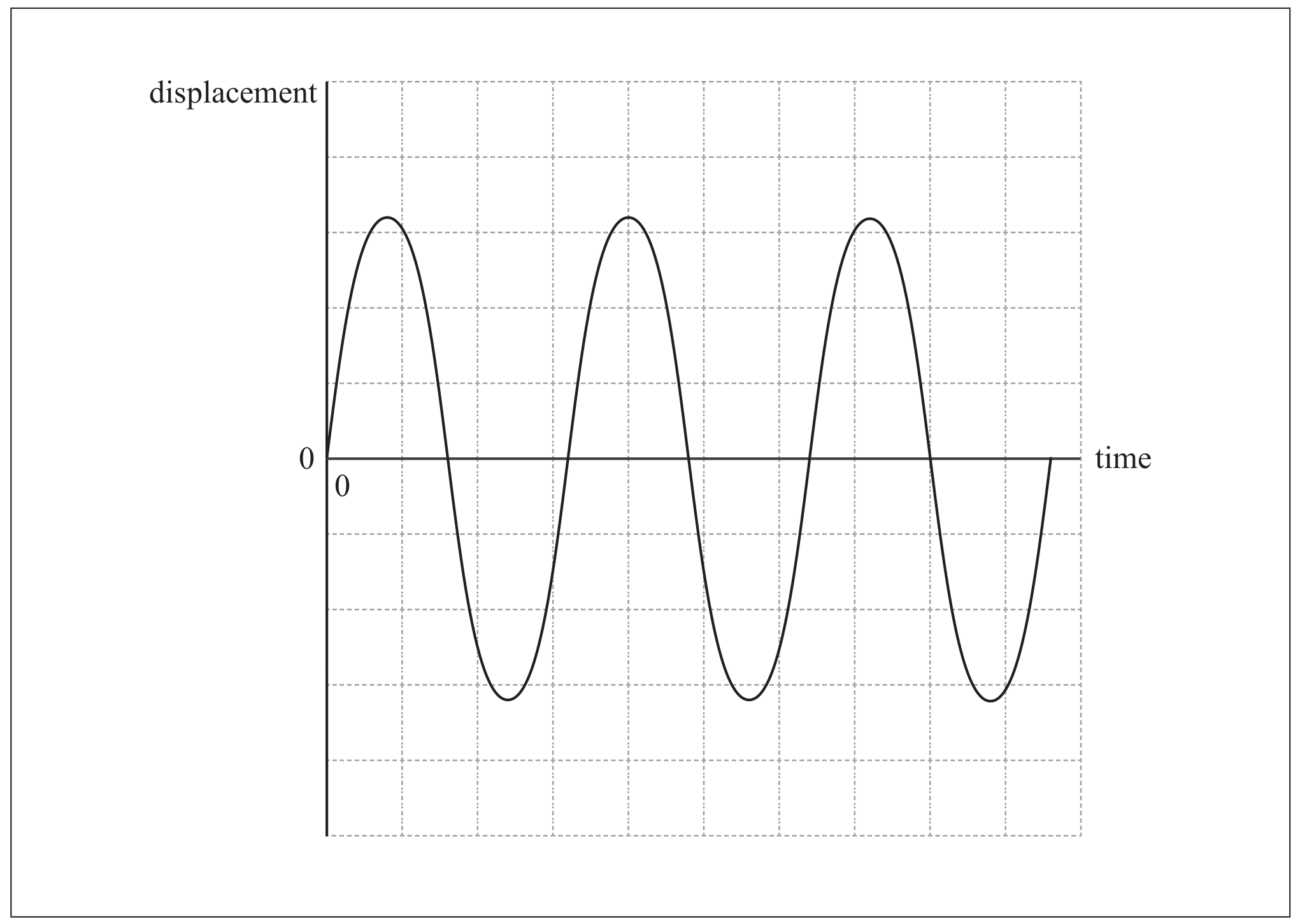
A string fixed at both ends oscillates in its fundamental (first harmonic) mode. The diagram shows the displacement of the string at time t=0. Point M is the point at the middle of the string.

Question image

At t=0 point M is moving upwards. The frequency of oscillation is 250 Hz . On the diagram, draw

[ 1 ]

Question A2(b)(i)

(i)

an arrow to indicate the direction of acceleration of point M .

[ 1 ]

Question 2

[Maximum number: 2]

The acceleration of a dynamics cart is measured as the cart rolls from rest down an inclined ramp.

A flexible metal strip is attached to the ramp. The metal strip performs simple harmonic oscillations.
A pen is attached to the metal strip and makes marks on paper that is fixed to the top surface of the cart.

Question image
Question image

The pen is displaced from its equilibrium position. The pen and the cart are then released at the same time.

As the cart accelerates down the ramp, the pen oscillates from side to side. The frequency of oscillation of the pen is 6.3 Hz .

The pen moves from point M to point N on the paper. The paper is shown with a grid, and the scale of the grid is marked on the diagram.

Air resistance is negligible in this experiment.

Question image

Question 2(a)

(a)

Calculate the time the pen takes to move from M to N .

[ 2 ]

Question 12

[Maximum number: 1]

The acceleration of an object executing simple harmonic motion is proportional to the

A

displacement of the object from equilibrium.

B

velocity of the object.

C

amplitude of oscillation.

D

frequency of oscillation.

Question 12

[Maximum number: 1]

An object performs simple harmonic motion (SHM) about a central point. The object has velocity v and acceleration a when it has displacement x from the point.

Which ratio is constant?

A

xa\frac{x}{a}

B

xv\frac{x}{v}

C

x2a\frac{x^{2}}{a}

D

va\frac{v}{a}

Question 12

[Maximum number: 1]

The motion of an object is described by the equation

 acceleration  - displacement. \text { acceleration } \propto \text { - displacement. }

What is the direction of the acceleration relative to that of the displacement and what is the displacement when the speed is a maximum?

Direction of acceleration

relative to displacement

Displacement when

speed is a maximum

same

max\max

same

zero

opposite

max\max

opposite

zero

Question 12

[Maximum number: 1]

An object undergoes simple harmonic motion with frequency f. The graph shows the variation of its acceleration with displacement.

Question image

What is the value of f2f^{2} in s2s^{-2} ?

A

5π2\frac{5}{\pi^{2}}

B

5π\frac{5}{\pi}

C

100π2\frac{100}{\pi^{2}}

D

100π\frac{100}{\pi}

Question 12

[Maximum number: 1]

A wave of period 5.0 ms travels through a medium. The graph shows the variation with distance d of the displacement x of points in the medium.

Question image

What is the average speed of a point in the medium during one full oscillation?

A

0 m s10 \mathrm{~m} \mathrm{~s}^{-1}

B

4.0 m s14.0 \mathrm{~m} \mathrm{~s}^{-1}

C

16 m s116 \mathrm{~m} \mathrm{~s}^{-1}

D

400 m s1400 \mathrm{~m} \mathrm{~s}^{-1}

Question 12

[Maximum number: 1]

A particle undergoing simple harmonic motion (SHM) oscillates with time period T and angular frequency ω\omega. The time period of the SHM changes to 2 T. Which of the following gives the new value of ω\omega ?

A

ω4\frac{\omega}{4}

B

ω2\frac{\omega}{2}

C

2ω2 \omega

D

4ω4 \omega

Question 3

[Maximum number: 2]

The solid line in the graph shows the variation with distance x of the displacement y of a travelling wave at t=0. The dotted line shows the wave 0.20 ms later. The period of the wave is longer than 0.20 ms .

Question image

Question 3(b)

(a)

The graph also shows the displacement of two particles, P and Q, in the medium at t=0. State and explain which particle has the larger magnitude of acceleration at t=0.

[ 2 ]

Question 3

[Maximum number: 6]

This question is about simple harmonic motion (SHM).

The graph shows the variation with time t of the acceleration a of an object X undergoing simple harmonic motion (SHM).

Question image

Question 3(a)

(a)

Define simple harmonic motion (SHM).

[ 2 ]

Question 3(c)

(b)

Determine the maximum displacement of X . Give your answer to an appropriate number of significant figures.

[ 4 ]
0 selected