IB Physics SL A.2.7 Frictional Force

Practise choosing static or dynamic friction, calculating the normal reaction first and using the frictional force with Newton's laws or kinematics on horizontal and inclined…

Syllabus
First assessment 2025
Objective
Level
SL

Exam points

  • compare the required friction with the static limit μsN before deciding whether an object slides
  • use Ff = μdN only during sliding and calculate N from the perpendicular force balance
  • insert friction with the correct direction in F = ma or an energy and kinematics calculation

A.2.7—Frictional force question 1

[Maximum number: 3]

A student strikes a tennis ball that is initially at rest so that it leaves the racquet at a speed of 64 m s164 \mathrm{~m} \mathrm{~s}^{-1}. The ball has a mass of 0.058 kg and the contact between the ball and the racquet lasts for 25 ms .

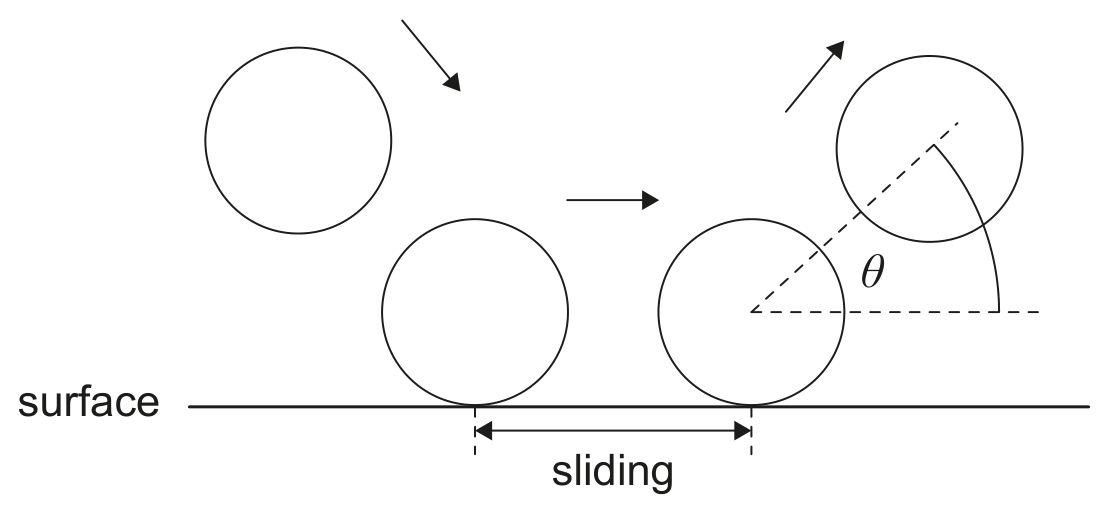
The student models the bounce of the tennis ball to predict the angle θ\theta at which the ball leaves a surface of clay and a surface of grass.

Figure for Question A.2.7—Frictional force question 1 — IB Physics SL

The model assumes
- during contact with the surface the ball slides.
- the sliding time is the same for both surfaces.
- the sliding frictional force is greater for clay than grass.
- the normal reaction force is the same for both surfaces.
Predict for the student's model, without calculation, whether θ\theta is greater for a clay surface or for a grass surface.

All question bank results loaded