IB Physics SL A.2.25 Direction Change in Circular Motion

Practise explaining why constant-speed circular motion is accelerated motion and identifying the inward resultant force needed to continuously change the velocity direction.

Syllabus
First assessment 2025
Objective
Level
SL

Exam points

  • state that velocity changes because its direction changes even when the speed remains constant
  • identify the inward resultant force that supplies centripetal acceleration towards the centre
  • explain an apparent outward throw through inertia when the upper body lacks sufficient inward force

A.2.25—Direction change in circular motion question 1

[Maximum number: 4]

This question is in two parts. Part 1 is about two children on a merry-go-round. Part 2 is about electric circuits.

Part 1 Two children on a merry-go-round
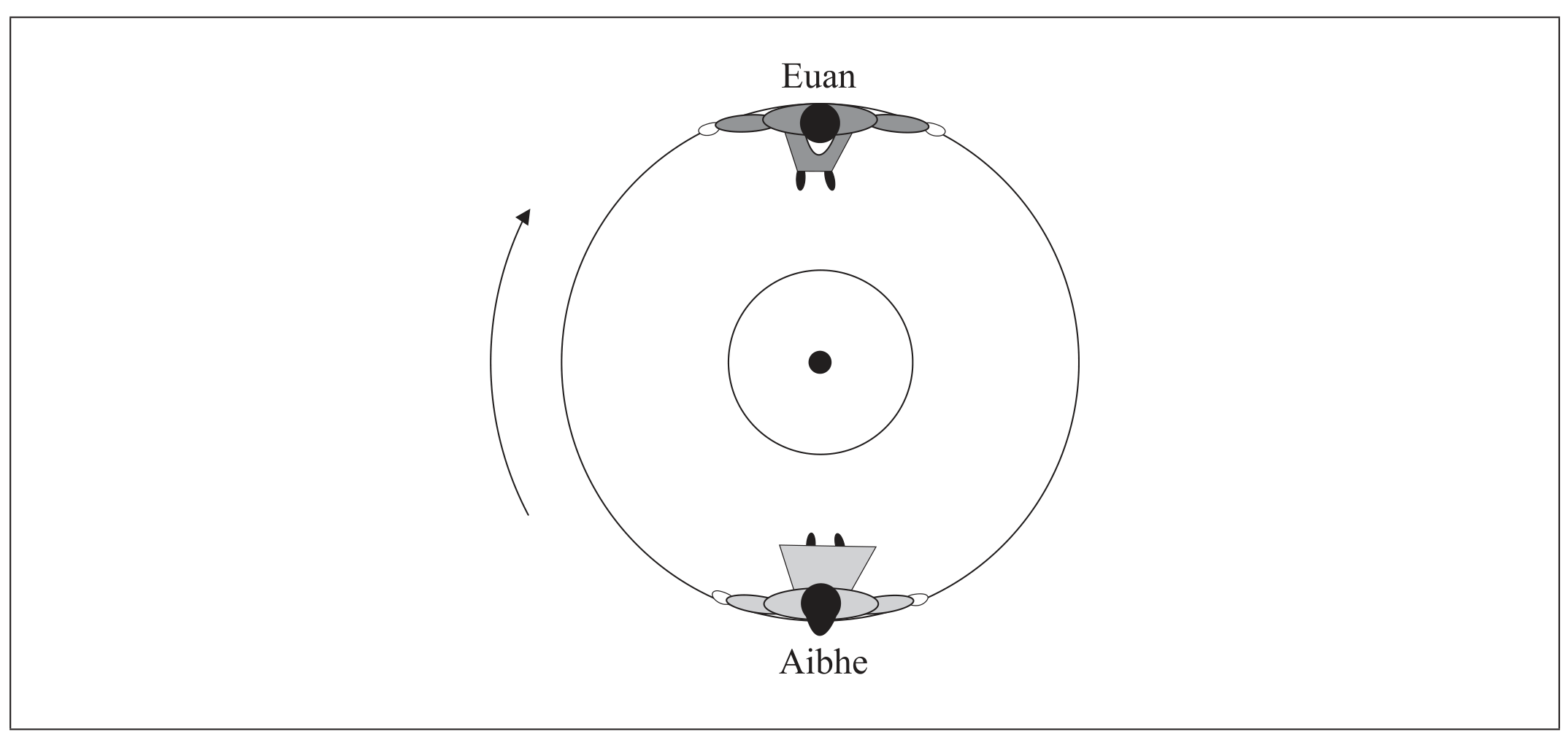
Aibhe and Euan are sitting on opposite sides of a merry-go-round, which is rotating at constant speed around a fixed centre. The diagram below shows the view from above.

Figure for Question A.2.25—Direction change in circular motion question 1 — IB Physics SL

Aibhe is moving at speed 1.0 ms11.0 \mathrm{~ms}^{-1} relative to the ground.

Question (a)

(a)

Outline why Aibhe is accelerating even though she is moving at constant speed.

[ 2 ]

Question (b)

(b)

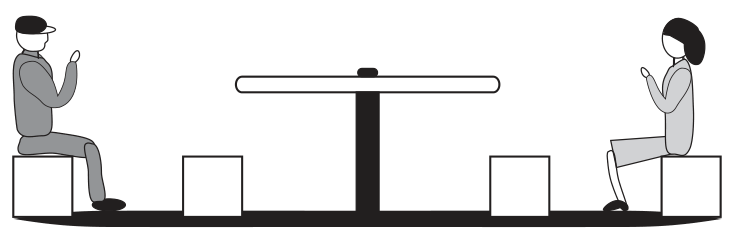
The diagram below shows a side view of Aibhe and Euan on the merry-go-round.

Figure for Question (b) — IB Physics SL

Explain why Aibhe feels as if her upper body is being "thrown outwards", away from the centre of the merry-go-round.

[ 2 ]
All question bank results loaded