IB Physics SL A.2.11 Buoyancy
Practise calculating buoyancy from displaced-fluid volume and density, then balancing it with weight or spring force for floating, submerged and accelerating objects.
- Syllabus
- First assessment 2025
- Objective
- —
- Level
- SL
Practise calculating buoyancy from displaced-fluid volume and density, then balancing it with weight or spring force for floating, submerged and accelerating objects.
A cylindrical cork of height H and cross-sectional area A is floating stationary in water. Its depth below the water surface is D.
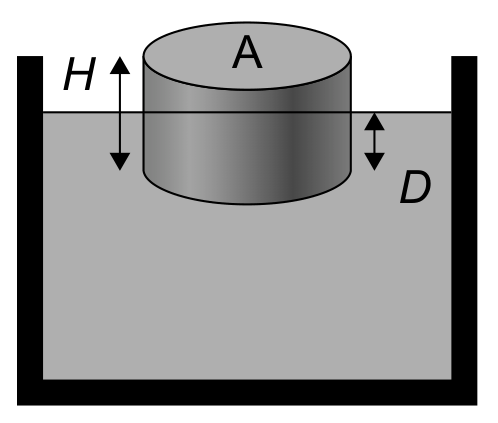
Show that
where is the density of the cork and is the density of water.
An icebreaking ship is designed to withstand a collision with an iceberg, a large partially submerged body of ice freely floating in water. The designers model the shape of the iceberg as a cylinder with an approximate cross-sectional area of and height above sea level of 32 m .
The following data are available:
Show that the mass of the iceberg is about .
The designers assume that the mass of the ship is about the mass of the iceberg and is moving at when it collides with the iceberg. They stick together after the collision.