IB Physics SL A.2.1 Newton’s three laws of motion
Apply Newton's laws to force pairs and resultant forces so you can explain motion changes in clear object-based terms.
- Syllabus
- First assessment 2025
- Objective
- —
- Level
- SL
Apply Newton's laws to force pairs and resultant forces so you can explain motion changes in clear object-based terms.
B3. This question is in two parts. Part 1 is about a collision. Part 2 is about electric current and resistance.
Part 1 A collision
Two identical blocks of mass 0.17 kg and length 0.050 m are travelling towards each other along a straight line through their centres as shown below. Assume that the surface is frictionless.
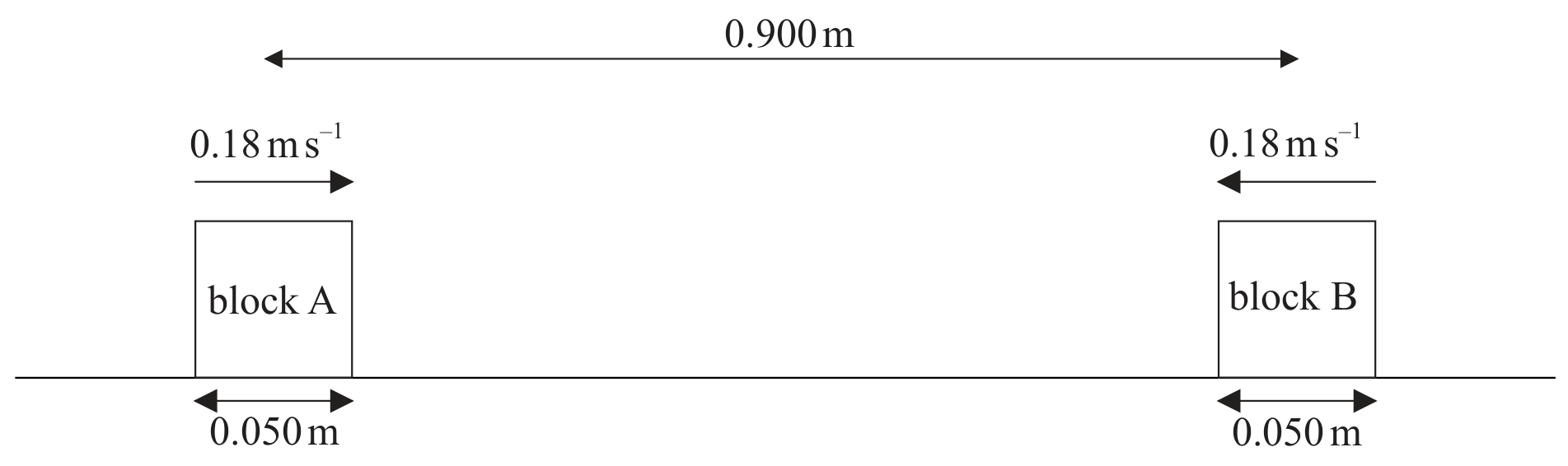
The initial distance between the centres of the blocks is 0.900 m and both blocks are moving at a speed of relative to the surface.
State Newton's third law of motion.
During the collision of the blocks, the magnitude of the force that block A exerts on block B is and the magnitude of the force that block B exerts on block A is . On the diagram below, draw labelled arrows to represent the magnitude and direction of the forces and .
