IB Physics SL A.2.18 Impulse-Momentum Change

Practise equating external impulse to vector momentum change, handling rebounds with signed velocities and using collision time to calculate the average resultant or contact force.

Syllabus
First assessment 2025
Objective
Level
SL

Exam points

  • calculate Δp = m(v - u) with signed velocities so a rebound adds the two speed magnitudes
  • equate external impulse to Δp and divide by contact time to find average resultant force
  • explain how extending stopping time reduces average force for the same momentum change

A.2.18—Impulse-momentum change question 1

[Maximum number: 3]

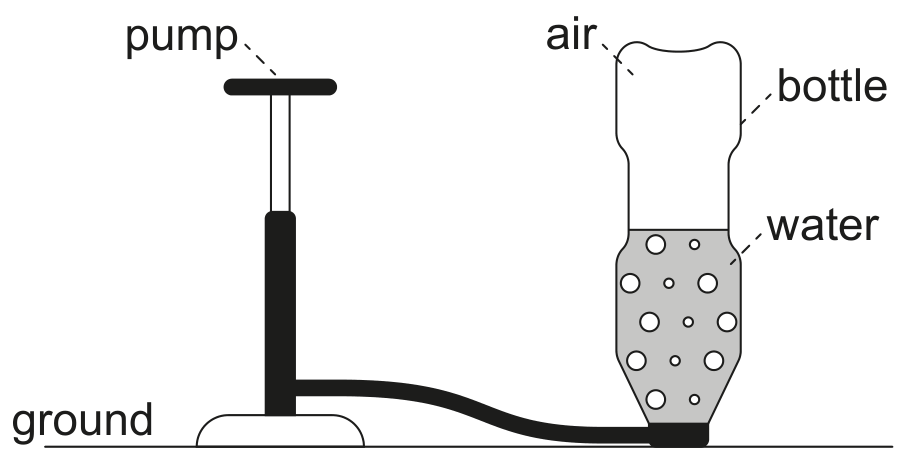
A toy rocket is made from a plastic bottle that contains some water.

Air is pumped into the vertical bottle until the pressure inside forces water and air out of the bottle. The bottle then travels vertically upwards.

Figure for Question A.2.18—Impulse-momentum change question 1 — IB Physics SL

The air-water mixture is called the propellant.
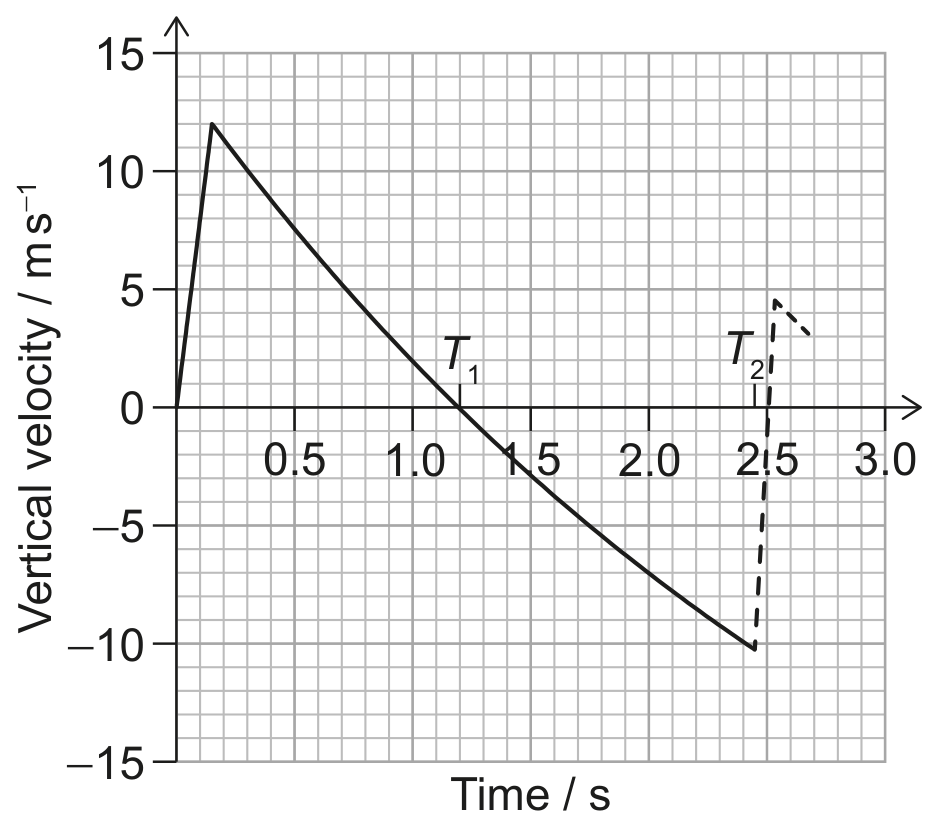
The variation with time of the vertical velocity of the bottle is shown.

Figure for Question A.2.18—Impulse-momentum change question 1 — IB Physics SL

The bottle reaches its highest point at time T1T_{1} on the graph and returns to the ground at time T2T_{2}. The bottle then bounces. The motion of the bottle after the bounce is shown as a dashed line.

The bottle bounces when it returns to the ground.

The mass of the bottle is 27 g and it is in contact with the ground for 85 ms .

Determine the average force exerted by the ground on the bottle. Give your answer to an appropriate number of significant figures.

All question bank results loaded