IB Physics SL A.2.20 Elastic & inelastic collisions
Practise deciding whether collisions are elastic or inelastic by comparing momentum and kinetic energy before and after impact.
- Syllabus
- First assessment 2025
- Objective
- —
- Level
- SL
Practise deciding whether collisions are elastic or inelastic by comparing momentum and kinetic energy before and after impact.
B3. This question is in two parts. Part 1 is about a collision. Part 2 is about electric current and resistance.
Part 1 A collision
Two identical blocks of mass 0.17 kg and length 0.050 m are travelling towards each other along a straight line through their centres as shown below. Assume that the surface is frictionless.
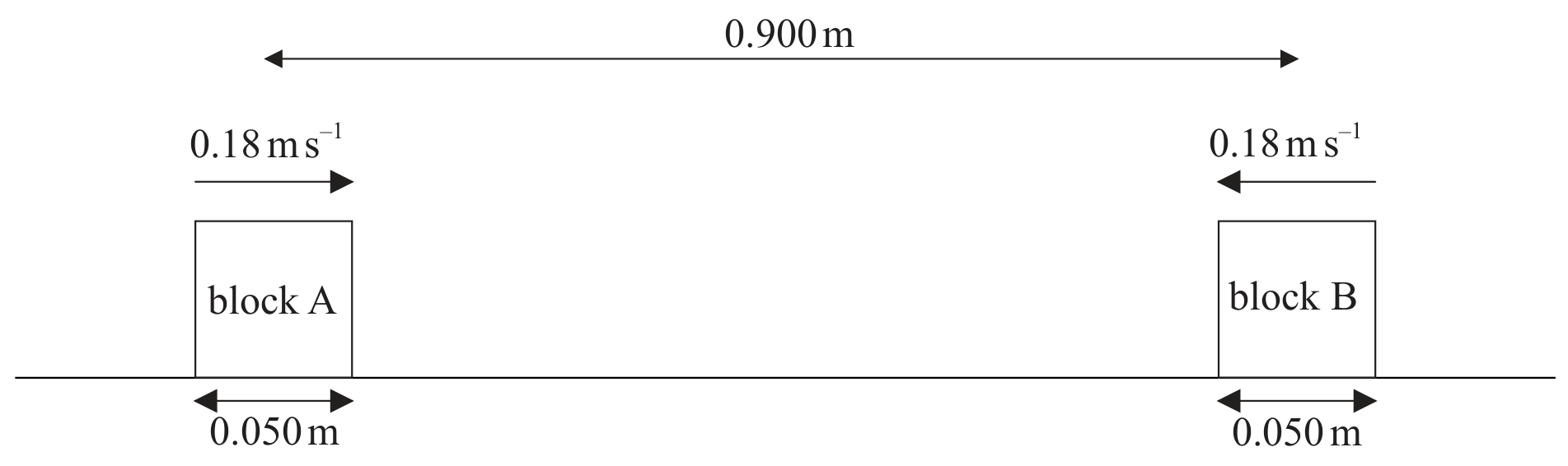
The initial distance between the centres of the blocks is 0.900 m and both blocks are moving at a speed of relative to the surface.
As a result of the collision, the blocks reverse their direction of motion and travel at the same speed as each other. During the collision, 20 % of the kinetic energy of the blocks is given off as thermal energy to the surroundings.
State and explain whether the collision is elastic or inelastic.