EduNinja

IB Physics SLA.1 KinematicsQuestion Bank

Question 1

[Maximum number: 1]

A ball is initially 50 m above the ground. The ball is thrown vertically upwards and takes 5.0 s to reach the ground. Air resistance is negligible.

What is the initial speed of the ball?

A

10 m s110 \mathrm{~m} \mathrm{~s}^{-1}

B

15 m s115 \mathrm{~m} \mathrm{~s}^{-1}

C

25 ms125 \mathrm{~ms}^{-1}

D

35 m s135 \mathrm{~m} \mathrm{~s}^{-1}

Question 1

[Maximum number: 1]

Instantaneous velocity is defined as...

A

 displacement  time taken \frac{\text { displacement }}{\text { time taken }}.

B

rate of change of position.

C

 distance moved  time taken \frac{\text { distance moved }}{\text { time taken }}.

D

rate of change of distance.

Question 1

[Maximum number: 1]

A person walks 40 m due west and then 30 m due north. The total walking time is 100 s . What are the average speed and the magnitude of the average velocity of the person?

Average speed/m s 1{ }^{-1}

Magnitude of average
velocity /ms1/ \mathrm{m} \mathrm{s}^{-1}

0.5

0.5

0.5

0.7

0.7

0.5

0.7

0.7

Question 1

[Maximum number: 2]

A glider is an aircraft with no engine. To be launched, a glider is uniformly accelerated from rest by a cable pulled by a motor that exerts a horizontal force on the glider throughout the launch.

Question image

Question 1(a)

(a)

The glider reaches its launch speed of 27.0 m s127.0 \mathrm{~m} \mathrm{~s}^{-1} after accelerating for 11.0 s . Assume that the glider moves horizontally until it leaves the ground. Calculate the total distance travelled by the glider before it leaves the ground.

[ 2 ]

Question 1

[Maximum number: 2]

An elastic climbing rope is tested by fixing one end of the rope to the top of a crane. The other end of the rope is connected to a block which is initially at position A. The block is released from rest. The mass of the rope is negligible.

Question image

The unextended length of the rope is 60.0 m . From position A to position B, the block falls freely.

Question 1(a)

(a)

At position B the rope starts to extend. Calculate the speed of the block at position B.

[ 2 ]

Question 1

[Maximum number: 2]

A student uses a load to pull a box up a ramp inclined at 3030^{\circ}. A string of constant length and negligible mass connects the box to the load that falls vertically. The string passes over a pulley that runs on a frictionless axle. Friction acts between the base of the box and the ramp. Air resistance is negligible.

Question image

The load has a mass of 3.5 kg and is initially 0.95 m above the floor. The mass of the box is 1.5 kg .
The load is released and accelerates downwards.

Question 1(c)

Question 1(c)(i)

(a)
(i)

Show that the speed of the load when it hits the floor is about 2.1 ms12.1 \mathrm{~ms}^{-1}.

[ 2 ]

Question 1

[Maximum number: 4]

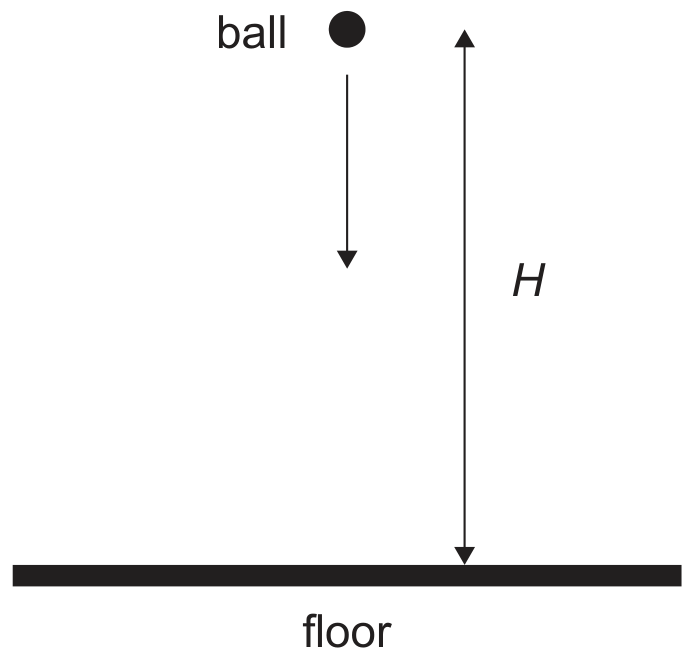
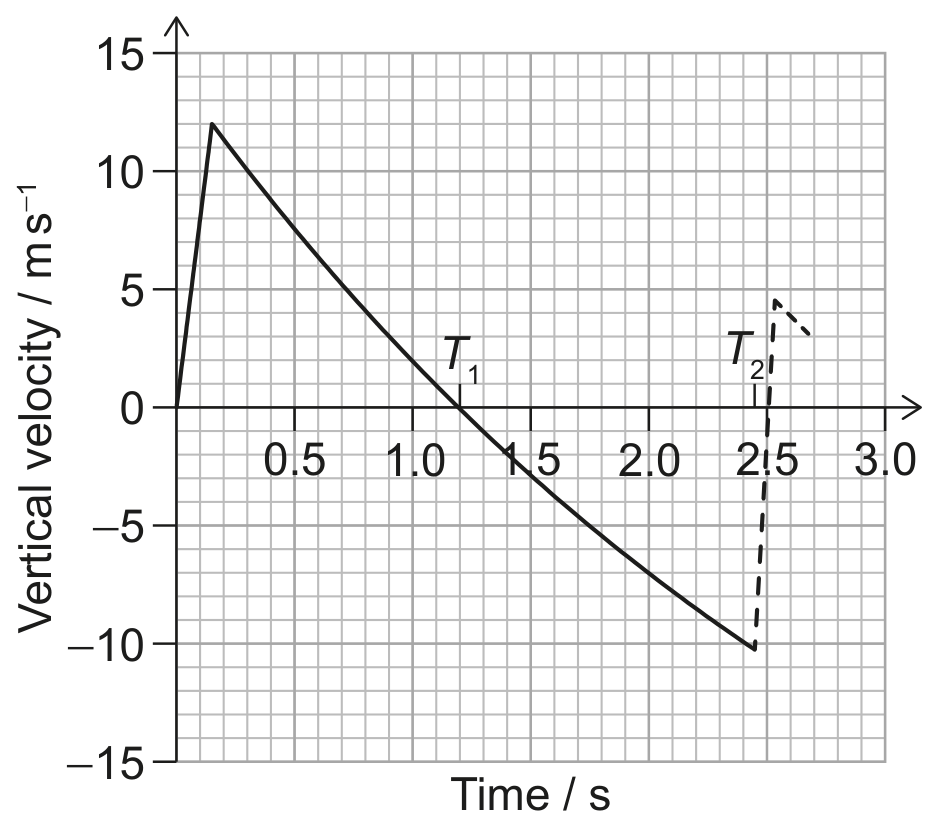
A ball of mass 0.250 kg is released from rest at time t=0, from a height H above a horizontal floor.

Question image

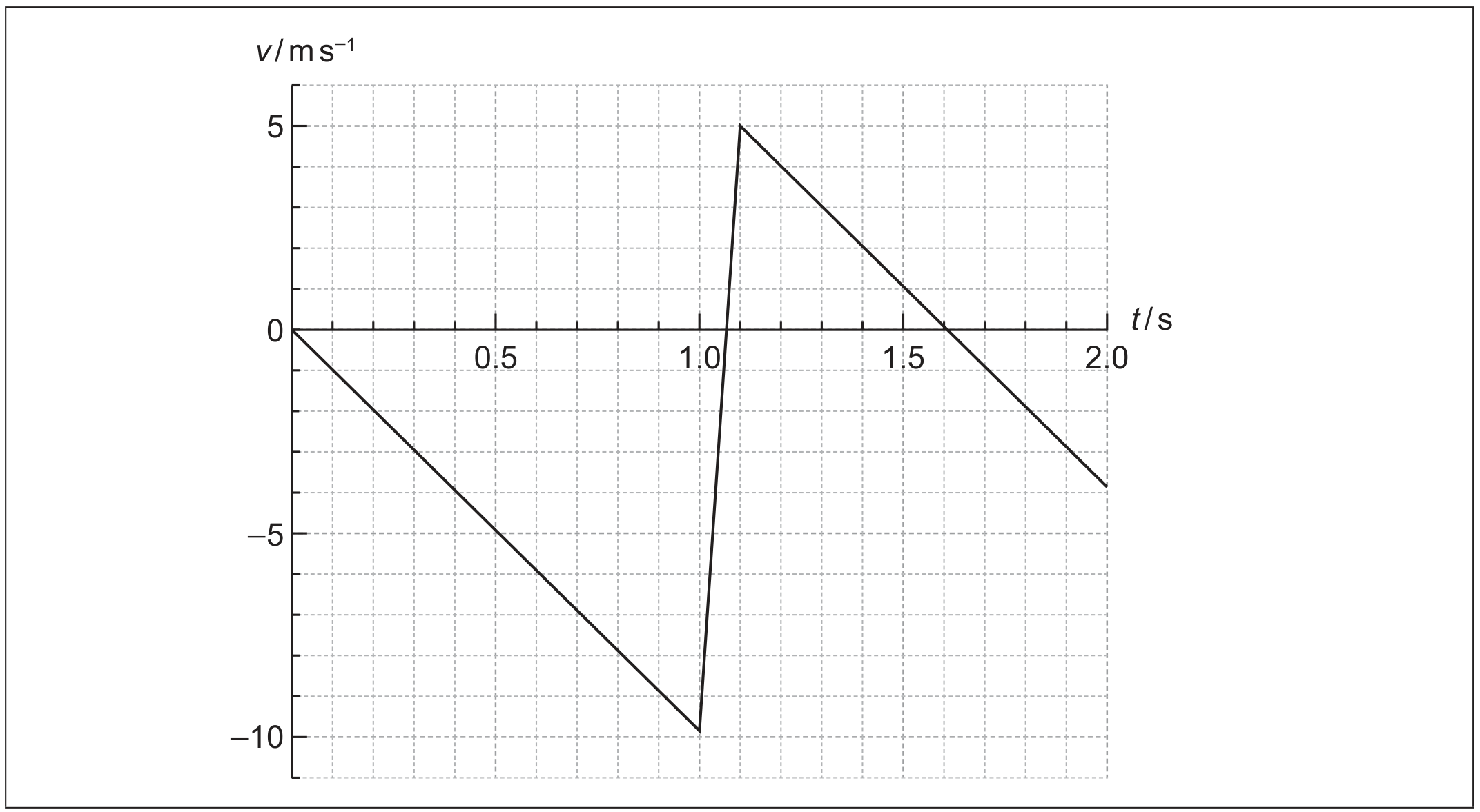
The graph shows the variation with time t of the velocity v of the ball. Air resistance is negligible. Take g=9.80 ms2g=-9.80 \mathrm{~ms}^{-2}. The ball reaches the floor after 1.0 s .

Question image

Question 1(a)

(a)

Determine H.

[ 1 ]

Question 1(b)

Question 1(b)(i)

(b)
(i)

Label the time and velocity graph, using the letter M , the point where the ball reaches the maximum rebound height.

[ 1 ]

Question 1(b)(ii)

(ii)

State the acceleration of the ball at the maximum rebound height.

[ 1 ]

Question 1(b)(iii)

(iii)

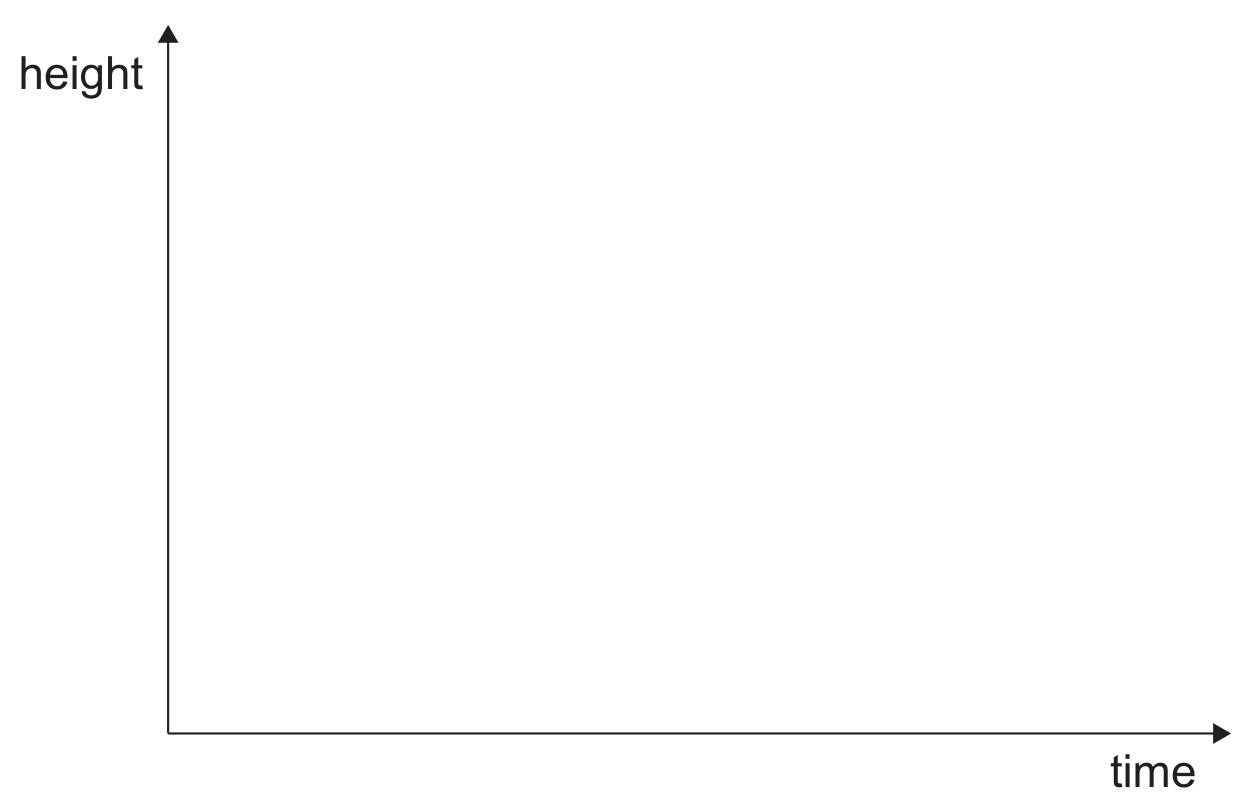
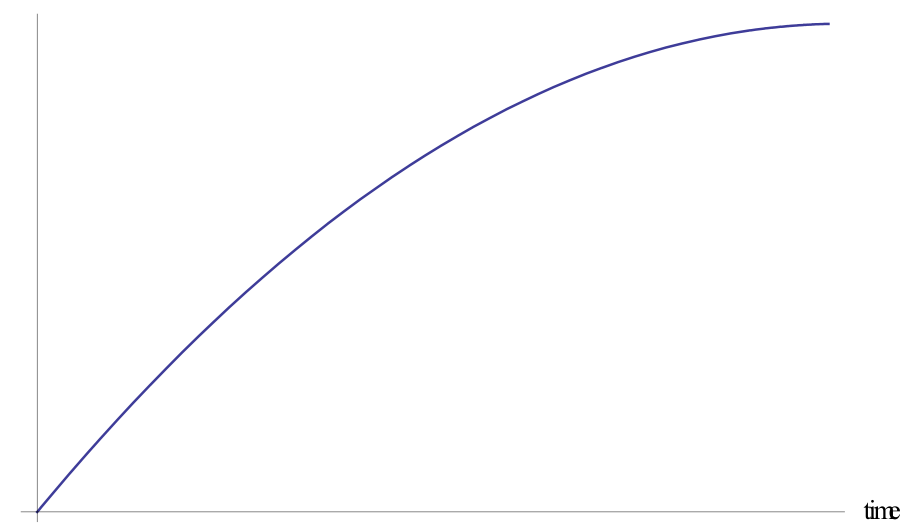
Draw, on the axes, a graph to show the variation with time of the height of the ball from the instant it rebounds from the floor until the instant it reaches the maximum rebound height. No numbers are required on the axes.

Question image
[ 1 ]

Question 1

[Maximum number: 1]

A car decelerates uniformly to rest. From an initial velocity v to a velocity v2\frac{v}{2}, it covers a distance d. How much further does it travel before coming to rest?

A

d4\frac{d}{4}

B

d3\frac{d}{3}

C

d2\frac{d}{2}

D

d

Question 1

[Maximum number: 2]

A space probe of mass 95 kg is designed to land on the surface of an asteroid. The gravitational field strength g of the asteroid at its surface is 2.7×10³ ms22.7 \times 10^{-3} \mathrm{~ms}^{-2}.

Question 1(d)

(a)

As the probe lands, a small stone resting on a rock on the asteroid's surface is projected horizontally from the top of the rock. The horizontal speed of the stone is 34 m s134 \mathrm{~m} \mathrm{~s}^{-1} from a height of 1.9 m above the surface of the asteroid.

Question image

Estimate the horizontal distance from the stone's point of projection along the line AB at which the stone lands. Ignore the curvature of the asteroid.

[ 2 ]

Question 1

[Maximum number: 6]

Two players are playing table tennis. Player A hits the ball at a height of 0.24 m above the edge of the table, measured from the top of the table to the bottom of the ball. The initial speed of the ball is 12.0 ms112.0 \mathrm{~ms}^{-1} horizontally. Assume that air resistance is negligible.

Question image

Question 1(a)

(a)

Show that the time taken for the ball to reach the surface of the table is about 0.2 s .

[ 1 ]

Question 1(b)

(b)

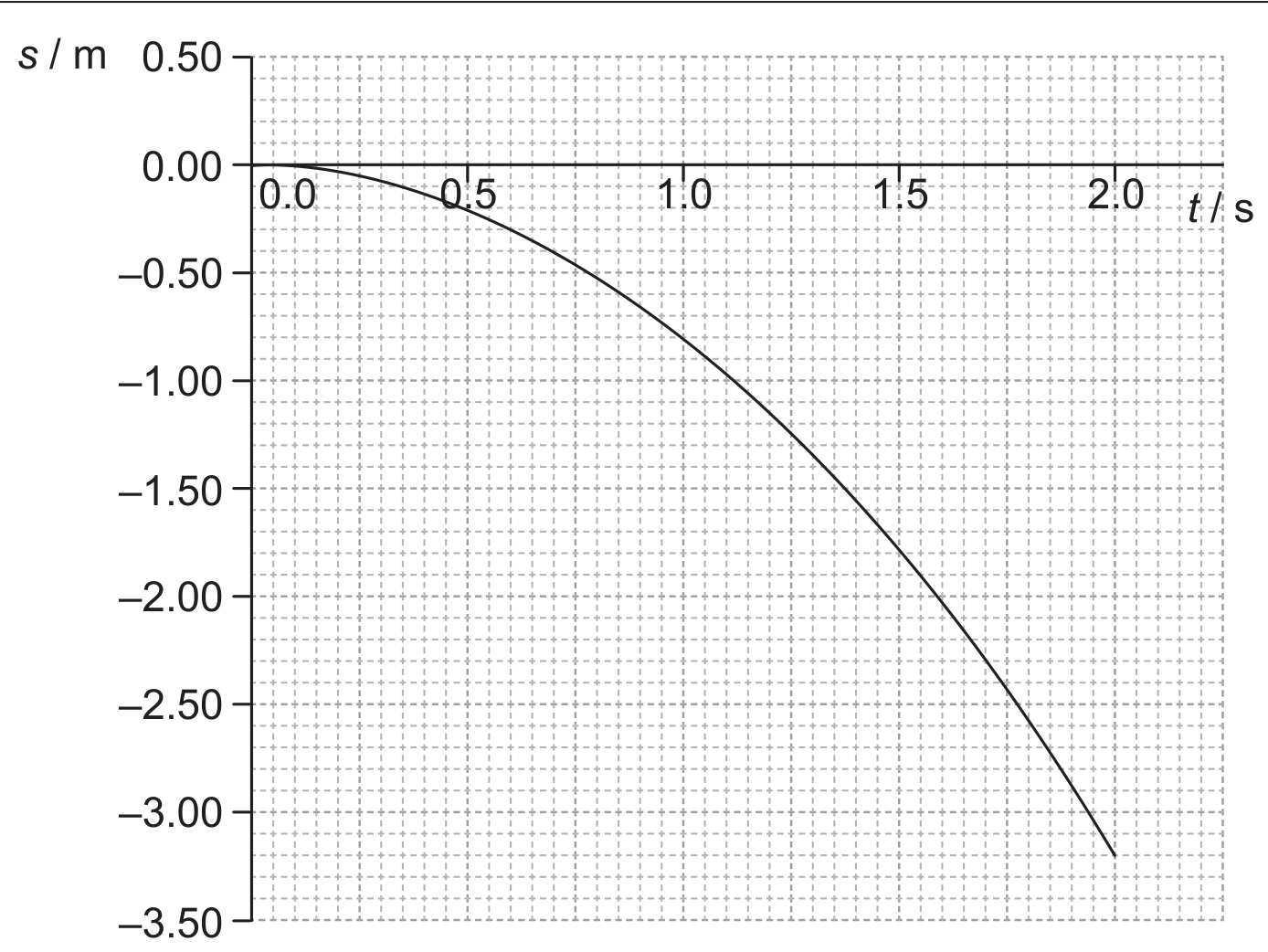
Sketch, on the axes, a graph showing the variation with time of the vertical component of velocity vvv_{v} of the ball until it reaches the table surface. Take g to be +10 ms2+10 \mathrm{~ms}^{-2}.

Question image
[ 2 ]

Question 1(c)

(c)

The net is stretched across the middle of the table. The table has a length of 2.74 m and the net has a height of 15.0 cm .

Show that the ball will go over the net.

[ 3 ]
0 selected