Question 4(d)(i)
[Maximum number: 1]
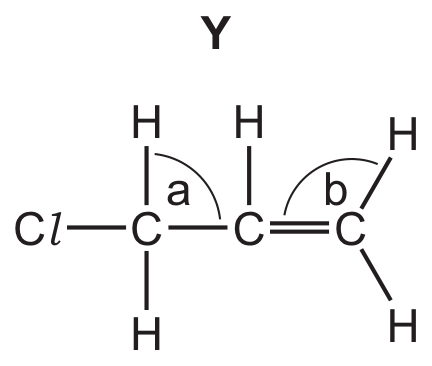
The structure of compound Y is shown.
Samples of organic compounds, A, B, C and D, are placed in unlabelled bottles.
A
B
C
D
Identify all of the compound(s), A-D, that contain a carbonyl group.
 EduNinja
Practise reading syllabus organic notation and recognising functional groups from displayed, structural or skeletal formulae.
The structure of compound Y is shown.
Samples of organic compounds, A, B, C and D, are placed in unlabelled bottles.
A
B
C
D
Identify all of the compound(s), A-D, that contain a carbonyl group.
1,3-dichloropropan-2-ol can be made by reacting M.
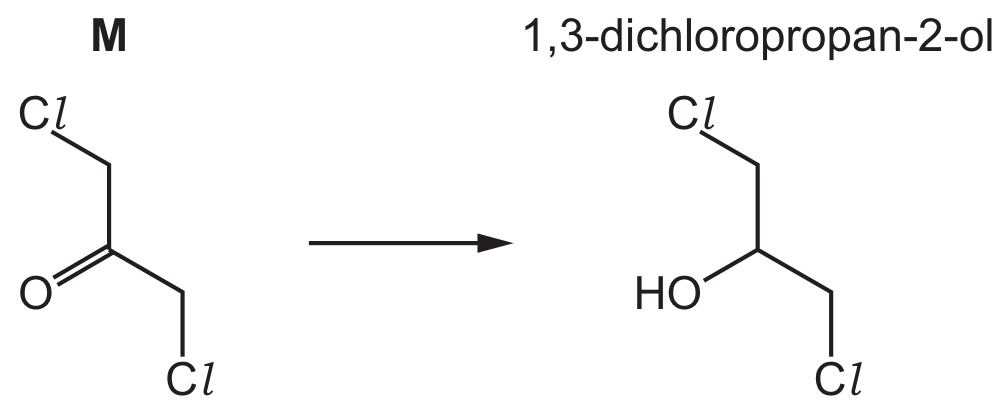
Name the functional group present in M that changes during this reaction.
Compound W has molecular formula . It contains only one functional group.
Y is a structural isomer of W.
Both W and Y produce colourless bubbles when sodium is added to them.
Y does not react when heated with acidified .
Y does not react when warmed with alkaline .
Name the functional group present in Y.
Compound V is a liquid.
V contains 77.2 % carbon, 11.4 % hydrogen and 11.4 % oxygen by mass.
V has a relative molecular mass of 280 .
W, X and Y have the same molecular formula, .
W, X and Y are added separately to different reagents. Observations for these reactions are described in Table 4.1.

Table 4.1
W, X and Y each contain a common functional group.
Name the functional group that is present in all three compounds.
V shows stereoisomerism.
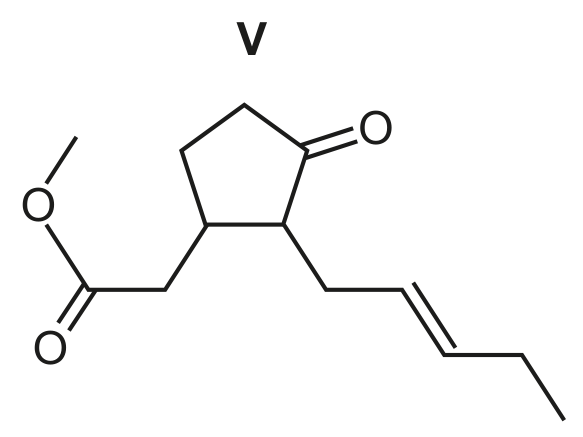
Fig. 6.1
Name all the functional groups present in V.
A and B are structural isomers with molecular formula .
They are both straight-chained molecules with only one functional group.
Table 5.1 describes observations when separate samples of A and B are added to different reagents.
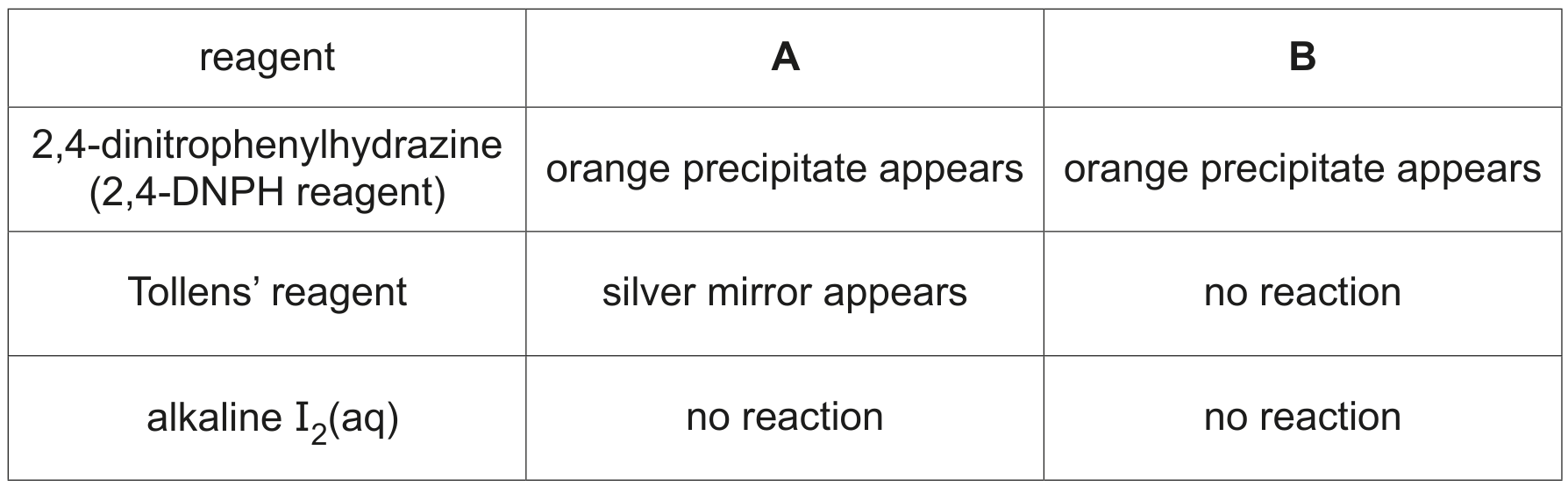
Table 5.1
Name the functional group present in both A and B.
D reacts in the presence of a sulfuric acid catalyst to form E and water.
The structure of E is shown in Fig. 5.1.
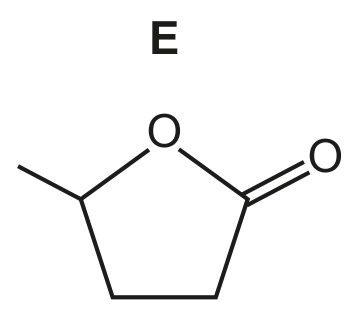
Fig. 5.1
Name the functional group present in E.
Three bottles of colourless liquids labelled F, G and H contain separate pure samples of the compounds ethanal, propanal or propanone but not necessarily in that order.
State the functional group in ethanal, propanal and propanone.