EduNinja

A-Level CAIE Chemistry AS8.1 Rate of reactionQuestion Bank

Question 1

[Maximum number: 2]

Calcium, magnesium and radium are Group 2 elements. Radium follows the same trends as the other members of Group 2.

Question 1(g)

(a)

Cold water reacts slowly with a piece of Mg to produce bubbles of H2( g)\mathrm{H}_{2}(\mathrm{~g}). Cold water reacts rapidly with burning Mg to produce H2( g)\mathrm{H}_{2}(\mathrm{~g}) in an explosive mixture.

Mg+2H2OMg(OH)2+H2\mathrm{Mg}+2 \mathrm{H}_{2} \mathrm{O} \rightarrow \mathrm{Mg}(\mathrm{OH})_{2}+\mathrm{H}_{2}

Explain why the rate of reaction of cold water with burning magnesium is greater.

[ 2 ]

Question 1

[Maximum number: 3]

The elements sodium to chlorine, in the third period, all form oxides.

Question 1(c)

(a)

SO3\mathrm{SO}_{3} is produced by the reaction between SO2\mathrm{SO}_{2} and O2\mathrm{O}_{2} in the Contact process. A dynamic equilibrium is established.

2SO2( g)+O2( g)2SO3( g)ΔH=196 kJ mol12 \mathrm{SO}_{2}(\mathrm{~g})+\mathrm{O}_{2}(\mathrm{~g}) \rightleftharpoons 2 \mathrm{SO}_{3}(\mathrm{~g}) \quad \Delta H=-196 \mathrm{~kJ} \mathrm{~mol}^{-1}
[ 3 ]

Question 1(c)(ii)

(i)

Explain why the gradients of the SO2\mathrm{SO}_{2} and O2\mathrm{O}_{2} lines decrease with time.

[ 2 ]

Question 1(c)(iv)

(ii)

Suggest a reason why the initial gradient of the SO2\mathrm{SO}_{2} line is steeper than that of the O2\mathrm{O}_{2} line.

[ 1 ]

Question 1

[Maximum number: 3]

Sulfuric acid is manufactured by the Contact process.
One stage in this process is the conversion of sulfur dioxide into sulfur trioxide in the presence of a heterogeneous catalyst of vanadium(V) oxide, V2O5\mathrm{V}_{2} \mathrm{O}_{5}.

Question image

Question 1(d)

Question 1(d)(i)

(a)
(i)

State and explain the effect of increasing temperature on the rate of production of SO3\mathrm{SO}_{3}.

[ 3 ]

Question 1

[Maximum number: 1]

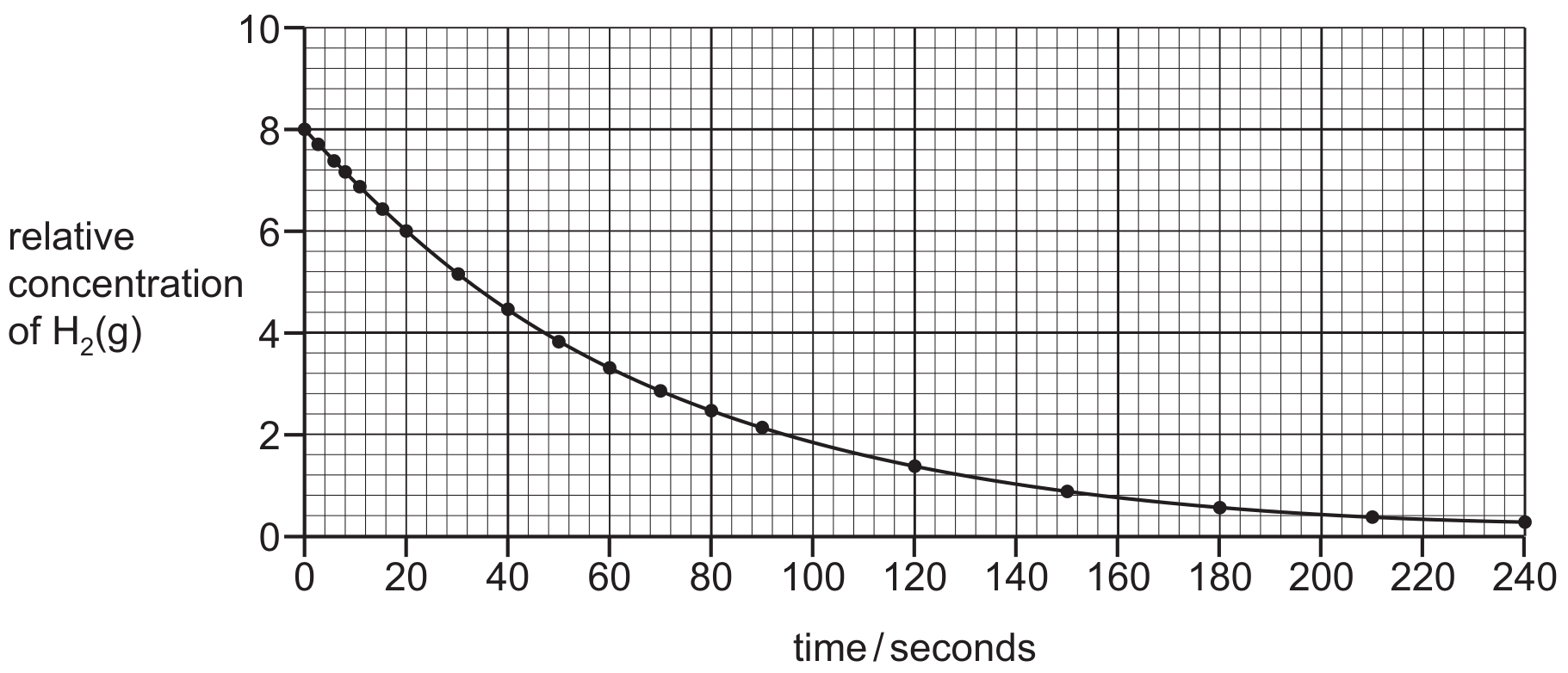
The rate of the reaction H2( g)+I2( g)2HI(g)\mathrm{H}_{2}(\mathrm{~g})+\mathrm{I}_{2}(\mathrm{~g}) \rightleftharpoons 2 \mathrm{HI}(\mathrm{g}) is studied.

Question 1(a)

(a)

A small amount of H2( g)\mathrm{H}_{2}(\mathrm{~g}) is mixed with a large excess of I2( g)\mathrm{I}_{2}(\mathrm{~g}) at a temperature of 400 K and the reaction is monitored. The graph obtained is shown.

Question image
[ 1 ]

Question 1(a)(i)

(i)

Suggest why a large excess of I2( g)\mathrm{I}_{2}(\mathrm{~g}) is used in this experiment.

[ 1 ]

Question 1

[Maximum number: 12]

Hydrazine, N2H4\mathrm{N}_{2} \mathrm{H}_{4}, can be used as a rocket fuel and is stored as a liquid. It reacts exothermically with oxygen to give only gaseous products.

The enthalpy change of a reaction such as that between hydrazine and oxygen may be calculated by using standard enthalpy changes of formation.

Question 1(b)

(a)

Hydrazine reacts with oxygen according to the following equation.

N2H4(l)+O2( g)N2( g)+2H2O( g)\mathrm{N}_{2} \mathrm{H}_{4}(\mathrm{l})+\mathrm{O}_{2}(\mathrm{~g}) \rightarrow \mathrm{N}_{2}(\mathrm{~g})+2 \mathrm{H}_{2} \mathrm{O}(\mathrm{~g})

Question 1(b)(ii)

(i)

Although the above reaction is highly exothermic, hydrazine does not burn spontaneously in oxygen.
Suggest a reason for this.

Question 3

[Maximum number: 1]

A student carries out four experiments to investigate the rate of reaction between 3.0 g of calcium carbonate and hydrochloric acid.

CaCO3( s)+2HCl(aq)CaCl2(aq)+CO2( g)+H2O(l)\mathrm{CaCO}_{3}(\mathrm{~s})+2 \mathrm{HCl}(\mathrm{aq}) \rightarrow \mathrm{CaCl}_{2}(\mathrm{aq})+\mathrm{CO}_{2}(\mathrm{~g})+\mathrm{H}_{2} \mathrm{O}(\mathrm{l})

experiment 1CaCO31 \quad \mathrm{CaCO}_{3} powder +2.0moldm3HCl+2.0 \mathrm{moldm}^{-3} \mathrm{HCl} at 35C35^{\circ} \mathrm{C}
experiment 2CaCO32 \mathrm{CaCO}_{3} powder +2.0moldm3HCl+2.0 \mathrm{moldm}^{-3} \mathrm{HCl} at 35C35^{\circ} \mathrm{C}
experiment 3 large chips of CaCO3+1.0moldm3HCl\mathrm{CaCO}_{3}+1.0 \mathrm{moldm}^{-3} \mathrm{HCl} at room temperature
experiment 4 large chips of CaCO3+1.0moldm3HCl\mathrm{CaCO}_{3}+1.0 \mathrm{moldm}^{-3} \mathrm{HCl} at 35C35^{\circ} \mathrm{C}

The student collects the CO2( g)\mathrm{CO}_{2}(\mathrm{~g}) and times how long it takes to produce the same volume of gas for each experiment.

What could be the correct times for the four experiments?

experiment 1 /s

experiment 2 /s

experiment 3 /s

experiment 4 /s

5

10

30

95

5

10

95

30

5

30

95

10

95

30

10

5

Question 5

[Maximum number: 1]

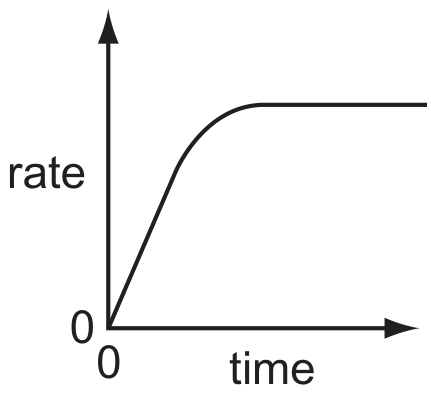
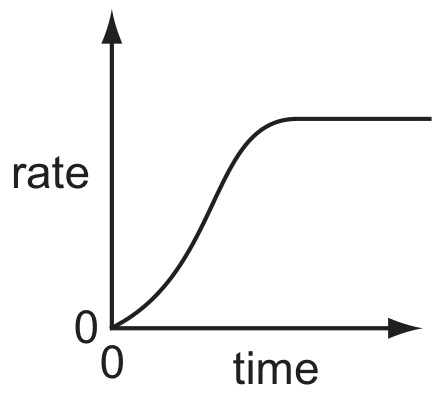
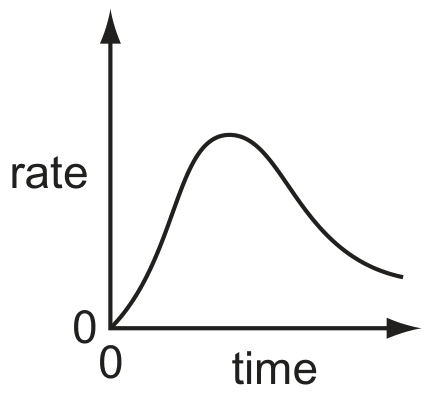
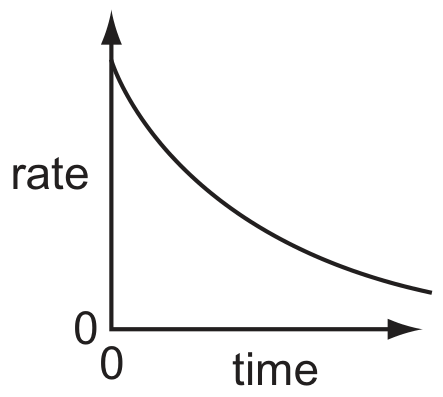
An autocatalytic reaction is a reaction in which one of the products catalyses the reaction.
Which curve was obtained if the rate of reaction was plotted against time for an autocatalytic reaction?

A
Question image
B
Question image
C
Question image
D
Question image

Question 5

[Maximum number: 1]

Na2 S2O3\mathrm{Na}_{2} \mathrm{~S}_{2} \mathrm{O}_{3} reacts with dilute HCl to give a pale yellow precipitate. If 1 cm31 \mathrm{~cm}^{3} of 0.1moldm3HCl0.1 \mathrm{moldm}^{-3} \mathrm{HCl} is added to 10 cm310 \mathrm{~cm}^{3} of 0.02 moldm3Na2 S2O30.02 \mathrm{~mol} \mathrm{dm}^{-3} \mathrm{Na}_{2} \mathrm{~S}_{2} \mathrm{O}_{3} the precipitate forms slowly.

If the experiment is repeated with 1 cm31 \mathrm{~cm}^{3} of 0.1 moldm3HCl0.1 \mathrm{~mol} \mathrm{dm}^{-3} \mathrm{HCl} and 10 cm310 \mathrm{~cm}^{3} of 0.05moldm3Na2 S2O30.05 \mathrm{moldm}^{-3} \mathrm{Na}_{2} \mathrm{~S}_{2} \mathrm{O}_{3} the precipitate forms more quickly.

Why is this?

A

The activation energy of the reaction is lower when 0.05moldm3Na2 S2O30.05 \mathrm{moldm}^{-3} \mathrm{Na}_{2} \mathrm{~S}_{2} \mathrm{O}_{3} is used.

B

The collisions between reactant particles are more violent when 0.05moldm3Na2 S2O30.05 \mathrm{moldm}^{-3} \mathrm{Na}_{2} \mathrm{~S}_{2} \mathrm{O}_{3} is used.

C

The reactant particles collide more frequently when 0.05moldm3Na2 S2O30.05 \mathrm{moldm}^{-3} \mathrm{Na}_{2} \mathrm{~S}_{2} \mathrm{O}_{3} is used.

D

The reaction proceeds by a different pathway when 0.05moldm3Na2 S2O30.05 \mathrm{moldm}^{-3} \mathrm{Na}_{2} \mathrm{~S}_{2} \mathrm{O}_{3} is used.

Question 5

[Maximum number: 1]

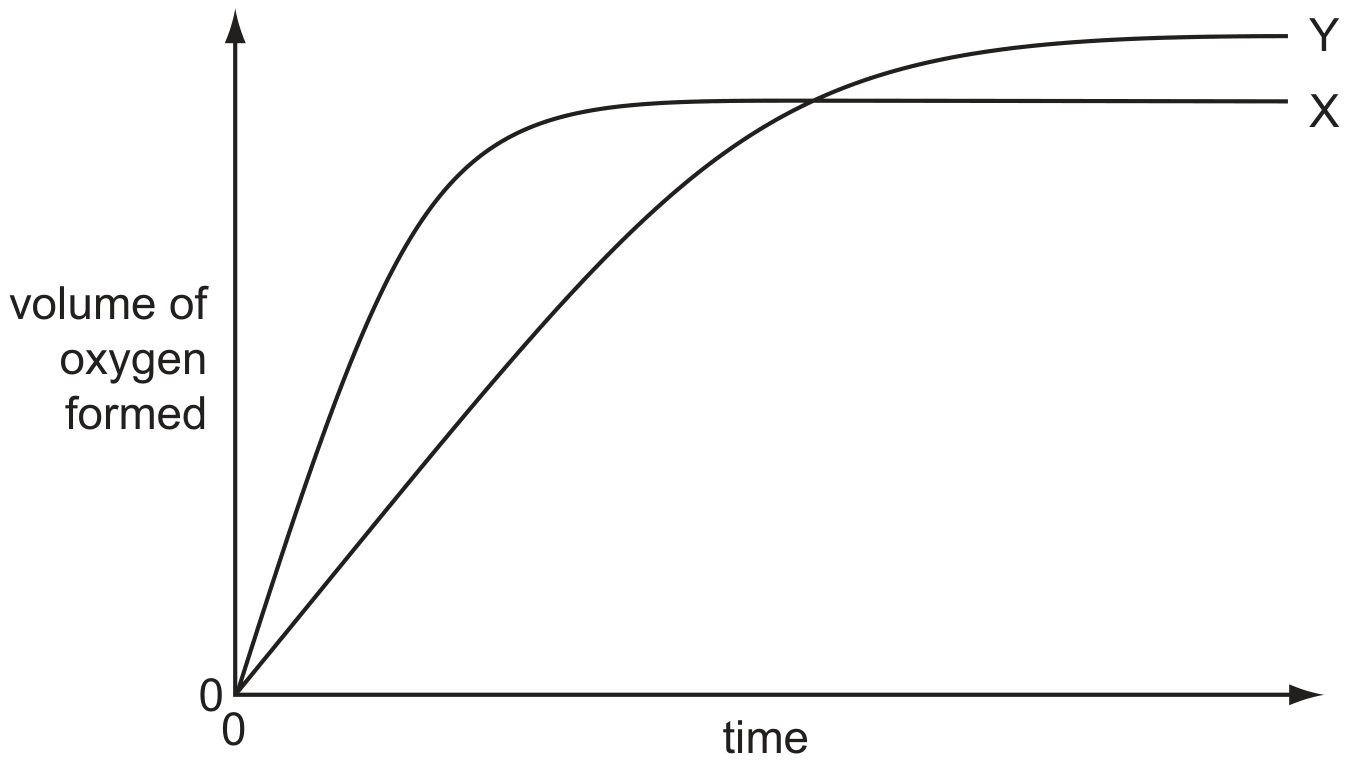
In the diagram, curve X was obtained by observing the decomposition of 100 cm3100 \mathrm{~cm}^{3} of 1.0 moldm31.0 \mathrm{~mol} \mathrm{dm}^{-3} hydrogen peroxide, catalysed by manganese(IV) oxide.

Question image

Which alteration to the original experimental conditions would produce curve Y ?

A

adding more manganese(IV) oxide

B

adding some 0.1 moldm30.1 \mathrm{~mol} \mathrm{dm}^{-3} hydrogen peroxide

C

adding water

D

raising the temperature

Question 6

[Maximum number: 1]

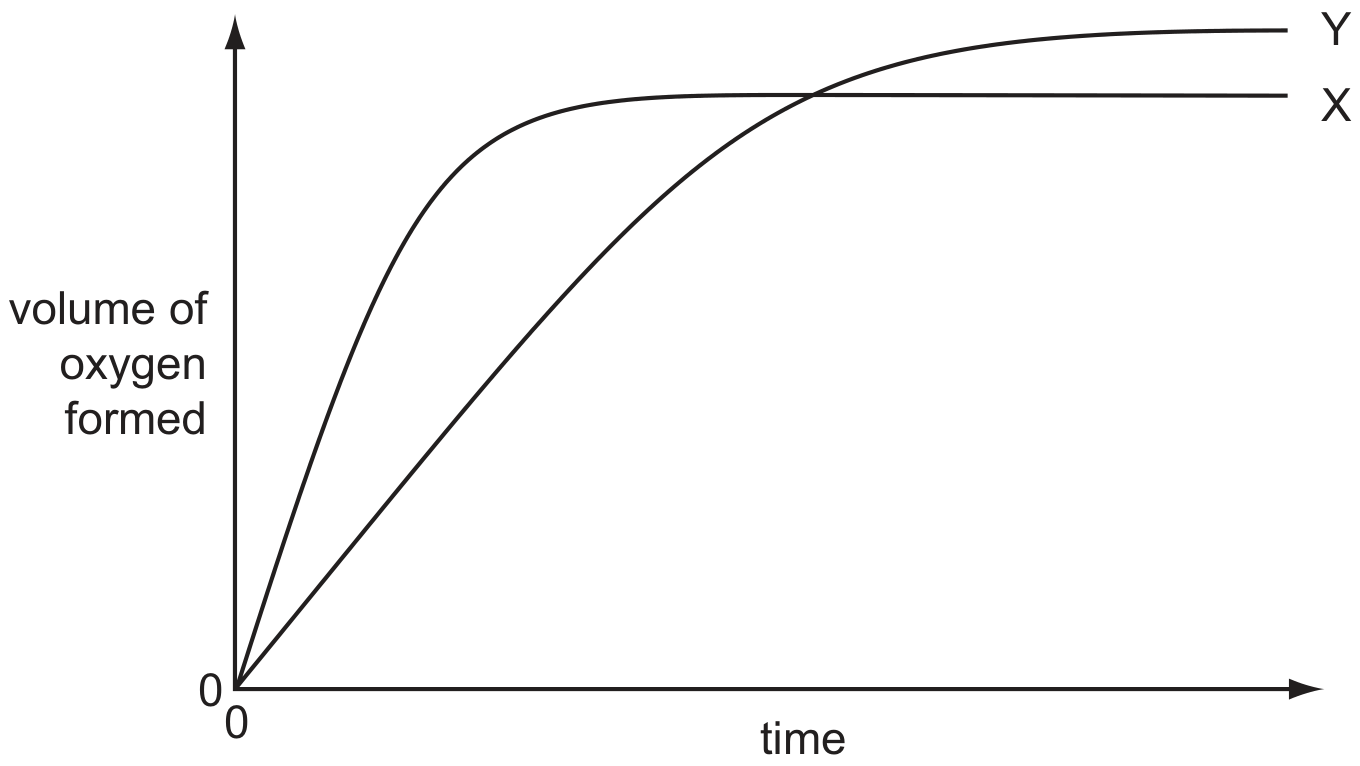
In the diagram, curve X was obtained by observing the decomposition of 100 cm3100 \mathrm{~cm}^{3} of 1.0 moldm31.0 \mathrm{~mol} \mathrm{dm}^{-3} hydrogen peroxide, catalysed by manganese(IV) oxide.

Question image

Which alteration to the original experimental conditions would produce curve Y ?

A

adding some 0.1 moldm30.1 \mathrm{~mol} \mathrm{dm}^{-3} hydrogen peroxide

B

adding water

C

lowering the temperature

D

using less manganese(IV) oxide

0 selected