EduNinja

A-Level CAIE Chemistry AS7.1 Chemical equilibria and dynamic equilibriumQuestion Bank

Question 1

Question 1(c)

(a)

Consider the following two equilibria and associated data values at 298 K .

AgBr( s)Ag+(aq)+Br(aq) equilibrium 1Ksp=5.0×10¹³ mol2dm6Ag+(aq)+2NH3(aq)[Ag(NH3)2]+(aq) equilibrium 2Kstab =1.7×10⁷ mol2dm6\begin{array}{ccc} \mathrm{AgBr}(\mathrm{~s}) \rightleftharpoons \mathrm{Ag}^{+}(\mathrm{aq})+\mathrm{Br}^{-}(\mathrm{aq}) & \text { equilibrium } 1 \quad K_{\mathrm{sp}}=5.0 \times 10^{-13} \mathrm{~mol}^{2} \mathrm{dm}^{-6} \\ \mathrm{Ag}^{+}(\mathrm{aq})+2 \mathrm{NH}_{3}(\mathrm{aq}) \rightleftharpoons\left[\mathrm{Ag}\left(\mathrm{NH}_{3}\right)_{2}\right]^{+}(\mathrm{aq}) & \text { equilibrium } 2 \quad K_{\text {stab }}=1.7 \times 10^{7} \mathrm{~mol}^{-2} \mathrm{dm}^{6} \end{array}

The equilibrium constant for equilibrium 1 is the solubility product, KspK_{\mathrm{sp}}, of AgBr(s). The equilibrium constant for equilibrium 2 is the stability constant, Kstab K_{\text {stab }}, for the formation of [Ag(NH3)2]+(aq)\left[\mathrm{Ag}\left(\mathrm{NH}_{3}\right)_{2}\right]^{+}(\mathrm{aq}).

[ 2 ]

Question 1(c)(ii)

(i)

Use Le Chatelier's principle as applied to equilibria 1 and 2 to suggest why AgBr(s)\operatorname{AgBr}(\mathbf{s}) dissolves in concentrated NH3(aq)\mathrm{NH}_{3}(\mathrm{aq}).

[ 2 ]

Question 1

[Maximum number: 11]

The elements sodium to chlorine, in the third period, all form oxides.

Question 1(c)

(a)

SO3\mathrm{SO}_{3} is produced by the reaction between SO2\mathrm{SO}_{2} and O2\mathrm{O}_{2} in the Contact process. A dynamic equilibrium is established.

2SO2( g)+O2( g)2SO3( g)ΔH=196 kJ mol12 \mathrm{SO}_{2}(\mathrm{~g})+\mathrm{O}_{2}(\mathrm{~g}) \rightleftharpoons 2 \mathrm{SO}_{3}(\mathrm{~g}) \quad \Delta H=-196 \mathrm{~kJ} \mathrm{~mol}^{-1}
[ 5 ]

Question 1(c)(i)

(i)

Explain why increasing the total pressure, at constant temperature, increases the rate of production of SO3\mathrm{SO}_{3} and increases the yield of SO3\mathrm{SO}_{3}.
rate
yield

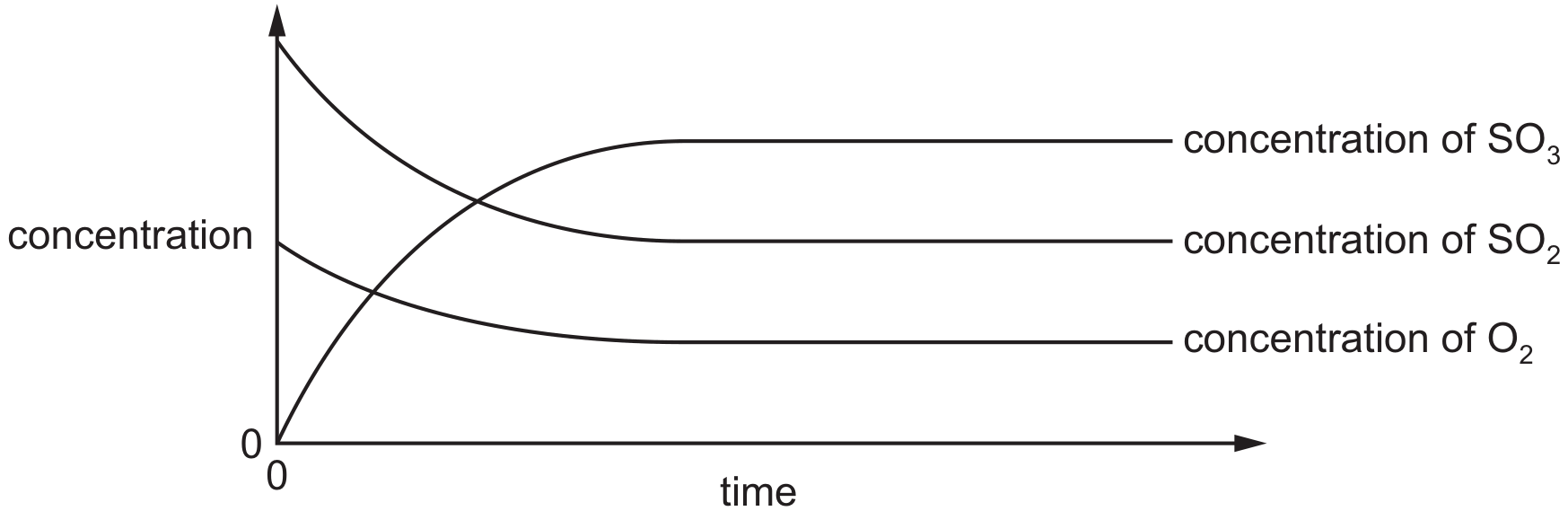
The graph shows how the concentrations of all three species in the system change with time for a typical reaction mixture. The gradients of all three lines decrease with time and then level off in this dynamic equilibrium.

Question image
[ 4 ]

Question 1(c)(iii)

(ii)

Explain why all three lines become horizontal.

[ 1 ]

Question 1(d)

(b)

2.00 moles of SO2( g)\mathrm{SO}_{2}(\mathrm{~g}) and 2.00 moles of O2( g)\mathrm{O}_{2}(\mathrm{~g}) are sealed in a container with a suitable catalyst, at constant temperature and pressure. The resulting equilibrium mixture contains 1.98 moles of SO3( g)\mathrm{SO}_{3}(\mathrm{~g}).
The total volume of the equilibrium mixture is 40.0dm340.0 \mathrm{dm}^{3}.

2SO2( g)+O2( g)2SO3( g)2 \mathrm{SO}_{2}(\mathrm{~g})+\mathrm{O}_{2}(\mathrm{~g}) \rightleftharpoons 2 \mathrm{SO}_{3}(\mathrm{~g})
[ 6 ]

Question 1(d)(i)

(i)

Write the expression for the equilibrium constant, KcK_{\mathrm{c}}, for the reaction between SO2( g)\mathrm{SO}_{2}(\mathrm{~g}) and O2( g)\mathrm{O}_{2}(\mathrm{~g}) to produce SO3( g)\mathrm{SO}_{3}(\mathrm{~g}).

Kc=K_{c}=
[ 1 ]

Question 1(d)(ii)

(ii)

Calculate the amount, in moles, of SO2( g)\mathrm{SO}_{2}(\mathrm{~g}) and O2( g)\mathrm{O}_{2}(\mathrm{~g}) in the equilibrium mixture.

SO2( g)=..molO2( g)=..mol\begin{array}{r} \mathrm{SO}_{2}(\mathrm{~g})=\ldots \ldots \ldots \ldots \ldots \ldots \ldots \ldots \ldots \ldots . . \mathrm{mol} \\ \mathrm{O}_{2}(\mathrm{~g})=\ldots \ldots \ldots \ldots \ldots \ldots \ldots \ldots \ldots \ldots . . \mathrm{mol} \end{array}
[ 2 ]

Question 1(d)(iii)

(iii)

Use your answers to (d)(i) and (d)(ii) to calculate the value of KcK_{\mathrm{c}} for this equilibrium mixture. Give the units of KcK_{\mathrm{c}}.

Kc= units =\begin{array}{r} K_{\mathrm{c}}= \\ \text { units }= \end{array}
[ 3 ]

Question 1

[Maximum number: 3]

Sulfuric acid is manufactured by the Contact process.
One stage in this process is the conversion of sulfur dioxide into sulfur trioxide in the presence of a heterogeneous catalyst of vanadium(V) oxide, V2O5\mathrm{V}_{2} \mathrm{O}_{5}.

Question image

Question 1(d)

Question 1(d)(ii)

(a)
(i)

State and explain the effect of increasing temperature on the yield of SO3\mathrm{SO}_{3}.

[ 3 ]

Question 1

[Maximum number: 10]

Ammonia, NH3\mathrm{NH}_{3}, is manufactured from nitrogen and hydrogen by the Haber process.

N2( g)+3H2( g)2NH3( g)ΔH=92 kJ mol1\mathrm{N}_{2}(\mathrm{~g})+3 \mathrm{H}_{2}(\mathrm{~g}) \rightleftharpoons 2 \mathrm{NH}_{3}(\mathrm{~g}) \quad \Delta H=-92 \mathrm{~kJ} \mathrm{~mol}^{-1}

Question 1(b)

(a)

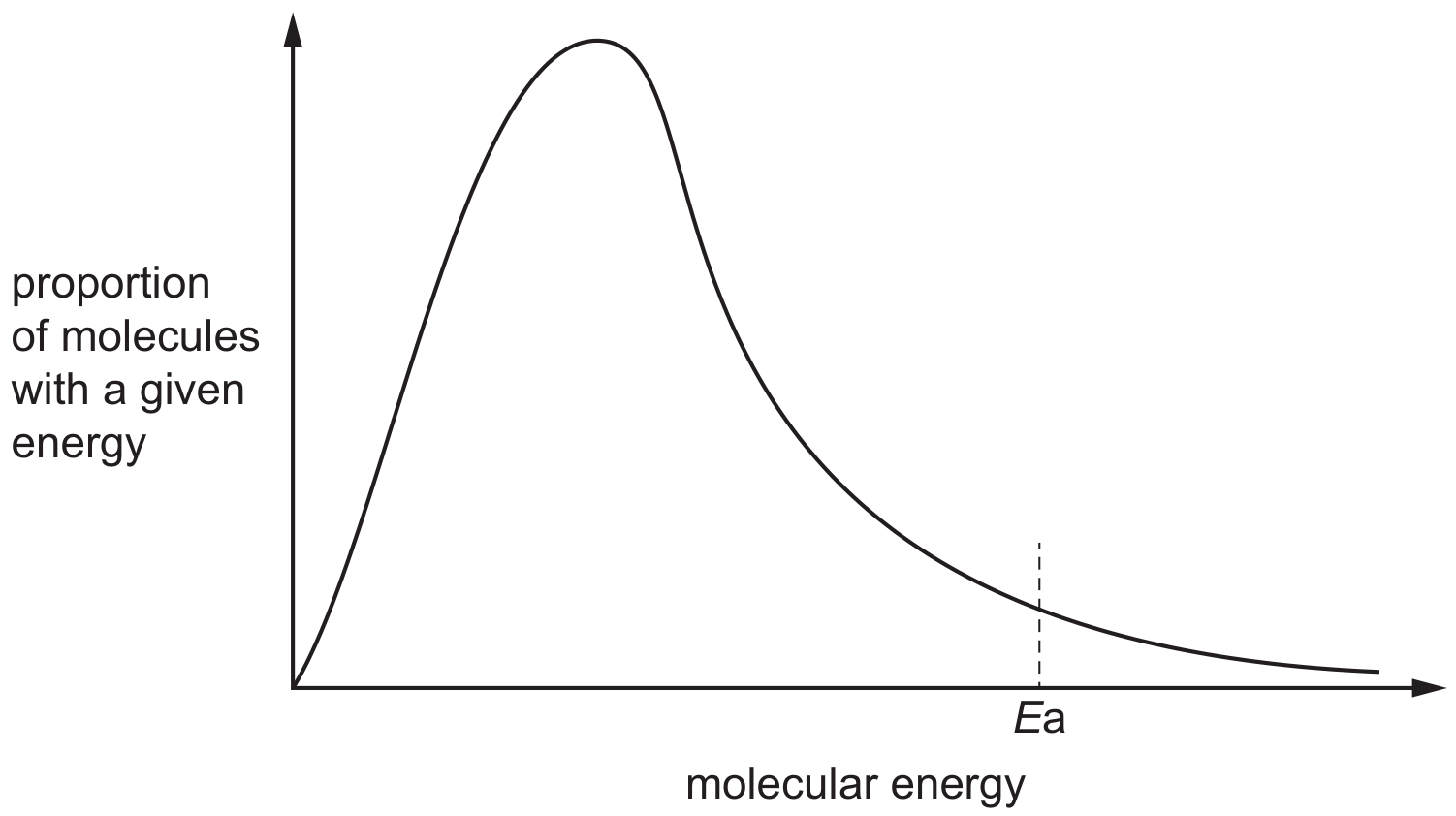
The Haber process is usually carried out at a temperature of approximately 400C400^{\circ} \mathrm{C} in the presence of a catalyst. Changing the temperature affects both the rate of production of ammonia and the yield of ammonia.

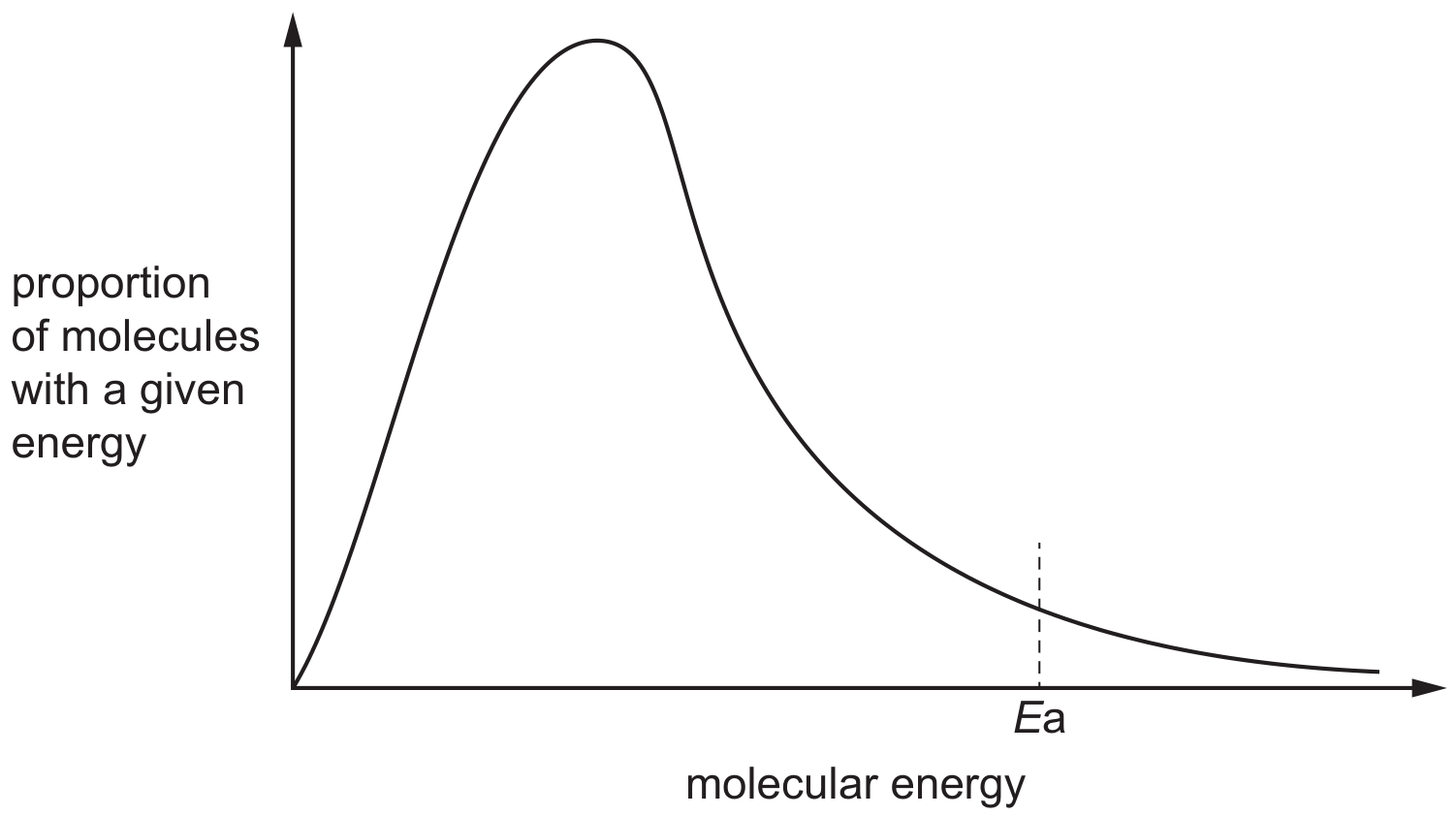
The Boltzmann distribution for a mixture of nitrogen and hydrogen at 400C400^{\circ} \mathrm{C} is shown. Ea represents the activation energy for the reaction.

Question image
[ 3 ]

Question 1(b)(iii)

(i)

State and explain the effect of increasing temperature on the yield of ammonia. Use Le Chatelier's principle to explain your answer.

[ 3 ]

Question 1(c)

(b)

At a pressure of 2.00×10⁷ Pa,1.00 mol2.00 \times 10^{7} \mathrm{~Pa}, 1.00 \mathrm{~mol} of nitrogen, N2( g)\mathrm{N}_{2}(\mathrm{~g}), was mixed with 3.00 mol of hydrogen, H2( g)\mathrm{H}_{2}(\mathrm{~g}). The final equilibrium mixture formed contained 0.300 mol of ammonia, NH3( g)\mathrm{NH}_{3}(\mathrm{~g}).

[ 2 ]

Question 1(c)(i)

(i)

Calculate the amounts, in mol, of N2( g)\mathrm{N}_{2}(\mathrm{~g}) and H2( g)\mathrm{H}_{2}(\mathrm{~g}) in the equilibrium mixture.

N2( g)=. mol H2( g)=.. mol \begin{aligned} & \mathrm{N}_{2}(\mathrm{~g})=\ldots \ldots \ldots \ldots \ldots \ldots \ldots \ldots \ldots \ldots . \text { mol } \\ & \mathrm{H}_{2}(\mathrm{~g})=\ldots \ldots \ldots \ldots \ldots \ldots \ldots \ldots \ldots . . \text { mol } \end{aligned}
[ 2 ]

Question 1(c)(ii)

(ii)

Calculate the partial pressure of ammonia, pNH3\mathrm{pNH}_{3}, in the equilibrium mixture.

Give your answer to three significant figures.

pNH3=p \mathrm{NH}_{3}=

Pa

Question 1(d)

(c)

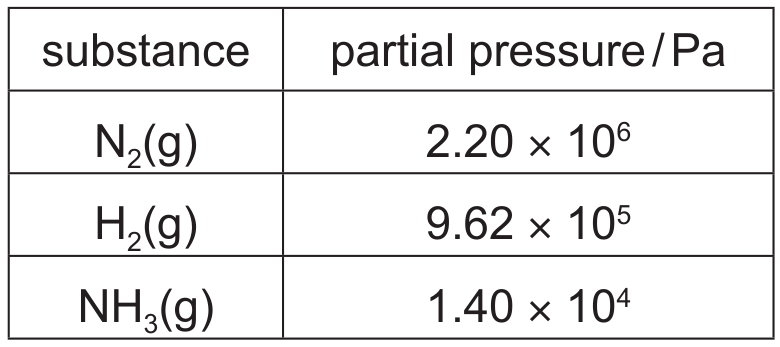
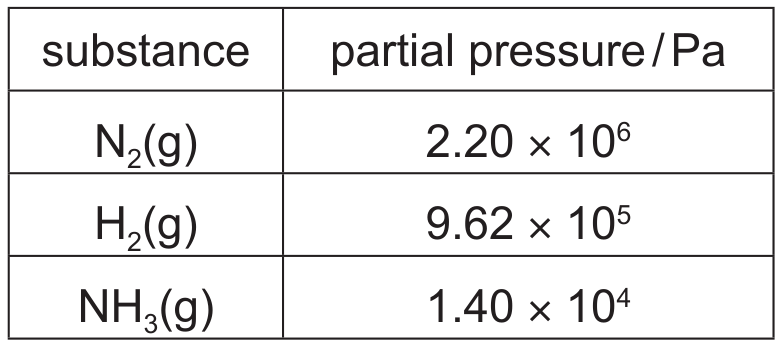
In another equilibrium mixture the partial pressures are as shown.

Table
[ 5 ]

Question 1(d)(i)

(i)

Write the expression for the equilibrium constant, KpK_{\mathrm{p}}, for the production of ammonia from nitrogen and hydrogen.

Kp=K_{p}=
[ 1 ]

Question 1(d)(ii)

(ii)

Calculate the value of KpK_{\mathrm{p}} for this reaction.

State the units.

Kp=K_{p}=

units =

[ 2 ]

Question 1(d)(iii)

(iii)

This reaction is repeated with the same starting amounts of nitrogen and hydrogen. The same temperature is used but the container has a smaller volume.

State the effects, if any, of this change on the yield of ammonia and on the value of KpK_{\mathrm{p}}. effect on yield of ammonia
effect on value of KpK_{p}

[ 2 ]

Question 1

[Maximum number: 7]

Methylpropane, (CH3)2CHCH3\left(\mathrm{CH}_{3}\right)_{2} \mathrm{CHCH}_{3}, is an isomer of butane, CH3(CH2)2CH3\mathrm{CH}_{3}\left(\mathrm{CH}_{2}\right)_{2} \mathrm{CH}_{3}.

Question 1(b)

(a)

When a sample of butane is heated to 373 K , in the presence of a catalyst, and allowed to reach equilibrium the following reaction occurs.

CH3(CH2)2CH3( g)(CH3)2CHCH3( g)ΔH=8.0 kJ mol1\mathrm{CH}_{3}\left(\mathrm{CH}_{2}\right)_{2} \mathrm{CH}_{3}(\mathrm{~g}) \rightleftharpoons\left(\mathrm{CH}_{3}\right)_{2} \mathrm{CHCH}_{3}(\mathrm{~g}) \quad \Delta H=-8.0 \mathrm{~kJ} \mathrm{~mol}^{-1}

State and explain the effect on the composition of this equilibrium mixture when the temperature is increased to 473 K .

[ 2 ]

Question 1(c)

(b)

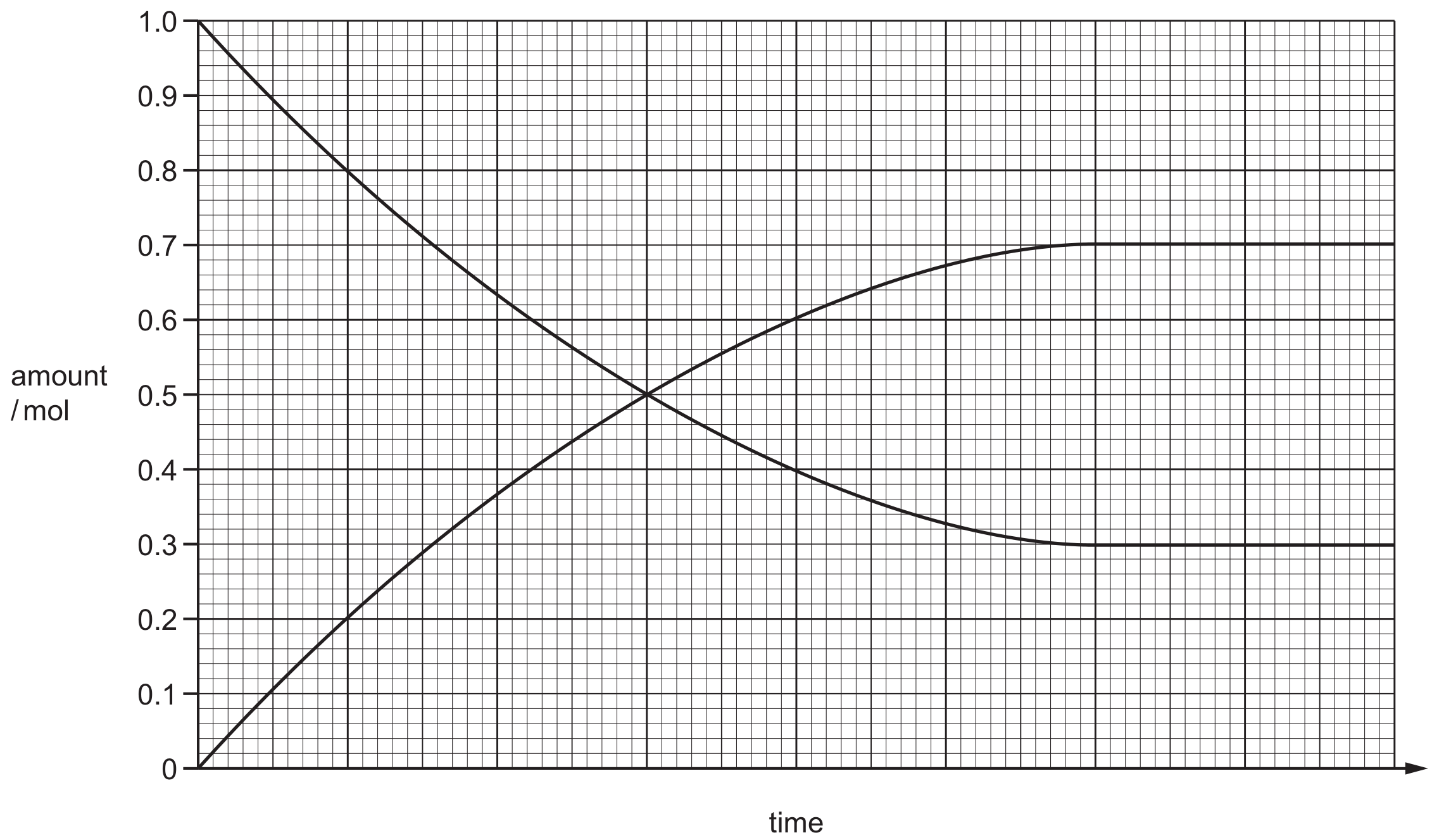
1 mole of butane gas was added to a 1dm31 \mathrm{dm}^{3} closed system, at a constant temperature and pressure. The amount of butane and methylpropane was measured at regular time intervals.

Question image
[ 5 ]

Question 1(c)(i)

(i)

Label the graph with a t to show the time taken to reach dynamic equilibrium.

[ 1 ]

Question 1(c)(ii)

(ii)

Use the graph to find the concentration of butane and methylpropane in the mixture at equilibrium.
concentration of butane = moldm3\mathrm{mol} \mathrm{dm}^{-3}
concentration of methylpropane = moldm3\mathrm{mol} \mathrm{dm}^{-3}

[ 1 ]

Question 1(c)(iii)

(iii)

Write an expression for KcK_{\mathrm{c}} for this reaction.

[ 1 ]

Question 1(c)(iv)

(iv)

Calculate a value for KcK_{\mathrm{c}} and state its units.

Kc=K_{\mathrm{c}}=

units =

[ 2 ]

Question 1

[Maximum number: 4]

In the Periodic Table, the p block contains elements whose outer electrons are found in the p subshell.

Question 1(d)

(a)

SO2\mathrm{SO}_{2} can react with ozone, O3\mathrm{O}_{3}, to form SO3\mathrm{SO}_{3} in two different reactions.

[ 4 ]

Question 1(d)(i)

(i)

In one reaction, SO2\mathrm{SO}_{2} reacts with O3\mathrm{O}_{3} until a dynamic equilibrium is established.

SO2( g)+O3( g)SO3( g)+O2( g)\mathrm{SO}_{2}(\mathrm{~g})+\mathrm{O}_{3}(\mathrm{~g}) \rightleftharpoons \mathrm{SO}_{3}(\mathrm{~g})+\mathrm{O}_{2}(\mathrm{~g})

State and explain the effect of an increase in pressure on the composition of the equilibrium mixture.

[ 2 ]

Question 1(d)(ii)

(ii)

In the other reaction, a different equilibrium is established at 300 K as shown.

3SO2( g)+O3( g)3SO3( g)ΔH=+462.3 kJ mol13 \mathrm{SO}_{2}(\mathrm{~g})+\mathrm{O}_{3}(\mathrm{~g}) \rightleftharpoons 3 \mathrm{SO}_{3}(\mathrm{~g}) \quad \Delta H=+462.3 \mathrm{~kJ} \mathrm{~mol}^{-1}

Suggest a temperature needed to increase the yield of SO3\mathrm{SO}_{3} at equilibrium.
Explain your answer.

[ 2 ]

Question 1

[Maximum number: 10]

Ammonia, NH3\mathrm{NH}_{3}, is manufactured from nitrogen and hydrogen by the Haber process.

N2( g)+3H2( g)2NH3( g)ΔH=92 kJ mol1\mathrm{N}_{2}(\mathrm{~g})+3 \mathrm{H}_{2}(\mathrm{~g}) \rightleftharpoons 2 \mathrm{NH}_{3}(\mathrm{~g}) \quad \Delta H=-92 \mathrm{~kJ} \mathrm{~mol}^{-1}

Question 1(b)

(a)

The Haber process is usually carried out at a temperature of approximately 400C400^{\circ} \mathrm{C} in the presence of a catalyst. Changing the temperature affects both the rate of production of ammonia and the yield of ammonia.

The Boltzmann distribution for a mixture of nitrogen and hydrogen at 400C400^{\circ} \mathrm{C} is shown. Ea represents the activation energy for the reaction.

Question image
[ 3 ]

Question 1(b)(iii)

(i)

State and explain the effect of increasing temperature on the yield of ammonia. Use Le Chatelier's principle to explain your answer.

[ 3 ]

Question 1(c)

(b)

At a pressure of 2.00×10⁷ Pa,1.00 mol2.00 \times 10^{7} \mathrm{~Pa}, 1.00 \mathrm{~mol} of nitrogen, N2( g)\mathrm{N}_{2}(\mathrm{~g}), was mixed with 3.00 mol of hydrogen, H2( g)\mathrm{H}_{2}(\mathrm{~g}). The final equilibrium mixture formed contained 0.300 mol of ammonia, NH3( g)\mathrm{NH}_{3}(\mathrm{~g}).

[ 2 ]

Question 1(c)(i)

(i)

Calculate the amounts, in mol, of N2( g)\mathrm{N}_{2}(\mathrm{~g}) and H2( g)\mathrm{H}_{2}(\mathrm{~g}) in the equilibrium mixture.

N2( g)=. mol H2( g)=.. mol \begin{aligned} & \mathrm{N}_{2}(\mathrm{~g})=\ldots \ldots \ldots \ldots \ldots \ldots \ldots \ldots \ldots \ldots . \text { mol } \\ & \mathrm{H}_{2}(\mathrm{~g})=\ldots \ldots \ldots \ldots \ldots \ldots \ldots \ldots \ldots . . \text { mol } \end{aligned}
[ 2 ]

Question 1(c)(ii)

(ii)

Calculate the partial pressure of ammonia, pNH3\mathrm{pNH}_{3}, in the equilibrium mixture.

Give your answer to three significant figures.

pNH3=p \mathrm{NH}_{3}=

Pa

Question 1(d)

(c)

In another equilibrium mixture the partial pressures are as shown.

Table
[ 5 ]

Question 1(d)(i)

(i)

Write the expression for the equilibrium constant, KpK_{\mathrm{p}}, for the production of ammonia from nitrogen and hydrogen.

Kp=K_{p}=
[ 1 ]

Question 1(d)(ii)

(ii)

Calculate the value of KpK_{p} for this reaction.

State the units.

Kp=K_{p}=

units =

[ 2 ]

Question 1(d)(iii)

(iii)

This reaction is repeated with the same starting amounts of nitrogen and hydrogen. The same temperature is used but the container has a smaller volume.

State the effects, if any, of this change on the yield of ammonia and on the value of KpK_{\mathrm{p}}. effect on yield of ammonia
effect on value of KpK_{p}

[ 2 ]

Question 1

[Maximum number: 10]

Ethanoic acid can be reacted with alcohols to form esters, an equilibrium mixture being formed.

CH3CO2H+ROHCH3CO2R+H2O\mathrm{CH}_{3} \mathrm{CO}_{2} \mathrm{H}+\mathrm{ROH} \rightleftharpoons \mathrm{CH}_{3} \mathrm{CO}_{2} \mathrm{R}+\mathrm{H}_{2} \mathrm{O}

The reaction is usually carried out in the presence of an acid catalyst.

Question 1(a)

(a)

Write an expression for the equilibrium constant, KcK_{\mathrm{c}}, for this reaction, clearly stating the units.

Kc=K_{\mathrm{c}}=

units

In an experiment to determine KcK_{\mathrm{c}} a student placed together in a conical flask 0.10 mol of ethanoic acid, 0.10 mol of an alcohol ROH, and 0.005 mol of hydrogen chloride catalyst.
The flask was sealed and kept at 25C25^{\circ} \mathrm{C} for seven days.
After this time, the student titrated all of the contents of the flask with 2.00moldm3NaOH2.00 \mathrm{moldm}^{-3} \mathrm{NaOH} using phenolphthalein indicator.
At the end-point, 22.5 cm322.5 \mathrm{~cm}^{3} of NaOH had been used.

[ 2 ]

Question 1(c)

Question 1(c)(i)

(b)
(i)

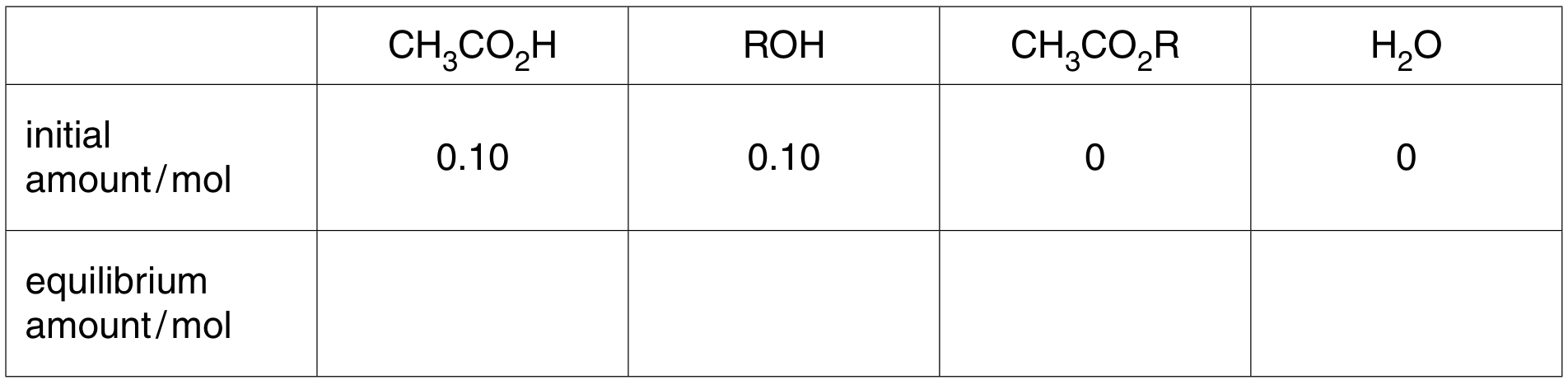
Use your results from (b) to calculate the amount, in moles, of ethanoic acid present at equilibrium. Hence complete the table below.

Table
[ 3 ]

Question 1(c)(ii)

(ii)

Use your results to calculate a value for KcK_{\mathrm{c}} for this reaction.

[ 3 ]

Question 1(e)

(c)

What would be the effect, if any, on the amount of ester present if all of the water were removed from the flask and the flask kept for a further week at 25C25^{\circ} \mathrm{C} ?

Explain your answer.

[ 2 ]

Question 1

Question 1(b)

(a)

When concentrated hydrochloric acid is added to a solution containing [Co(H2O)6]2+\left[\mathrm{Co}\left(\mathrm{H}_{2} \mathrm{O}\right)_{6}\right]^{2+}, a blue solution of [CoCl4]2\left[\mathrm{CoCl}_{4}\right]^{2-} is formed and the following equilibrium is established.

[Co(H2O)6]2++4Cl[CoCl4]2+6H2O\left[\mathrm{Co}\left(\mathrm{H}_{2} \mathrm{O}\right)_{6}\right]^{2+}+4 \mathrm{Cl}^{-} \rightleftharpoons\left[\mathrm{CoCl}_{4}\right]^{2-}+6 \mathrm{H}_{2} \mathrm{O}

Use Le Chatelier's principle to suggest the expected observations when silver nitrate solution is added dropwise to the blue solution of [CoCl4]2\left[\mathrm{CoCl}_{4}\right]^{2-}. Explain your answer.

[ 2 ]

Question 1

[Maximum number: 4]

Hydrogen iodide, HI, is a colourless gas at room temperature.

Question 1(c)

(a)

HI(g) can be formed by reacting H2( g)\mathrm{H}_{2}(\mathrm{~g}) with I2( g)\mathrm{I}_{2}(\mathrm{~g}). The reaction is reversible, and an equilibrium forms quickly at high temperatures.

H2( g)+I2( g)2HI( g)\mathrm{H}_{2}(\mathrm{~g})+\mathrm{I}_{2}(\mathrm{~g}) \rightleftharpoons 2 \mathrm{HI}(\mathrm{~g})
[ 4 ]

Question 1(c)(i)

(i)

Construct an expression for the equilibrium constant, KpK_{\mathrm{p}}, for the reaction of H2( g)\mathrm{H}_{2}(\mathrm{~g}) and I2( g)\mathrm{I}_{2}(\mathrm{~g}) to form HI(g).

Kp=K_{\mathrm{p}}=
[ 1 ]

Question 1(c)(ii)

(ii)

The equilibrium partial pressures of the gases at 200C200^{\circ} \mathrm{C} are as follows.

pH2( g)=895 PapI2( g)=895 PapHI( g)=4800 Pa\begin{aligned} & p_{\mathrm{H}_{2}(\mathrm{~g})}=895 \mathrm{~Pa} \\ & p_{\mathrm{I}_{2}(\mathrm{~g})}=895 \mathrm{~Pa} \\ & p_{\mathrm{HI}(\mathrm{~g})}=4800 \mathrm{~Pa} \end{aligned}

Calculate KpK_{p} for this reaction.

Kp=K_{\mathrm{p}}=
[ 1 ]

Question 1(c)(iii)

(iii)

State how the value of KpK_{\mathrm{p}} would change, if at all, if the reaction were carried out at 100C100^{\circ} \mathrm{C} rather than 200C200^{\circ} \mathrm{C}.

Explain your answer.

[ 2 ]
0 selected