EduNinja

A-Level CAIE Chemistry AS2.1 Relative masses of atoms and moleculesQuestion Bank

Question 1

Question 1(b)

(a)

Most elements exist naturally as a mixture of isotopes, each with their own relative isotopic mass. The mass spectrum of an element reveals the abundances of these isotopes, which can be used to calculate the relative atomic mass of the element.

Magnesium has three stable isotopes. Information about two of these isotopes is given.
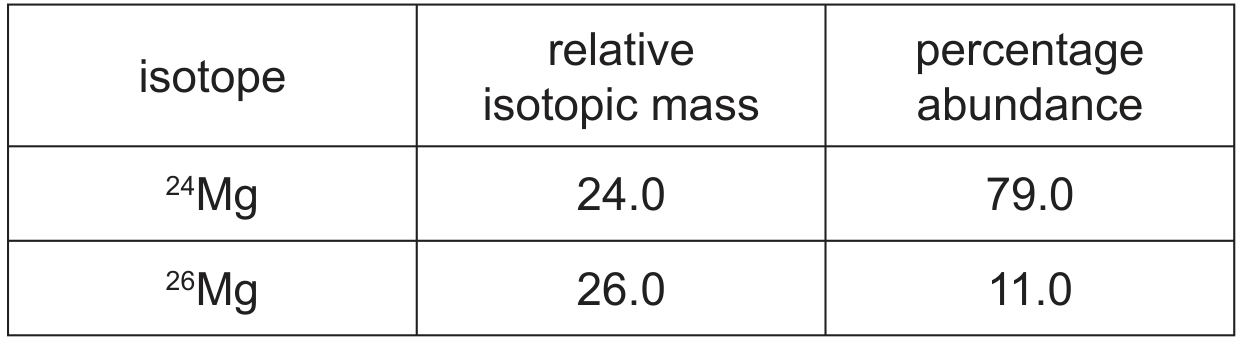
Table
[ 2 ]

Question 1(b)(i)

(i)

Define the term relative isotopic mass.

[ 2 ]
Question 1

[Maximum number: 4]

The composition of atoms and ions can be determined from knowledge of atomic number, nucleon number and charge.

Question 1(b)

(a)

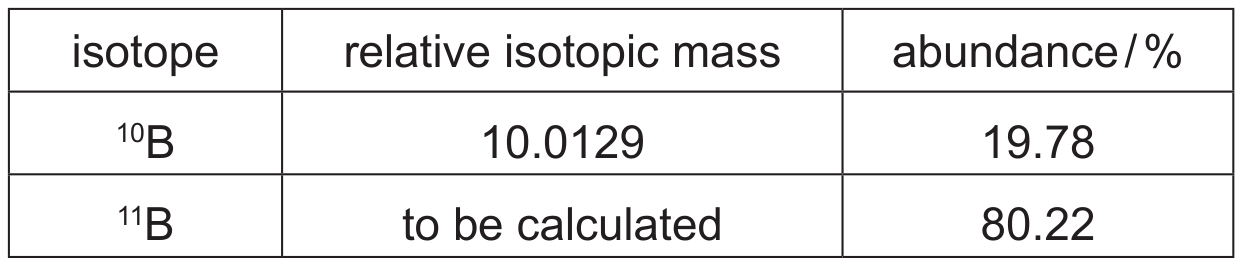
Boron occurs naturally as a mixture of two stable isotopes, 10 B{ }^{10} \mathrm{~B} and 11 B{ }^{11} \mathrm{~B}. The relative isotopic masses and percentage abundances are shown.

Table
[ 4 ]

Question 1(b)(i)

(i)

Define the term relative isotopic mass.

[ 2 ]
Question 1(b)(ii)

(ii)

Calculate the relative isotopic mass of 11 B{ }^{11} \mathrm{~B}.

Give your answer to six significant figures. Show your working.

[ 2 ]

Question 1

Question 1(c)

(a)

Cerium is a lanthanoid metal that shows similar chemical reactions to some elements in the third period. Most of cerium's compounds contain Ce3+\mathrm{Ce}^{3+} or Ce4+\mathrm{Ce}^{4+} ions.

[ 3 ]

Question 1(c)(iii)

(i)

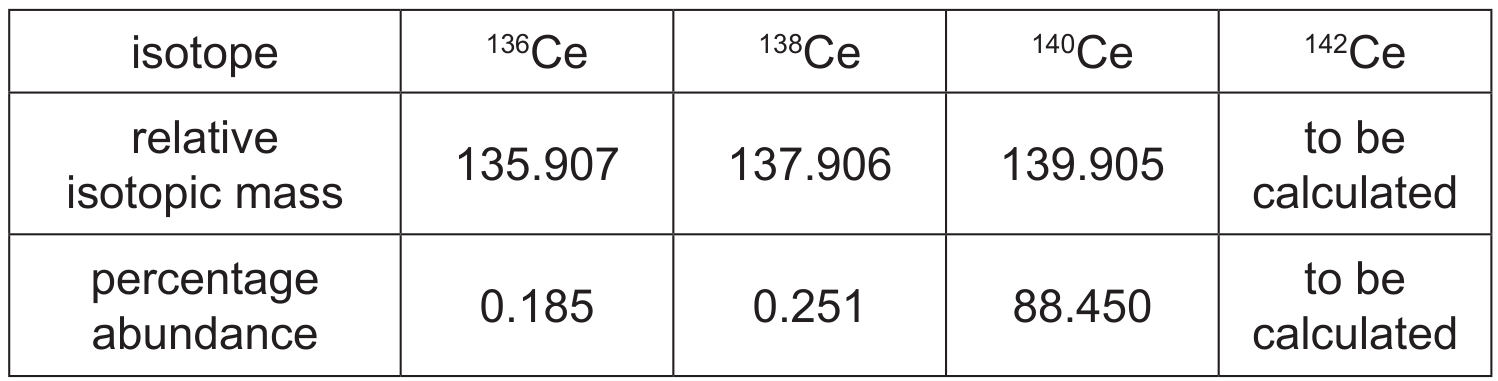
A naturally occurring sample of cerium contains only four isotopes. Data for three of the isotopes are shown in the table.

Table

The ArA_{r} of the sample is 140.116 .
Use these data to calculate the relative isotopic mass of the fourth isotope in this sample of cerium.

Give your answer to three decimal places.
relative isotopic mass =

[ 3 ]

Question 1

[Maximum number: 3]

A0.17 g sample of a Group 14 chloride, XCl4\mathrm{XCl}_{4}, reacted with water to produce an oxide, XO2\mathrm{XO}_{2}, and HCl.
equation 1

XCl4( s)+2H2O(l)XO2( s)+4HCl(aq)\mathrm{XCl}_{4}(\mathrm{~s})+2 \mathrm{H}_{2} \mathrm{O}(\mathrm{l}) \rightarrow \mathrm{XO}_{2}(\mathrm{~s})+4 \mathrm{HCl}(\mathrm{aq})

The HC lproduced was absorbed in 100 cm3100 \mathrm{~cm}^{3} of 0.10 moldm30.10 \mathrm{~mol} \mathrm{dm}^{-3} sodium hydroxide solution (an excess).
In a titration, the unreacted sodium hydroxide solution required 30.0 cm330.0 \mathrm{~cm}^{3} of 0.20 moldm30.20 \mathrm{~mol} \mathrm{dm}^{-3} hydrochloric acid for complete neutralisation.

Question 1(g)

(a)

Calculate the molecular mass, MrM_{\mathrm{r}}, of XCl XCl4\mathbf{X C l}_{4}.

Mr=M_{r}=
[ 1 ]

Question 1(h)

(b)

Calculate the relative atomic mass, ArA_{\mathrm{r}}, of X and suggest its identity.
ArA_{r} of X= identity of X

[ 2 ]

Question 1

Question 1(d)

(a)

A sample of strontium exists as a mixture of four isotopes. Information about three of these isotopes is given in the table.

Table
[ 1 ]

Question 1(d)(i)

(i)

Calculate the abundance of the fourth isotope.
abundance = \%

[ 1 ]

Question 1(d)(ii)

(ii)

The relative atomic mass of this sample of strontium is 87.71.

Calculate the mass number of the fourth isotope.
mass number =

Question 1

[Maximum number: 2]

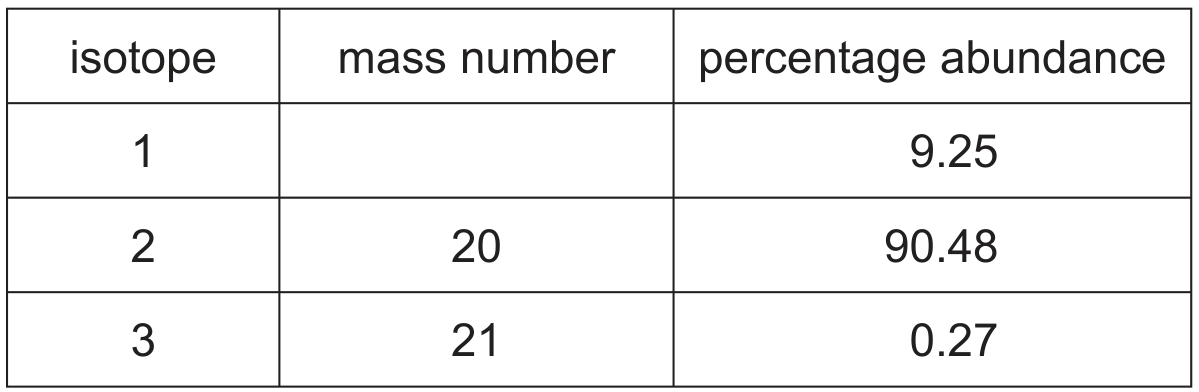
Neon is a noble gas.

Question 1(c)

(a)

Neon has three stable isotopes.

Table
[ 2 ]

Question 1(c)(i)

(i)

Define the term relative atomic mass.

[ 2 ]

Question 1

Question 1(b)

(a)

Bromine exists naturally as a mixture of two stable isotopes, 79Br{ }^{79} \mathrm{Br} and 81Br{ }^{81} \mathrm{Br}, with relative isotopic masses of 78.92 and 80.92 respectively.

[ 2 ]

Question 1(b)(i)

(i)

Define the term relative isotopic mass.

[ 2 ]

Question 1

[Maximum number: 2]

Sulfur, S, and polonium, Po, are both elements in Group VI of the Periodic Table.

Sulfur has three isotopes.

Question 1(b)

(a)

A sample of sulfur has the following isotopic composition by mass.

Table

Calculate the relative atomic mass, ArA_{\mathrm{r}}, of sulfur to two decimal places.

Ar=A_{\mathrm{r}}=
[ 2 ]

Question 1

Question 1(c)

(a)

Another element, Z, in the same period of the Periodic Table as A, reacts with chlorine to form a compound with empirical formula ZCl2\mathrm{ZCl}_{2}. The percentage composition by mass of ZCl2\mathrm{ZCl}_{2} is Z, 31.13 ; Cl, 68.87.

[ 2 ]

Question 1(c)(i)

(i)

Define the term relative atomic mass.

[ 2 ]

Question 1

[Maximum number: 1]

Which statement is correct?

A

Cl has a relative isotopic mass of 35.5.

B

Cl2\mathrm{Cl}_{2} has a relative molecular mass of 70 .

C

ICl has a relative molecular mass of 162.4.

D

NaCl has a relative molecular mass of 58.5.

0 selected