Question 1
[Maximum number: 2]
The elements sodium to sulfur react with chlorine. The melting points of some of the chlorides formed are shown.

Question 1(b)
Question 1(b)(ii)
(a)
(i)
Explain why the melting point of is higher than that of .
[ 2 ]
 EduNinja
The elements sodium to sulfur react with chlorine. The melting points of some of the chlorides formed are shown.
Explain why the melting point of is higher than that of .
Using all relevant bond energy values from the Data Booklet, explain why the thermal stability of HF is much more than that of HCl .
Sulfur and fluorine react together to give the covalent compound .
State whether a molecule of has a dipole moment. Explain your answer.
Ammonia, , and methane, , are the hydrides of elements which are next to one another in the Periodic Table.
Ammonia is polar whereas methane is non-polar. The physical properties of the two compounds are different.
Explain, using ammonia as the example, the meaning of the term bond polarity.
Explain why the ammonia molecule is polar.
State one physical property of ammonia which is caused by its polarity.
Silicon tetrachloride, , is formed when silicon reacts with chlorine under suitable conditions. It is a colourless liquid with a low boiling point.
reacts with water to produce an acidic solution.
Describe two visual observations when silicon tetrachloride is added drop by drop to a small amount of water.
1
2
Group VII is the only group in the Periodic Table containing elements in all three states of matter at room conditions.
State and explain, in terms of intermolecular forces, the trend in the boiling points of the elements down Group VII.
An aldehyde, an alkane and a carboxylic acid, all of similar volatility, are mixed together. The mixture is then analysed in a gas chromatograph.
The gas chromatogram produced is shown.
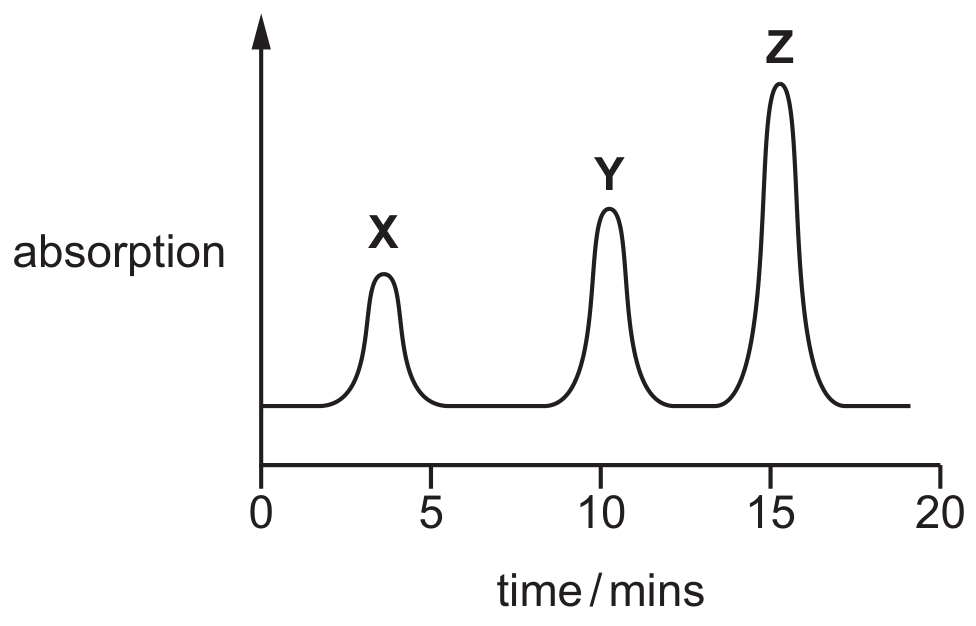
The separation of the compounds depends on their relative solubilities in the stationary phase. The stationary phase is a liquid alcohol.
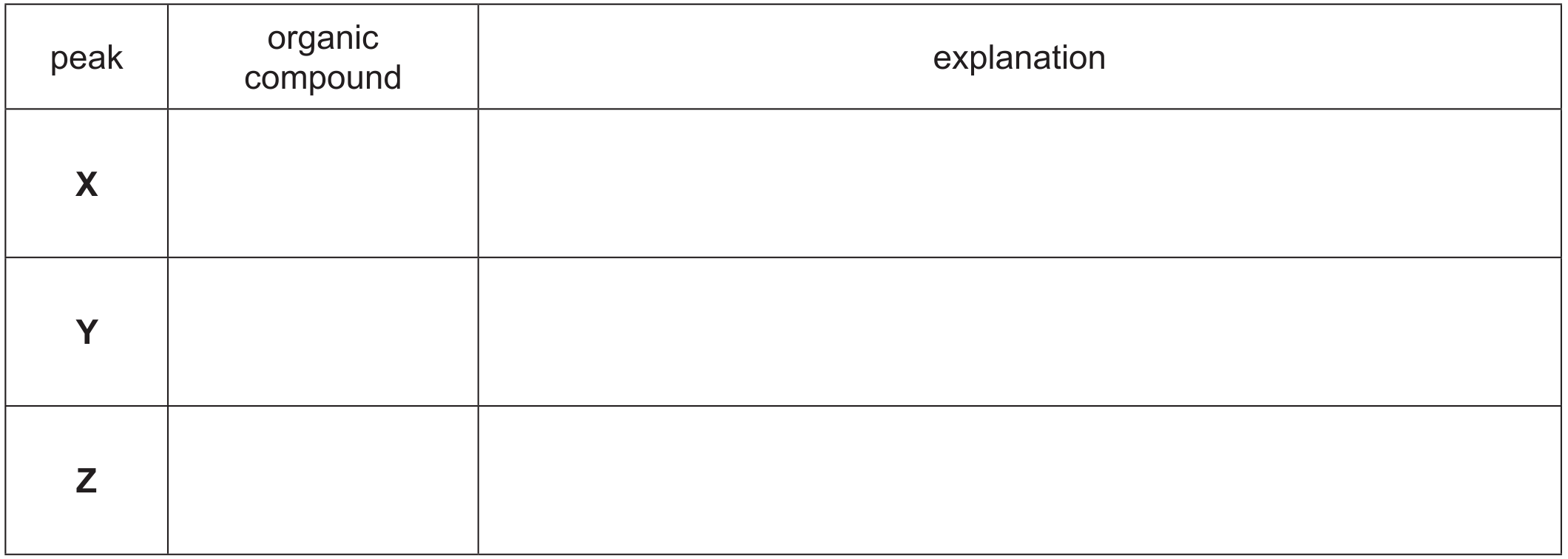
Complete the table to suggest which compound in the mixture is responsible for each peak X, Y and Z. Explain your answer by reference to the intermolecular forces of the compounds.
Neon is a noble gas.
Neon and argon can both be obtained by fractional distillation of liquid air as they have different boiling points.
Neon has a boiling point of 27.3 K . The boiling point of argon is 87.4 K .
Name the force that has to be overcome in order to boil neon or argon and explain what causes it.
Explain why argon has a higher boiling point than neon.
Why is the boiling point of ammonia, , higher than the boiling point of phosphine, ?
Ammonia molecules are polar; phosphine molecules are not.
Ammonia molecules have significant hydrogen bonding; phosphine molecules do not.
N-H covalent bonds are stronger than P-H covalent bonds.
There is one lone pair in each ammonia molecule but no lone pair in each phosphine molecule.
Sulfides are compounds that contain sulfur but not oxygen.
Carbon disulfide, , is a volatile liquid at room temperature and pressure.
is a liquid under room conditions, while is a gas.
Explain what causes the difference in the physical properties between and .
The Pauling electronegativity values of elements can be used to predict the chemical properties of compounds.
Use the information in Table 1.1 to answer the following questions.

Table 1.1
Complete Table 1.2 by placing a tick to show which of the compounds have molecules with an overall dipole moment.

Table 1.2