Question 1
[Maximum number: 2]
Ammonia, , is manufactured from nitrogen and hydrogen by the Haber process.
Question 1(a)
(a)
Some bond energies are given.
[ 2 ]
Question 1(a)(i)
(i)
Explain the meaning of the term bond energy.
[ 2 ]
 EduNinja
Ammonia, , is manufactured from nitrogen and hydrogen by the Haber process.
Some bond energies are given.
Explain the meaning of the term bond energy.
Magnesium nitrate, , is very soluble in water. When a hot saturated solution of magnesium nitrate is cooled, crystals of the hydrate, , are formed.
In the crystals, six water molecules bond to each ion, and some of these water molecules are also bonded to the nitrate ions.
Suggest the type of bonding that occurs between
and ,
and .
Suggest a reason why sulfur can form both and whereas oxygen can only form .
Which molecule contains six bonding electrons?
Which feature is present in both ethene and poly(ethene)?
bond angles of
covalent bonds
covalent bonds
orbitals
The structure of is shown. Ethanoate ions act as ligands in this complex. The ethanoate ligand, , is shown as O .
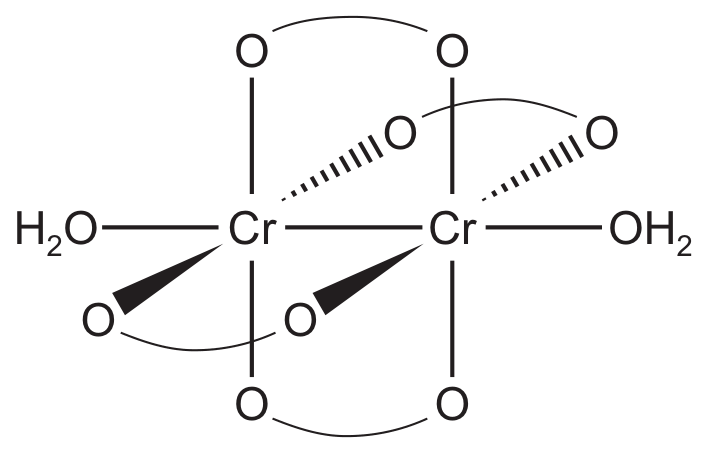
State the type of bond between the two atoms in the Cr-Cr bond.
Gaseous ammonia and hydrogen fluoride react together to give solid ionic ammonium fluoride.
What type of reaction is this?
Covalent bonds can be bonds or bonds.
Complete Table 1.1 to show the number of and bonds in a molecule of and to describe how the orbitals overlap to form and bonds.
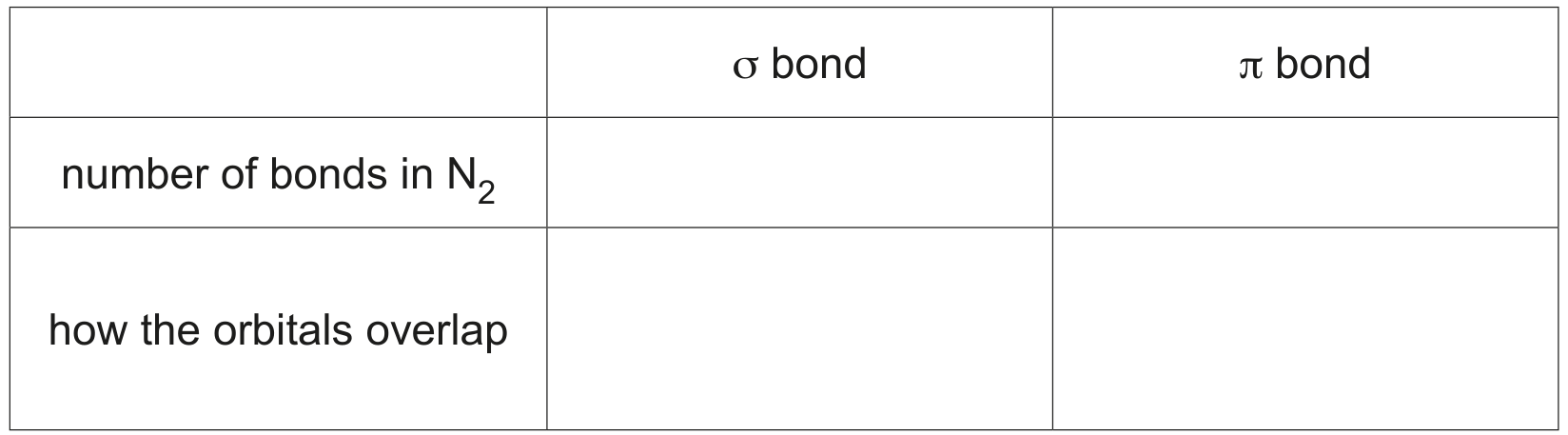
Table 1.1
Elements and compounds which have small molecules usually exist as gases or liquids.
Hydrogen cyanide, HCN , is a gas which is also isoelectronic with and with CO . Each molecule contains a strong triple bond with the following bond energies.
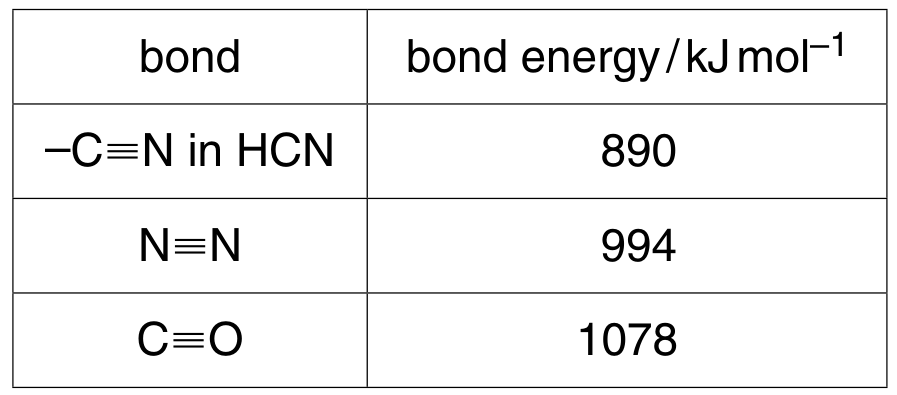
Although each compound contains the same number of electrons and a strong triple bond in its molecule, CO and HCN are both very reactive whereas is not.
Suggest a reason for this.
Gallium is a metal in Group 13 of the Periodic Table.
Gallium and its compounds show similar properties to aluminium and its compounds. Gallium reacts with excess chlorine to form gallium trichloride.
At , gallium trichloride is a gas.
Suggest the type of attraction that exists at
- between atoms within a gallium trichloride molecule
- between gallium trichloride molecules.
When gallium trichloride is cooled a solid, , forms.
Suggest the name of the attraction formed between two gallium trichloride molecules to form .