EduNinja

A-Level CAIE Chemistry AS15.1 HalogenoalkanesQuestion Bank

Question 1

Question 1(c)

(a)

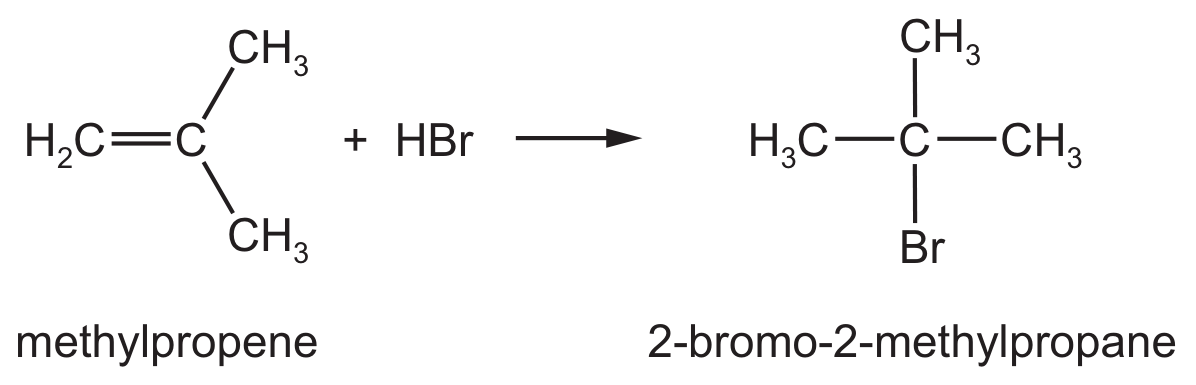
Halogenoalkanes can be formed from the reaction of an alkene with a hydrogen halide. Methylpropene reacts with hydrogen bromide to form 2-bromo-2-methylpropane.
Question image
[ 4 ]

Question 1(c)(i)

(i)

Draw the mechanism of this reaction. Include all relevant curly arrows, dipoles and charges.

[ 3 ]

Question 1(c)(ii)

(ii)

1-bromo-2-methylpropane is also formed in this reaction.

Explain why 2-bromo-2-methylpropane will be the major product in this reaction.

[ 1 ]
Question 1

[Maximum number: 15]

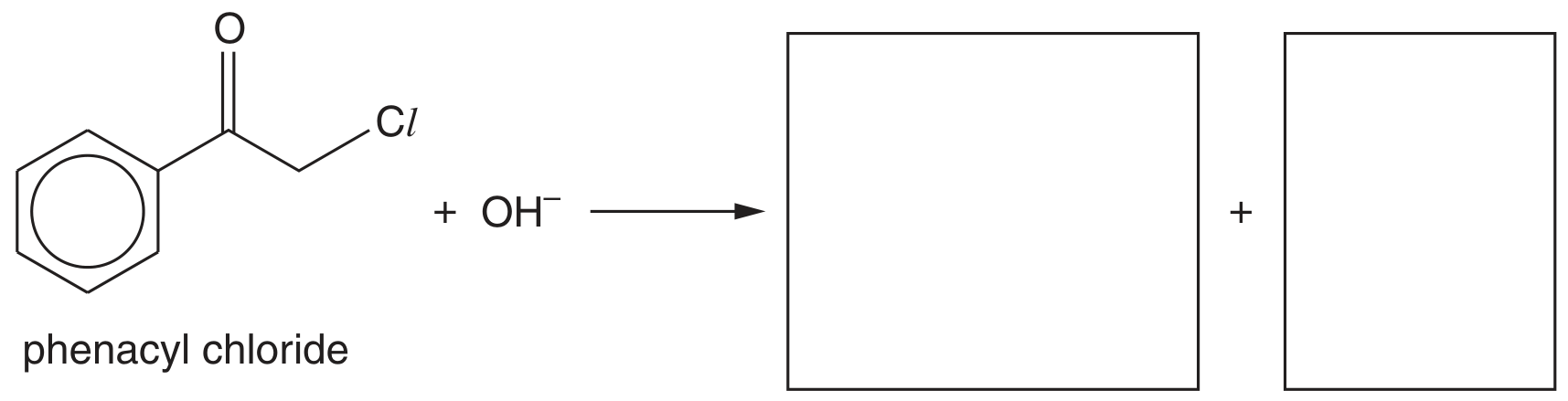
Phenacyl chloride has been used as a component of some tear gases. Its lachrymatory and irritant properties are due to it reacting with water inside body tissues to produce hydrochloric acid.

It undergoes a nucleophilic substitution reaction with NaOH(aq).

Question image

Question 1(b)

Question 1(b)(iv)

(a)
(i)

Describe the mechanism for this reaction that is consistent with your overall rate equation.

You should show all intermediates and/or transition states and partial charges, and you should represent the movements of electron pairs by curly arrows.

[ 7 ]

Question 1(c)

Question 1(c)(i)

(b)
(i)

Describe an experiment that would show that CH3COCl\mathrm{CH}_{3} \mathrm{COCl} reacts with water at a much faster rate than phenacyl chloride. Include the reagents you would use, and the observations you would make with each chloride.

[ 4 ]

Question 1(c)(ii)

(ii)

Suggest an explanation for this difference in reactivity.

[ 4 ]

Question 1

[Maximum number: 4]

Species such as NH4+,CO32\mathrm{NH}_{4}{ }^{+}, \mathrm{CO}_{3}{ }^{2-} and PO43\mathrm{PO}_{4}{ }^{3-} are examples of molecular ions.

Question 1(e)

(a)

OH(aq)\mathrm{OH}^{-}(\mathrm{aq}) reacts with 2-bromo-2-methylpropane in an SN1\mathrm{S}_{\mathrm{N}} 1 reaction. The molecular ion (CH3)3C+\left(\mathrm{CH}_{3}\right)_{3} \mathrm{C}^{+}forms as the intermediate in this reaction.

[ 4 ]

Question 1(e)(i)

(i)

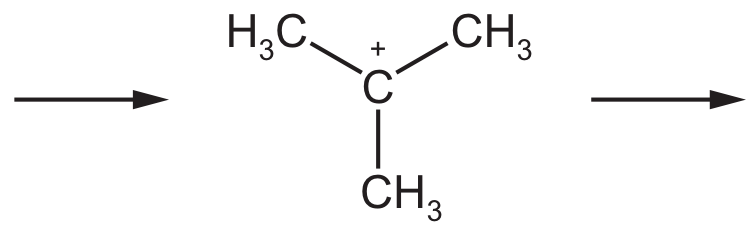
Draw the mechanism for the SN1\mathrm{S}_{\mathrm{N}} 1 reaction of OH\mathrm{OH}^{-}with 2-bromo-2-methylpropane. Include charges, dipoles, lone pairs of electrons and curly arrows as appropriate. Draw the structures of the organic reactant and organic product.

Question image
[ 3 ]

Question 1(e)(ii)

(ii)

2-bromo-2-methylpropane is a tertiary bromoalkane.

Define tertiary bromoalkane.

[ 1 ]

Question 2

Question 2(a)

(a)

Both chloroalkanes and acyl chlorides react with water, but only acyl chlorides fume in moist air.

[ 1 ]

Question 2(a)(i)

(i)

State which product causes the fumes in this reaction.

[ 1 ]

Question 2

Question 2(d)

Question 2(d)(i)

(a)
(i)

Suggest the mechanism for the reaction of 2-chlorobutane with iodide ions. Draw out the steps involved, including the following.
- all relevant lone pairs and dipoles
- curly arrows to show the movement of electron pairs
- the structure of any transition state or intermediate

[ 3 ]

Question 2(d)(ii)

(ii)

This reaction was carried out using a single optical isomer of 2-chlorobutane.

Use your mechanism in (i) to predict whether the product will be a single optical isomer or a mixture of two optical isomers. Explain your answer.

[ 1 ]

Question 17

[Maximum number: 1]

Concentrated sulfuric acid can behave both as a strong acid and as an oxidising agent. With which compound does concentrated sulfuric acid react in this way?

A

ethanol

B

magnesium carbonate

C

propanenitrile

D

sodium bromide

Question 19

[Maximum number: 1]

Butanedioic acid occurs in amber, algae, lichens, sugar cane and beets. It may be synthesised in two steps from 1,2-dibromoethane.

BrCH2CH2Br step 1 × step 2 HO2CCH2CH2CO2H\mathrm{BrCH}_{2} \mathrm{CH}_{2} \mathrm{Br} \xrightarrow{\text { step 1 }} \times \xrightarrow{\text { step 2 }} \mathrm{HO}_{2} \mathrm{CCH}_{2} \mathrm{CH}_{2} \mathrm{CO}_{2} \mathrm{H}

Which reagents could be used for this synthesis?

step 1

step 2

HCN(g)

HCl(aq)

HCO2Na(aq)\mathrm{HCO}_{2} \mathrm{Na}(\mathrm{aq})

HCl(aq)

KCN(aq / alcoholic )

H2SO4(aq)\mathrm{H}_{2} \mathrm{SO}_{4}(\mathrm{aq})

NaOH(aq)

K2Cr2O7/H2SO4(aq)\mathrm{K}_{2} \mathrm{Cr}_{2} \mathrm{O}_{7} / \mathrm{H}_{2} \mathrm{SO}_{4}(\mathrm{aq})

Question 2

[Maximum number: 2]

The Group 17 elements, chlorine, bromine and iodine, are non-metals that show trends in their physical and chemical properties.

Question 2(e)

(a)

Lucas's reagent is a mixture of HCl and ZnCl2\mathrm{ZnCl}_{2}. Primary, secondary and tertiary alcohols can be distinguished by their reaction with Lucas's reagent.

Alcohols react with the HCl in Lucas's reagent to form halogenoalkanes.
ZnCl2\mathrm{ZnCl}_{2} acts as a homogeneous catalyst for these reactions.

[ 2 ]

Question 2(e)(ii)

(i)

Pentan-3-ol, C2H5CH(OH)C2H5\mathrm{C}_{2} \mathrm{H}_{5} \mathrm{CH}(\mathrm{OH}) \mathrm{C}_{2} \mathrm{H}_{5}, reacts slowly with HC l to form a secondary halogenoalkane. Complete the equation for this reaction using structural formulae.
C2H5CH(OH)C2H5+\mathrm{C}_{2} \mathrm{H}_{5} \mathrm{CH}(\mathrm{OH}) \mathrm{C}_{2} \mathrm{H}_{5}+

[ 1 ]

Question 2(e)(iv)

(ii)

Tertiary alcohols tend to react with Lucas's reagent using the same mechanism as in their reaction with HCl .

Suggest the type of reaction shown by tertiary alcohols with Lucas's reagent.

[ 1 ]

Question 20

[Maximum number: 1]

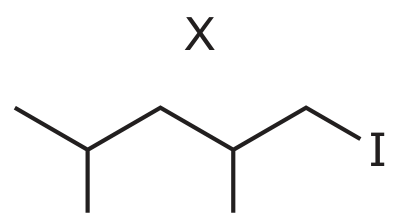
The Finkelstein reaction occurs when NaI in propanone reacts with a chloroalkane or bromoalkane. The halogen is directly replaced by I. The reaction only works for primary halogenoalkanes.

Which halogenoalkane produces compound X ?

Question image
A

(CH3)2CHCH(CH3)CH2CH2Br\left(\mathrm{CH}_{3}\right)_{2} \mathrm{CHCH}\left(\mathrm{CH}_{3}\right) \mathrm{CH}_{2} \mathrm{CH}_{2} \mathrm{Br}

B

(CH3)2CHCH(CH3)CH2Br\left(\mathrm{CH}_{3}\right)_{2} \mathrm{CHCH}\left(\mathrm{CH}_{3}\right) \mathrm{CH}_{2} \mathrm{Br}

C

(CH3)2CHCH2CH2CH(CH3)Cl\left(\mathrm{CH}_{3}\right)_{2} \mathrm{CHCH}_{2} \mathrm{CH}_{2} \mathrm{CH}\left(\mathrm{CH}_{3}\right) \mathrm{Cl}

D

(CH3)2CHCH2CH(CH3)CH2Cl\left(\mathrm{CH}_{3}\right)_{2} \mathrm{CHCH}_{2} \mathrm{CH}\left(\mathrm{CH}_{3}\right) \mathrm{CH}_{2} \mathrm{Cl}

Question 3

[Maximum number: 1]

Chlorine is a very reactive element.

Question 3(e)

(a)

CHCl3\mathrm{CHCl}_{3} and HF are used to form CHClF2\mathrm{CHClF}_{2} in a substitution reaction.

Construct an equation for this reaction.

[ 1 ]
0 selected