EduNinja

A-Level CAIE Chemistry AS4.2 Bonding and structureQuestion Bank

Question 1

[Maximum number: 3]

In the Periodic Table, the p block contains elements whose outer electrons are found in the p subshell.

Question 1(b)

(a)

Silicon is found in many compounds in the Earth's crust. Silicon has only three naturally occurring isotopes, 28Si,29Si{ }^{28} \mathrm{Si},{ }^{29} \mathrm{Si} and 30Si{ }^{30} \mathrm{Si}.

[ 3 ]

Question 1(b)(ii)

(i)

Silicon reacts with nitrogen gas to form Si3 N4\mathrm{Si}_{3} \mathrm{~N}_{4}.
Si3 N4\mathrm{Si}_{3} \mathrm{~N}_{4} is a solid with a melting point of 1900C1900^{\circ} \mathrm{C}. It is insoluble in water and does not conduct electricity when molten.

Suggest the type of bonding in and structure of Si3 N4\mathrm{Si}_{3} \mathrm{~N}_{4}. Explain your answer.

[ 3 ]

Question 1

[Maximum number: 6]

Aluminium is a metal in Period 3 and Group III of the Periodic Table.

Question 1(a)

(a)

Describe the structure of solid aluminium.

[ 2 ]

Question 1(b)

(b)

A common use of aluminium is to make the conducting cables in long distance overhead power lines.

[ 4 ]

Question 1(b)(i)

(i)

Suggest two properties of aluminium that make it suitable for this use.

The cables are attached to pylons by ceramic supports.

[ 2 ]

Question 1(b)(ii)

(ii)

Describe the structure of a ceramic material.

[ 1 ]

Question 1(b)(iii)

(iii)

State the property of a ceramic material that makes it suitable for this use.

[ 1 ]

Question 1

[Maximum number: 6]

Aluminium is a metal in Period 3 and Group III of the Periodic Table.

Question 1(a)

(a)

Describe the structure of solid aluminium.

[ 2 ]

Question 1(b)

(b)

A common use of aluminium is to make the conducting cables in long distance overhead power lines.

[ 4 ]

Question 1(b)(i)

(i)

Suggest two properties of aluminium that make it suitable for this use.

The cables are attached to pylons by ceramic supports.

[ 2 ]

Question 1(b)(ii)

(ii)

Describe the structure of a ceramic material.

[ 1 ]

Question 1(b)(iii)

(iii)

State the property of a ceramic material that makes it suitable for this use.

[ 1 ]

Question 1

[Maximum number: 3]

This question is about Period 3 elements and their compounds.

Question 1(a)

(a)

Give an explanation for each of the following statements.

[ 3 ]

Question 1(a)(iii)

(i)

Sodium is a better electrical conductor than phosphorus.

[ 2 ]

Question 1(a)(iv)

(ii)

Magnesium is a better electrical conductor than sodium.

[ 1 ]

Question 1

Question 1(c)

(a)

Cerium is a lanthanoid metal that shows similar chemical reactions to some elements in the third period. Most of cerium's compounds contain Ce3+\mathrm{Ce}^{3+} or Ce4+\mathrm{Ce}^{4+} ions.

[ 4 ]

Question 1(c)(i)

(i)

Cerium shows the same structure and bonding as a typical metal.

Draw a labelled diagram to show the structure and bonding in cerium.

[ 2 ]

Question 1(c)(ii)

(ii)

Cerium(IV) oxide, CeO2\mathrm{CeO}_{2}, is a ceramic.

Suggest two physical properties of cerium(IV) oxide.
1.
2.

[ 2 ]

Question 1

[Maximum number: 3]

The elements sodium to sulfur react with chlorine. The melting points of some of the chlorides formed are shown.

Table

Question 1(b)

Question 1(b)(i)

(a)
(i)

Explain, in terms of structure and bonding, why the melting point of SiCl4\mathrm{SiCl}_{4} is much lower than that of NaCl .

[ 3 ]

Question 1

[Maximum number: 4]

The elements sodium to chlorine, in the third period, all form oxides.

Question 1(b)

Question 1(b)(i)

(a)
(i)

Explain why the melting point of MgO is higher than that of Na2O\mathrm{Na}_{2} \mathrm{O}.

[ 2 ]

Question 1(b)(ii)

(ii)

Explain why the melting point of SiO2\mathrm{SiO}_{2} is much higher than that of SO3\mathrm{SO}_{3}.

[ 2 ]

Question 1

Question 1(a)

(a)

Magnesium has a melting point of 650C650^{\circ} \mathrm{C} and high electrical conductivity.
Explain these properties of magnesium by referring to its structure and bonding.

[ 2 ]

Question 1

[Maximum number: 4]

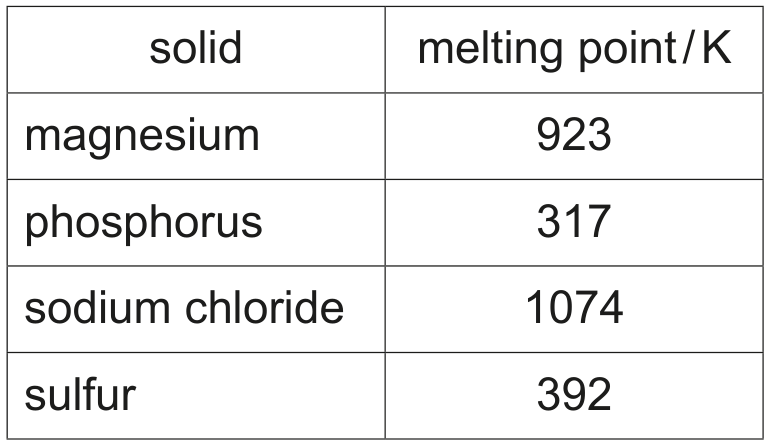
The melting points of some solids are shown in Table 1.1.

Table 1.1

Table 1.1

Question 1(a)

Question 1(a)(i)

(a)
(i)

State the type of bonding present in magnesium and in sodium chloride. bonding in magnesium
bonding in sodium chloride

[ 1 ]

Question 1(a)(ii)

(ii)

Explain the difference in the melting points of magnesium and sodium chloride.

[ 1 ]

Question 1(a)(iii)

(iii)

Explain the difference in the melting points of phosphorus and sulfur in terms of structure and bonding.

[ 2 ]

Question 1

Question 1(f)

Question 1(f)(ii)

(a)
(i)

Copper has a melting point of 1085C1085^{\circ} \mathrm{C} and a high electrical conductivity.

Explain these properties of copper by referring to its structure and bonding.

[ 2 ]
0 selected