Question 1
[Maximum number: 1]
Iron is a transition element in the fourth period. Iron forms compounds containing the ions and .
Question 1(a)
Question 1(a)(iii)
(a)
(i)
Complete the electronic configuration of an isolated gaseous ion.
[ 1 ]
 EduNinja
Iron is a transition element in the fourth period. Iron forms compounds containing the ions and .
Complete the electronic configuration of an isolated gaseous ion.
A simple ion contains eight protons.
What is the electronic configuration of ?
A Group 2 metal combines with bromine to form a crystalline solid, .
Excess aqueous is added to a solution of and a precipitate forms. The mixture is filtered. The precipitate is dried and the mass of the precipitate is recorded.
Separate 1.0 g samples of three different magnesium salts are tested in order to identify the anion present in each sample.
Complete the electron configuration of the magnesium cation present in these salts.
The most common zinc mineral contains zinc(II) sulfide, ZnS .
Complete the electrons in boxes diagram in Fig. 1.1 to show the electronic configuration of a zinc(II) ion.

Fig. 1.1
An aqueous solution of chromium(III) contains the green complex ion.
Complete the electronic configuration of an isolated, gaseous ion.
The most common oxidation states of cobalt are +2 and +3 .
Complete the electronic configurations of the following free ions.
- [Ar]
- [Ar]
Use of the Data Booklet is relevant to this question.
Atoms of element X have six unpaired electrons.
What could be element X ?
carbon
chromium
iron
selenium
Gallium is an element in Group 13.
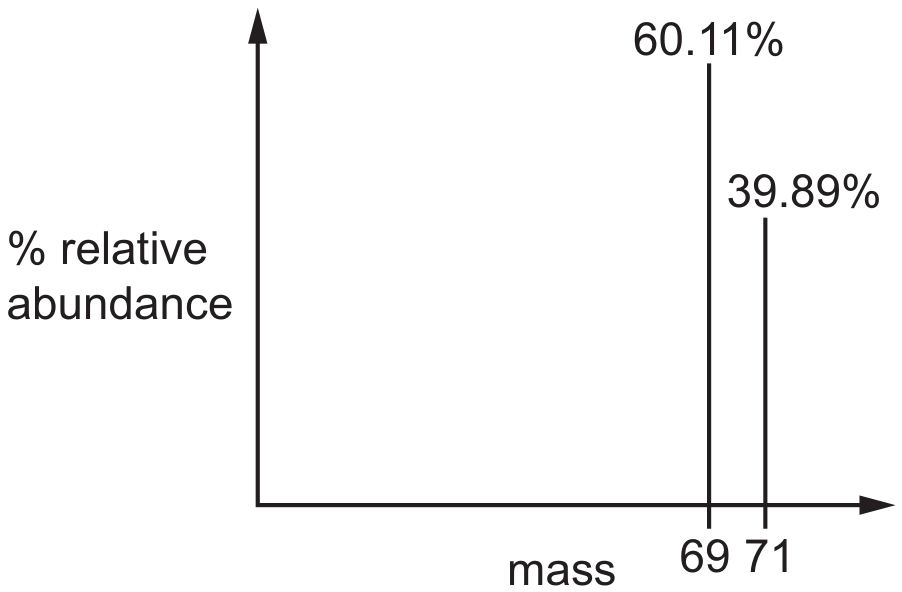
A sample of gallium is analysed using a mass spectrometer. The mass spectrum produced is shown.
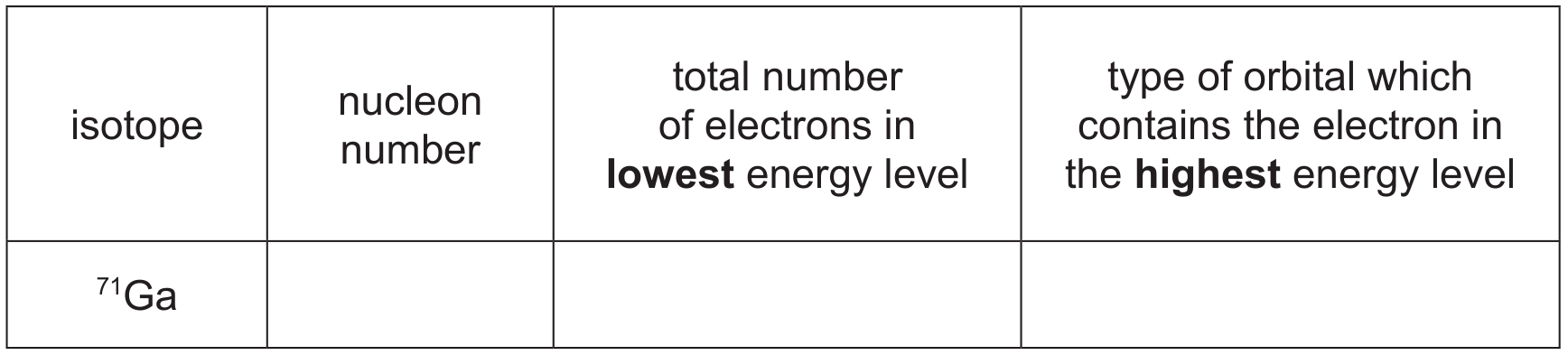
Complete the table which describes a gaseous atom of gallium.
In the Periodic Table, the p block contains elements whose outer electrons are found in the p subshell.
Elements in the p block show a general increase in first ionisation energy as the atomic number increases.
Draw the shape of a p orbital.
Copper is a transition element and has atomic number 29.
Complete the electronic configuration for the copper atom and the copper ion in the +2 oxidation state.
- copper atom
- copper ion in the +2 oxidation state
[Ar]
[Ar]