EduNinja

A-Level CAIE Chemistry AS9.2 Periodicity of chemical properties of the elements in Period 3Question Bank

Question 1

[Maximum number: 4]

Sodium and magnesium are the first two elements in the third period.

Question 1(a)

(a)

Sodium and magnesium both react with cold water to produce the same type of product in solution. With sodium the solution is clear but with magnesium it appears cloudy.

[ 1 ]

Question 1(a)(i)

(i)

Write an equation for the reaction of magnesium with cold water.

[ 1 ]

Question 1(b)

(b)

Group 2 elements, including magnesium, react with oxygen and with dilute acids. There are trends in both the physical and chemical properties of the elements and their compounds down the group. Reactivity generally increases from Mg to Ba .

[ 3 ]

Question 1(b)(ii)

(i)

Give two observations for the reaction of magnesium with oxygen. Write an equation for this reaction. Include state symbols.
equation

[ 3 ]

Question 1

[Maximum number: 5]

Oxides are compounds which usually contain oxygen combined with one other element.
Oxides are classified as follows.
acidic alkaline amphoteric basic

Question 1(a)

(a)

Using these terms only, complete the table to describe the oxides of the elements of the third period of the Periodic Table sodium to sulfur.

Table
[ 4 ]

Question 1(b)

(b)

Give the names of two elements from sodium to chlorine which form more than one oxide. and

[ 1 ]

Question 1

[Maximum number: 7]

The elements of the third period of the Periodic Table, sodium to sulfur, all form chlorides by direct combination.

Question 1(a)

Question 1(a)(i)

(a)
(i)

Sulfur forms a number of chlorides which are liquid at room temperature.

Which other element of the third period forms a chloride which is liquid at room temperature?

Question 1(a)(ii)

(ii)

Name one element of the third period which burns in chlorine with a coloured flame.

Question 1(a)(iii)

(iii)

Aluminium chloride may be produced by passing a stream of chlorine over heated aluminium powder in a long hard-glass tube.
State two observations you could make during this reaction. and

Question 1(a)(iv)

(iv)

Write a balanced equation, with state symbols, for this reaction of aluminium with chlorine.

Question 1(b)

(b)

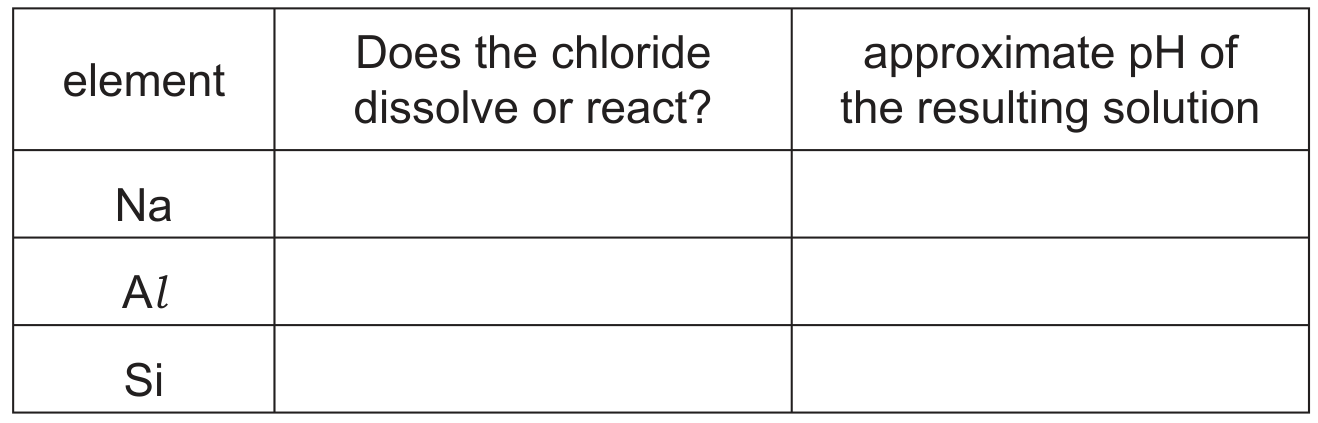
When chlorides of the elements of the third period are added to water, some simply dissolve while others can be seen to react with the water.

[ 7 ]

Question 1(b)(i)

(i)

Complete the table below, stating how the chlorides of Na, Al, and Si behave when mixed with water. In the first column use only the terms 'dissolve' or 'react'.

Table

Question 1(b)(ii)

(ii)

What type of reaction takes place between a chloride and water?

[ 7 ]

Question 1

[Maximum number: 15]

Although the actual size of an atom cannot be measured exactly, it is possible to measure the distance between the nuclei of two atoms. For example, the 'covalent radius' of the Cl atom is assumed to be half of the distance between the nuclei in a Cl2\mathrm{Cl}_{2} molecule. Similarly, the 'metallic radius' is half of the distance between two metal atoms in the crystal lattice of a metal. These two types of radius are generally known as 'atomic radii'.
The table below contains the resulting atomic radii for the elements of period three of the Periodic Table, Na to Cl.

Table

Question 1(c)

(a)

Each of the elements Na to Cl forms at least one oxide. Na2O\mathrm{Na}_{2} \mathrm{O} is an ionic oxide, SO2\mathrm{SO}_{2} is a covalent oxide. Both oxides react with water.

[ 15 ]

Question 1(c)(i)

(i)

Write an equation for the reaction of each of these oxides with water.
Na2O\mathrm{Na}_{2} \mathrm{O}SO2\mathrm{SO}_{2}

[ 5 ]

Question 1(c)(ii)

(ii)

What is the pH of the resulting solution in each case?
Na2O\mathrm{Na}_{2} \mathrm{O}

SO2\mathrm{SO}_{2}
[ 5 ]

Question 1(c)(iii)

(iii)

Write an equation for the reaction that occurs between the products of your reactions in (i).

[ 5 ]

Question 1

Question 1(d)

(a)

The elements in Period 3 of the Periodic Table show different behaviours in their reactions with oxygen.

[ 6 ]

Question 1(d)(i)

(i)

Describe what you would see when separate samples of magnesium and sulfur are reacted with oxygen.

Write an equation for each reaction.
magnesium
sulfur

[ 4 ]

Question 1(d)(ii)

(ii)

Write equations for the reactions of aluminium oxide, Al2O3\mathrm{Al}_{2} \mathrm{O}_{3}, with sodium hydroxide,
hydrochloric acid.

[ 2 ]

Question 1

Question 1(d)

(a)

The acid/base behaviour of the oxides in the third period varies across the period.

[ 6 ]

Question 1(d)(i)

(i)

Describe this behaviour and explain it with reference to the structure and bonding of sodium oxide, Na2O\mathrm{Na}_{2} \mathrm{O}, aluminium oxide, Al2O3\mathrm{Al}_{2} \mathrm{O}_{3}, and sulfur trioxide, SO3\mathrm{SO}_{3}.

[ 2 ]

Question 1(d)(ii)

(ii)

Write equations for reactions of these three oxides with hydrochloric acid and/or sodium hydroxide as appropriate.

[ 4 ]

Question 1

Question 1(a)

(a)

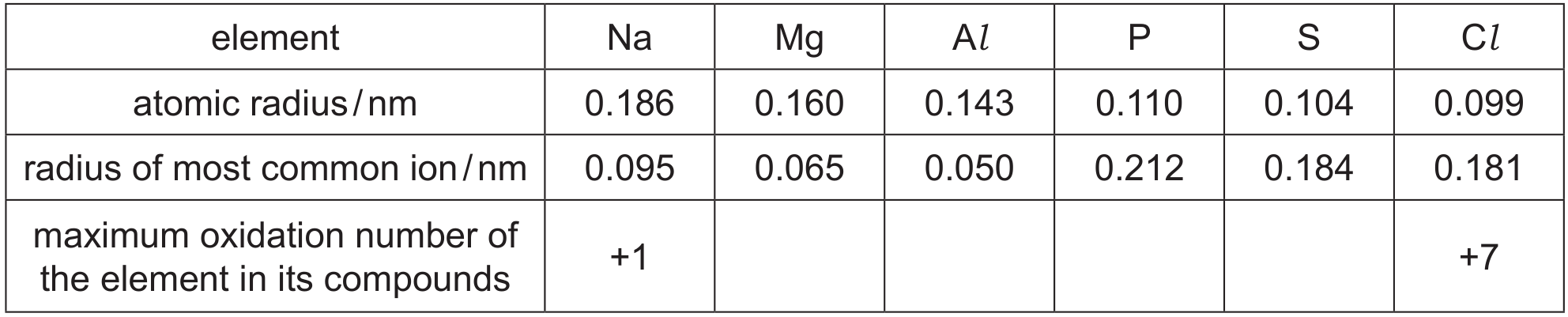
The table shows information about some of the elements in the third period.

Table
[ 1 ]

Question 1(a)(i)

(i)

Complete the table to show the maximum oxidation number of each element in its compounds.

[ 1 ]

Question 1

Question 1(c)

(a)

Gallium is a silver-grey solid. Aluminium and gallium share many similar chemical properties.

[ 2 ]

Question 1(c)(iii)

(i)

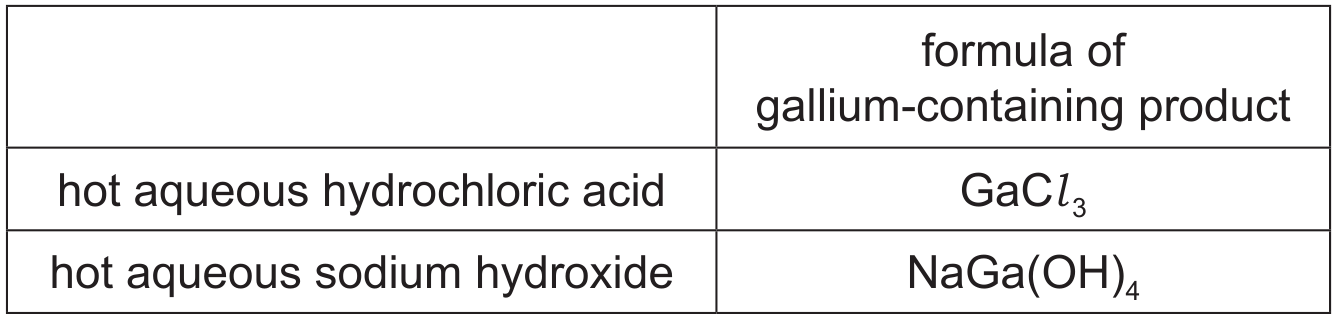
Complete the table by predicting the formula of each gallium-containing product formed when gallium oxide reacts separately with hot aqueous hydrochloric acid and with hot concentrated sodium hydroxide.

[Total: 12]

[Total: 12]

[ 2 ]

Question 1

[Maximum number: 2]

Group 2 metals form alkaline solutions in water.

Question 1(e)

(a)

Unlike the other oxides of Group 2 metals, beryllium oxide is amphoteric.

[ 2 ]

Question 1(e)(i)

(i)

Give the meaning of the term amphoteric.

[ 1 ]

Question 1(e)(ii)

(ii)

Beryllium oxide and aluminium oxide have similar chemical properties.

The Be(OH)42\mathrm{Be}(\mathrm{OH})_{4}{ }^{2-} anion is a product of the reaction between beryllium oxide and excess concentrated OH(aq)\mathrm{OH}^{-}(\mathrm{aq}).

Construct an equation for this reaction.

[ 1 ]

Question 1

[Maximum number: 3]

Gallium is a metal in Group 13 of the Periodic Table.

Question 1(c)

(a)

Gallium metal reacts rapidly when exposed to air. A white solid layer is formed on its surface.

[ 3 ]

Question 1(c)(i)

(i)

Suggest an equation to describe the reaction occurring when gallium metal is exposed to air.

[ 2 ]

Question 1(c)(ii)

(ii)

The table gives the formula of each gallium-containing product formed when gallium oxide reacts separately with hot aqueous hydrochloric acid and hot aqueous sodium hydroxide.

Table

Give the name of the type of behaviour shown by gallium oxide in these reactions.

[ 1 ]
0 selected