Question 1
Question 1(a)
(a)
Define the term mole.
[ 1 ]
 EduNinja
Define the term mole.
Another element, Z, in the same period of the Periodic Table as A, reacts with chlorine to form a compound with empirical formula . The percentage composition by mass of is Z, 31.13 ; Cl, 68.87.
Calculate the relative atomic mass, , of Z.
Give your answer to three significant figures.
Atoms with nuclei containing an odd number of protons tend to have fewer isotopes than those with an even number of protons.
Gallium has two stable isotopes, and .
The relative atomic mass of gallium, , is 69.723.
The relative isotopic masses of and are:
Use this information to calculate the percentage abundance of in elemental gallium. Show your working.
Assume that the element contains only the and isotopes.
Give your answer to four significant figures.
percentage abundance of \%
The element copper has a relative atomic mass of 63.5.
Calculate how many atoms are present in 1.05 g of copper.
Ethanedioic acid, , has a relative molecular mass of 90.0.
Calculate how many atoms of carbon are present in 0.18 g of ethanedioic acid, . Show your working.
atoms of carbon present =
In the Periodic Table, the p block contains elements whose outer electrons are found in the p subshell.
Silicon is found in many compounds in the Earth's crust. Silicon has only three naturally occurring isotopes, and .
The table shows data for and .

A sample of silicon contains . The total percentage abundance of and in the sample is 7.8 %.
The relative atomic mass, , of silicon in the sample is 28.09 .
Calculate the percentage abundance of .
Give your answer to one decimal place.
percentage abundance of \%
Neon is a noble gas.
Neon has three stable isotopes.
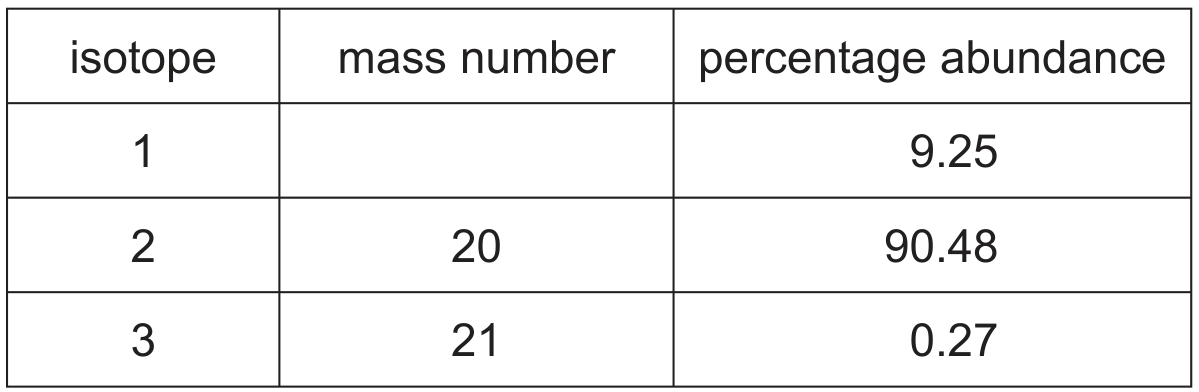
Use the relative atomic mass of neon, 20.2, to calculate the mass number of isotope 1.
A sample of sulfur contains only two isotopes, and . The relative atomic mass of this sample is 32.09 .
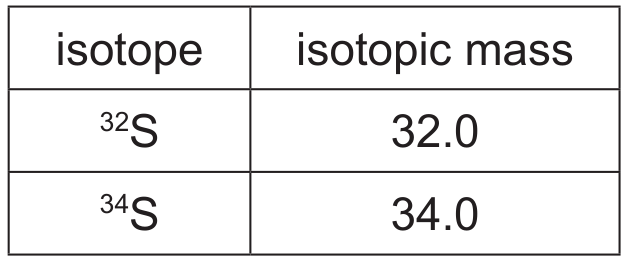
Calculate the percentage abundance of the isotopes present in this sample.
The element magnesium, Mg, proton number 12, is a metal which is used in many alloys which are strong and light.
Magnesium has several naturally occurring isotopes.
Calculate the relative atomic mass, , of magnesium in the sample. Express your answer to an appropriate number of significant figures.
Antimony, Sb, proton number 51, is another element which is used in alloys.
Magnesium and antimony each react when heated separately in chlorine.
Calculate the amount, in moles, of antimony atoms that reacted.
Calculate the amount, in moles, of chlorine atoms that reacted.
Most elements exist naturally as a mixture of isotopes, each with their own relative isotopic mass. The mass spectrum of an element reveals the abundances of these isotopes, which can be used to calculate the relative atomic mass of the element.
Magnesium has three stable isotopes. Information about two of these isotopes is given.
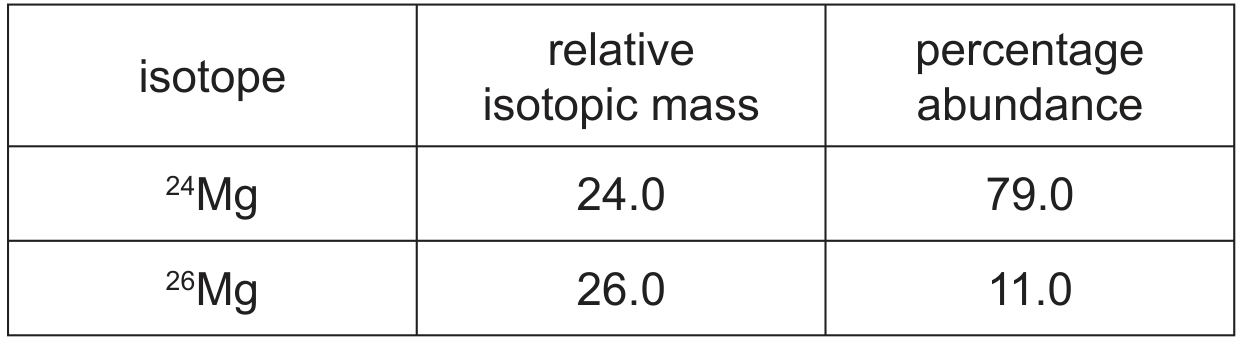
The relative atomic mass of magnesium is 24.3.
Calculate the percentage abundance and hence the relative isotopic mass of the third isotope of magnesium. Give your answer to three significant figures
percentage abundance =