
EduNinja

A-Level CAIE Chemistry AS3.2 Ionic bondingQuestion Bank

Question 1

[Maximum number: 3]

Ammonia, NH3\mathrm{NH}_{3}, and methane, CH4\mathrm{CH}_{4}, are the hydrides of elements which are next to one another in the Periodic Table.

Question 1(c)

(a)

When ammonia gas is mixed with hydrogen chloride, white, solid ammonium chloride is formed.

State each type of bond that is present in one formula unit of ammonium chloride and how many of each type are present.
You may draw diagrams.

[ 3 ]
Question 1

Question 1(a)

(a)

A sample of barium is heated in oxygen.

[ 2 ]

Question 1(a)(i)

(i)

Describe two observations for this reaction.

[ 2 ]

Question 1

[Maximum number: 2]

Species such as NH4+,CO32\mathrm{NH}_{4}{ }^{+}, \mathrm{CO}_{3}{ }^{2-} and PO43\mathrm{PO}_{4}{ }^{3-} are examples of molecular ions.

Question 1(a)

(a)

Ionic and covalent bonds both involve an electrostatic attraction between different species.

Identify the species that are electrostatically attracted to one another in:
- an ionic bond
- a covalent bond.

[ 2 ]

Question 1

[Maximum number: 2]

Aluminium is a metal in Period 3 and Group III of the Periodic Table.

Question 1(c)

(a)

Aluminium reacts with chlorine to form a white, solid chloride that contains 79.7 % chlorine and sublimes (changes straight from a solid to a gas) at 180C180^{\circ} \mathrm{C}.

[ 2 ]

Question 1(c)(i)

(i)

Describe the structure and bonding in this compound. Suggest how it explains the low sublimation temperature.

[ 2 ]

Question 1

Question 1(b)

(a)

One of the factors that determines the type of bonding present between the particles of a substance is the relative electronegativities of the bonded particles.

[ 2 ]

Question 1(b)(iii)

(i)

Name and describe the type of bonding you would expect to find between particles with very different electronegativities.

[ 2 ]

Question 1

[Maximum number: 2]

Aluminium is a metal in Period 3 and Group III of the Periodic Table.

Question 1(c)

(a)

Aluminium reacts with chlorine to form a white, solid chloride that contains 79.7 % chlorine and sublimes (changes straight from a solid to a gas) at 180C180^{\circ} \mathrm{C}.

[ 2 ]

Question 1(c)(i)

(i)

Describe the structure and bonding in this compound. Suggest how it explains the low sublimation temperature.

[ 2 ]

Question 1

Question 1(d)

(a)

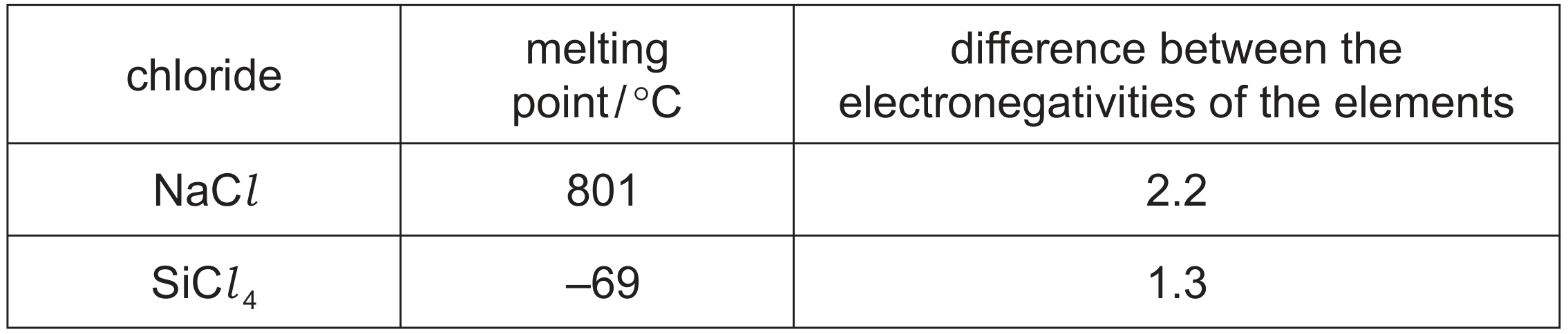
Sodium and silicon also react directly with chlorine to produce the chlorides shown.

Table
[ 2 ]

Question 1(d)(i)

(i)

Describe what you would see during the reaction between sodium and chlorine.

[ 2 ]

Question 1

Question 1(a)

(a)

Magnesium nitrate, Mg(NO3)2\mathrm{Mg}\left(\mathrm{NO}_{3}\right)_{2}, is very soluble in water. When a hot saturated solution of magnesium nitrate is cooled, crystals of the hydrate, Mg(NO3)26H2O\mathrm{Mg}\left(\mathrm{NO}_{3}\right)_{2} \cdot 6 \mathrm{H}_{2} \mathrm{O}, are formed.
In the crystals, six water molecules bond to each Mg2+\mathrm{Mg}^{2+} ion, and some of these water molecules are also bonded to the nitrate ions.

[ 1 ]

Question 1(a)(ii)

(i)

Describe the arrangement of the water molecules around the Mg2+\mathrm{Mg}^{2+} ion.

[ 1 ]

Question 1

Question 1(a)

(a)

Write a balanced equation for the reaction of each of the following chlorides with water.
phosphorus(V) chloride
silicon(IV) chloride

[ 2 ]

Question 1(c)

(b)

Under suitable conditions, SCl2\mathrm{SCl}_{2} reacts with water to produce a yellow precipitate of sulfur and a solution A. Solution A contains a mixture of SO2(aq)\mathrm{SO}_{2}(\mathrm{aq}) and compound B.

[ 1 ]

Question 1(c)(iv)

(i)

Construct an equation for the reaction between SCl2\mathrm{SCl}_{2} and water.

[ 1 ]

Question 1

Question 1(b)

(a)

Gaseous ammonia and hydrogen fluoride react together to give solid ionic ammonium fluoride.

NH3( g)+HF( g)NH4 F( s)ΔH=147 kJ mol1\mathrm{NH}_{3}(\mathrm{~g})+\mathrm{HF}(\mathrm{~g}) \rightleftharpoons \mathrm{NH}_{4} \mathrm{~F}(\mathrm{~s}) \quad \Delta H=-147 \mathrm{~kJ} \mathrm{~mol}^{-1}
[ 3 ]

Question 1(b)(iii)

(i)

There are three types of bonding in NH4 F\mathrm{NH}_{4} \mathrm{~F}.

Give the names of each of the three types, and state where in the compound each type occurs.

[ 3 ]

Question 1(c)

(b)

Many commercial copper and brass polishes contain ammonia. The tarnish that forms on the surface of copper is often copper sulfide, CuS . In the presence of O2\mathrm{O}_{2} from the air, NH3\mathrm{NH}_{3} can combine with this copper sulfide to produce the soluble cuprammonium sulfate, [Cu(NH3)4]SO4\left[\mathrm{Cu}\left(\mathrm{NH}_{3}\right)_{4}\right] \mathrm{SO}_{4}.

[ 1 ]

Question 1(c)(i)

(i)

Construct an equation for this reaction.

[ 1 ]
0 selected