Question 1
Sulfides are compounds that contain sulfur but not oxygen.
Question 1(a)
Carbon disulfide, , is a volatile liquid at room temperature and pressure.
Question 1(a)(iii)
Suggest the bond angle in a molecule of .
EduNinjaSulfides are compounds that contain sulfur but not oxygen.
Carbon disulfide, CS2, is a volatile liquid at room temperature and pressure.
Suggest the bond angle in a molecule of CS2.
Draw a three-dimensional diagram showing the shape of the chloride. Give the Cl-Si-Cl bond angle.
Tellurium is an element in Group 16. The most common isotope of tellurium is 130Te. Its electronic configuration is [Kr]4 d105 s25p4.
Te reacts with F2 at 150∘C to form TeFx. Molecules of TeFx are octahedral with bond angles of 90∘.
Explain why TeFx is octahedral with bond angles of 90∘.
The elements silicon, phosphorus and sulfur are in Period 3 of the Periodic Table.
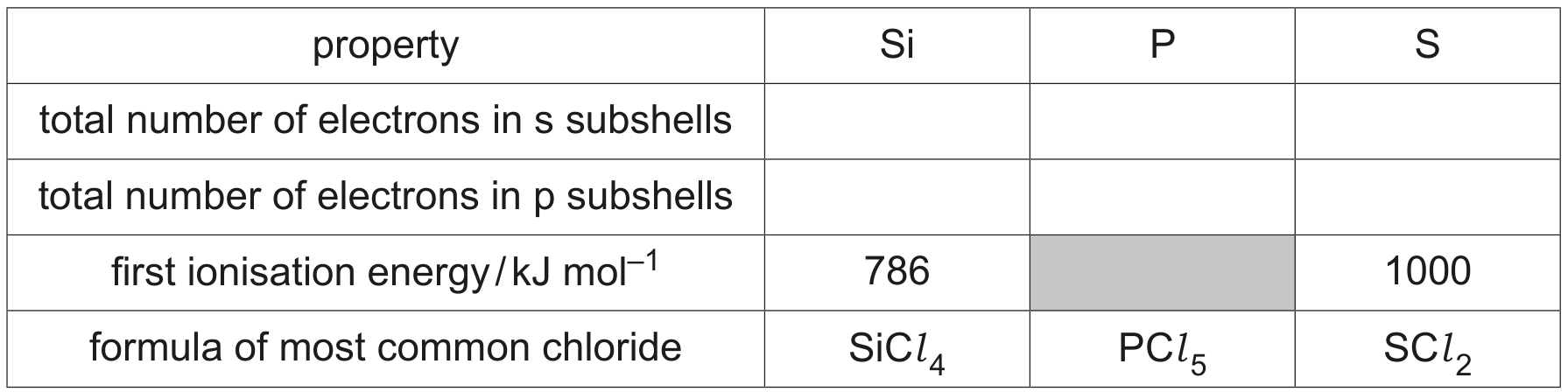
Table 1.1 shows some properties of the elements Si to S .
The first ionisation energy of P is not shown.

Table 1.1
Predict the shape of the SCl2 molecule.
Sulfur reacts with fluorine to form SF6. State the shape and bond angle of SF6.
shape of SF6
bond angle of SF6
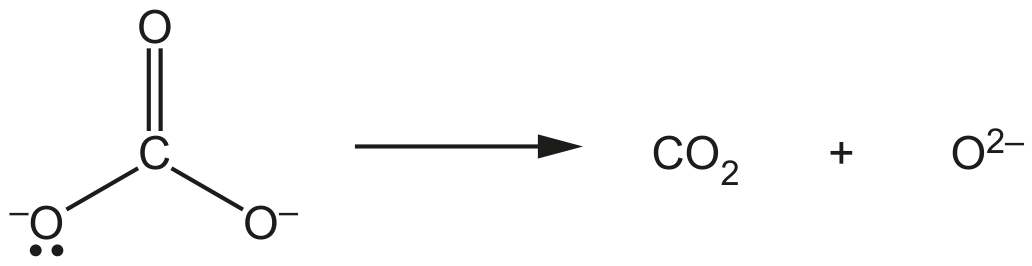
Group 2 carbonates decompose when heated to form the metal oxide and carbon dioxide.
Suggest a mechanism for the decomposition of the carbonate ion by adding two curly arrows in Fig. 1.1.

Fig. 1.1
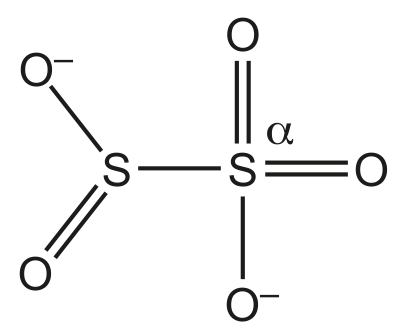
Potassium disulfite, K2 S2O5, is another food additive. The disulfite ion, S2O52−, has the displayed formula shown in Fig. 1.2.

Fig. 1.2
Deduce the geometry (shape) around the S(α) atom in S2O52−.
geometry around S(α)
Oxides are compounds which usually contain oxygen combined with one other element.
Oxides are classified as follows.
acidic alkaline amphoteric basic
Another sulfur compound which is present in the Earth's atmosphere is carbonyl sulfide, OCS. The sequence of atoms in the molecule is oxygen-carbon-sulfur and the molecule is not cyclic.
Suggest a value for the O-C-S bond angle.
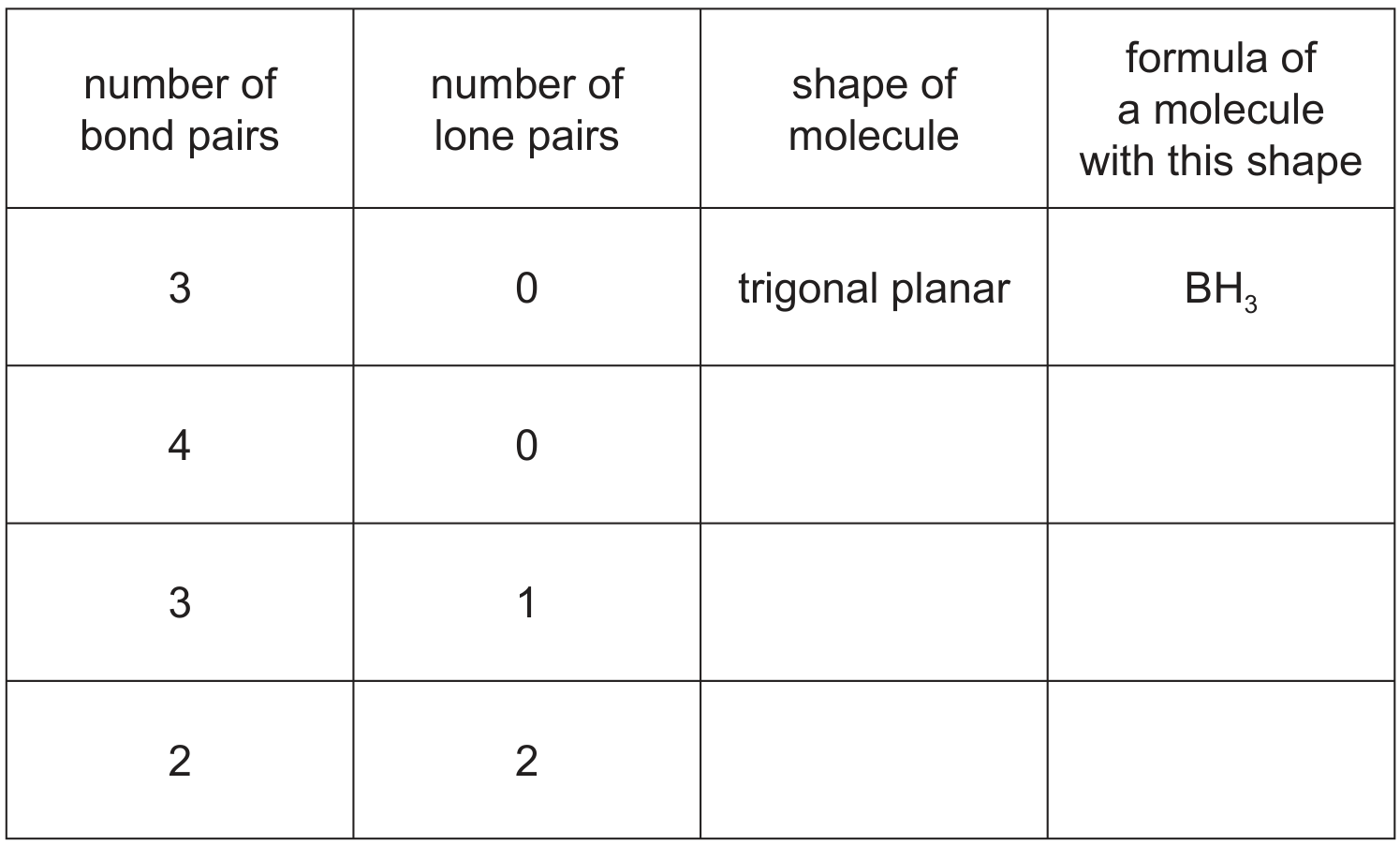
Valence Shell Electron Pair Repulsion theory (VSEPR) is a model of electron-pair repulsion (including lone pairs) that can be used to deduce the shapes of, and bond angles in, simple molecules.
Complete the table below by using simple hydrogen-containing compounds. One example has been included.

Tellurium, Te, proton number 52, is used in photovoltaic cells.
When fluorine gas is passed over tellurium at 150∘C, the colourless gas TeF6 is formed.
What will be the shape of the TeF6 molecule?
What is the F-Te-F bond angle in TeF6 ?
The elements of the third period of the Periodic Table, sodium to sulfur, all form chlorides by direct combination.
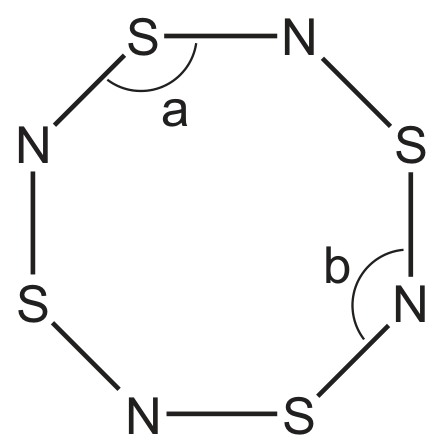
Sulfur forms the compound S4 N4 with nitrogen. The structure of S4 N4 is shown below. Assume all bonds shown are single bonds.

Which bond angle, a or b, in the S4 N4 molecule will be smaller? Explain your answer.
What are the shapes of the molecules of water and boron trifluoride?
H2O
BF3
linear
pyramidal
linear
trigonal
non-linear
pyramidal
non-linear
trigonal