D2.1.6—Shared features
Mitosis and meiosis share chromosome condensation, spindle microtubule movement and chromatid separation, although their outcomes differ strongly in dividing cells.
- Syllabus
- First assessment 2025
- Objective
- D2.1.6
- Level
- HL
Mitosis and meiosis share chromosome condensation, spindle microtubule movement and chromatid separation, although their outcomes differ strongly in dividing cells.

Coverage 2021–2021 · Updated 16 Jul 2026
Mitosis and meiosis both condense chromosomes and move them accurately between new nuclei.
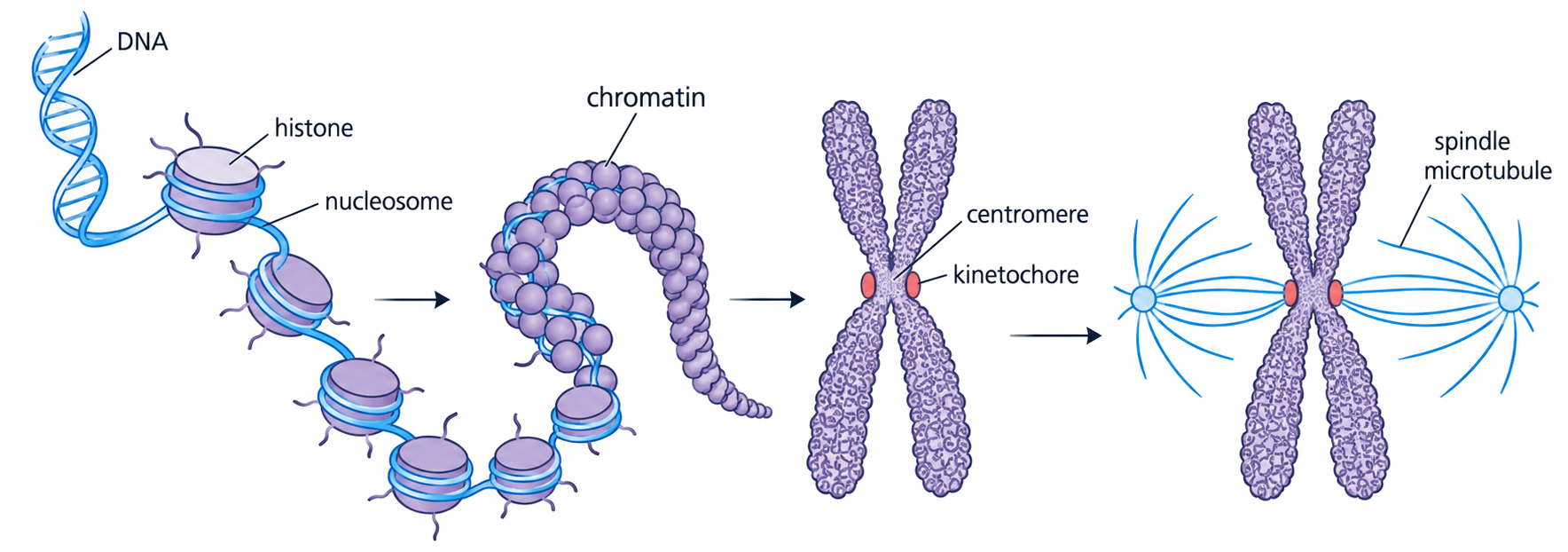
Histones organize DNA into nucleosomes, and further supercoiling condenses the long chromatin fibres into compact chromosomes that can be moved without tangling.
Spindle microtubules attach to chromosomes, and microtubule motors plus microtubule shortening or growth generate directed movement. Alignment and separation differ between divisions, but the same general machinery organizes chromosome distribution.
In both mitosis and meiosis II, sister chromatids move toward opposite poles; in meiosis I, homologous chromosomes move apart while sister chromatids remain together.
Shared condensation and movement mechanisms do not make the outcomes identical: the chromosome partners separated and the number of divisions differ.
This objective is assessed through multiple choice, commonly using Identify.
Identify
Build the answer around this relationship: Both mitosis and meiosis use spindle microtubules to move chromosomes.
Representative question
What occurs in cell division during both mitosis and meiosis?
Condensation of DNA by supercoiling in telophase
Movement of microtubules to move chromatids in anaphase
Pairing of homologous chromosomes in prophase
Crossing over between chromosomes in metaphase
B