D2.1.16 (HL)—Mutations in cell cycle genes

Mutations in cell-cycle control genes can activate oncogenes or disable suppressors, causing uncontrolled mitosis and tumour formation in tissues repeatedly.

Syllabus
First assessment 2025
Objective
D2.1.16
Level
HL

Exam analysis

Chance of appearing4%of analysed past papers
Latest appearanceMay 2025
Most common paperPaper2
Typical marks1–4

Common command terms

  • State
  • Outline
  • Explain
  • Predict

Scoring notes

Common mistake
Describing cancer as ordinary growth without linking it to uncontrolled cell division.

Recent exam appearances

May 2025Paper1A ["HL"] · TZ319[ 1 ]D2.1.16 (HL)—Mutations in cell cycle genes
May 2023Paper2 ["HL"] · TZ26(a)[ 4 ]D2.1.16 (HL)—Mutations in cell cycle genes
May 2019Paper1 ["HL"] · TZ23[ 1 ]D2.1.16 (HL)—Mutations in cell cycle genes
May 2019Paper2 ["HL"] · TZ22(a)(ii)[ 2 ]D2.1.16 (HL)—Mutations in cell cycle genes
Practice this objective

Coverage 2019–2025 · Updated 16 Jul 2026

Cell-Cycle Gene Mutations Can Cause Uncontrolled Division

HL only

Mutations can cause uncontrolled cell division by converting proto-oncogenes into oncogenes or by disabling tumour-suppressor genes.

Gene class Normal role Cancer-promoting mutation
Proto-oncogene Promotes division only when appropriate Gain of function produces an oncogene that sends excessive growth signals
Tumour-suppressor gene Slows the cycle, enforces checkpoints or prevents damaged cells dividing Loss of function removes a brake on division

A clone carrying one control mutation can continue dividing and acquire further mutations, progressively weakening the systems that restrain proliferation.

An activated oncogene can keep a growth pathway switched on while loss of a tumour suppressor allows damaged cells to pass a checkpoint; together they strongly favour tumour growth.

One mutation does not guarantee cancer. Several independent controls normally limit division, so tumour development often involves accumulated mutations.

Mutations in cell cycle genes

HL only

Assessment in practice

1–2 marks
How it is assessed

This objective is assessed through structured response, commonly using State / Outline / Explain.

Command terms

State / Outline / Explain / Predict

What earns marks

Build the answer around this relationship: Tumours result from uncontrolled cell division.

Watch for

Describing cancer as ordinary growth without linking it to uncontrolled cell division.

Representative question

Question 1

[Maximum number: 4]

Explain how changes to the cell cycle can result in tumour formation.

HL Cell Cycle and Cancer

HL only

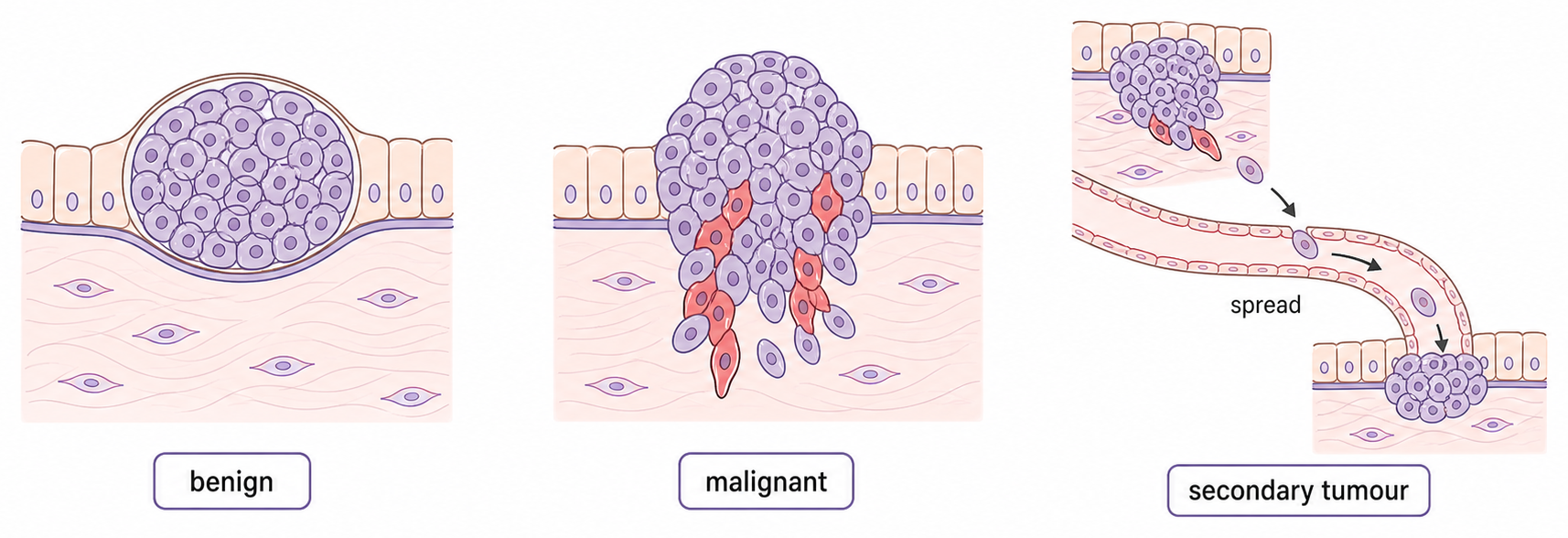
Cell proliferation increases cell number by repeated mitosis, as in plant meristems, early embryos, skin replacement, and wound healing. The cell cycle includes interphase, mitosis, and cytokinesis; interphase has G1 growth, S-phase DNA replication, and G2 preparation. Interphase is metabolically active, not resting; cells synthesize proteins, replicate DNA, grow cytoplasm, and increase organelles. Cyclin concentrations rise and fall to activate cyclin-dependent kinases; CDK-cyclin complexes such as MPF control checkpoints and mitosis entry. Proto-oncogene activation and tumour suppressor loss disrupt checkpoints; accumulated mutations can cause uncontrolled proliferation and cancer. Benign tumours grow locally, malignant tumours invade neighbouring tissues, and metastasis spreads cancer cells to form secondary tumours.

Concept essentials

  • Tumours result from uncontrolled cell division.
  • Oncogene mutations can disrupt cell-cycle regulation.
  • Loss of tumour suppressor function can remove checkpoint control.
  • A high mitotic index can indicate rapid tumour growth.