D1.1.5—Applications

Applications of DNA replication techniques use PCR, gel electrophoresis and DNA profiles to identify individuals, test paternity and support forensic or medical decisions.

Syllabus
First assessment 2025
Objective
D1.1.5
Level
HL

Exam analysis

Chance of appearing5%of analysed past papers
Latest appearanceMay 2022
Most common paperPaper1
Typical marks1–4

Common command terms

  • Identify
  • Determine
  • Explain
  • Describe
  • Outline

Scoring notes

Common mistake
Confusing DNA polymerase I primer replacement with DNA polymerase III strand elongation.

Recent exam appearances

May 2022Paper2 ["HL"] · TZ18(b)[ 5 ]D1.1.5—Applications
May 2021Paper2 ["HL"] · TZ18(a)[ 4 ]D1.1.5—Applications
November 2020Paper1 ["HL"] · TZ012[ 1 ]D1.1.5—Applications
November 2017Paper3 ["HL"] · TZ010(d)[ 1 ]D1.1.5—Applications
May 2016Paper1 ["HL"] · TZ07[ 1 ]D1.1.5—Applications

Coverage 2014–2022 · Updated 16 Jul 2026

Band Position Reports Fragment Length; Alignment Reports a Match

Observation Interpretation
band farther from wells shorter DNA fragments
bands at the same height in two lanes fragments of the same measured length
more intense band more stained DNA at that position, not a longer fragment

Compare lanes horizontally, one band position at a time. A profile comparison uses a pattern across many variable markers, not one matching band.

A same-height band supports a shared fragment length; it does not by itself prove that every base in the fragments is identical.
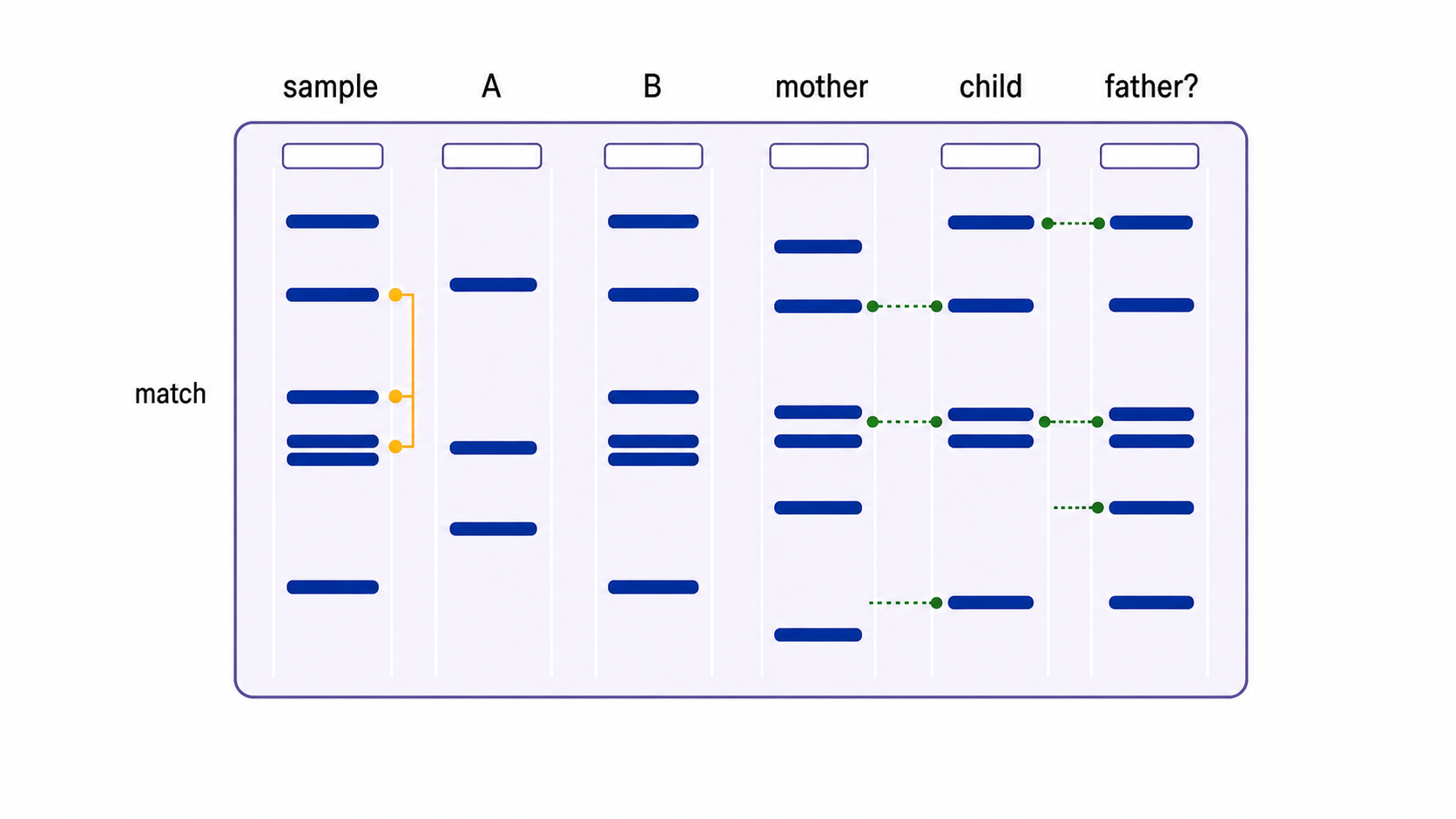
DNA profile lanes show a sample matching one reference and a child's bands aligning with bands from the two parents.

DNA Profiles Compare Several Variable Markers

collect and preserve samples → extract DNA → amplify selected STR or VNTR markers by PCR → separate products by electrophoresis → compare band or peak patterns

Result Supported conclusion Not established by the profile alone
questioned sample differs at a reliable marker that reference individual is excluded who left the sample
all tested markers match the samples may share a source when or how the DNA arrived

Match strength increases when more independent, variable markers agree and when the matching pattern is rare in the relevant population.

Contamination, mixed samples, degraded DNA and laboratory error can weaken the inference. Controls and careful sample handling are part of the evidence.

A Child's Markers Must Be Accounted for by Both Parents

At each tested marker, a child inherits one allele from the biological mother and one from the biological father.

Start with the child's pattern → account for bands or alleles shared with the known parent → compare every remaining child marker with the possible other parent.

Comparison Inference
a required child marker is absent from the possible parent exclude that person at that marker, after checking data quality
all non-maternal child markers are present in the possible father parentage is supported, with strength depending on marker number and frequencies

Close relatives share more DNA than unrelated people. Parentage conclusions use multiple markers and probability, not a visual impression from one or two bands.

Follow DNA from a Tiny Sample to a Qualified Conclusion

Stage Question answered Key control
primer design which region will be copied? complementary, target-specific flanking sequences
PCR is there enough target DNA to analyse? positive and negative controls; contamination prevention
electrophoresis what fragment lengths are present? ladder and correct electrode orientation
profile comparison are patterns consistent with a shared source or inheritance? enough informative markers and relevant frequencies

PCR changes quantity; electrophoresis changes position; interpretation changes neither. Each step supports a different claim.

A laboratory match is evidence of consistency. The final conclusion must remain limited by sample quality, contamination risk, marker informativeness and the biological question being tested.

Applications exam focus

[ 4 ]

Outline the process of DNA profiling.

Concept essentials

  • Applications depends on matching each strand, enzyme or laboratory step to its exact function.
  • Template strands and complementary base pairing give applications its copying accuracy.
  • Applications is clearer when amplification, separation and profiling are not confused.
  • Molecular evidence for applications must be interpreted from bands, isotopes, primers or enzyme roles.