Q BankQuestion BankDocsDocuments

D1.1.1—DNA replication

DNA replication explains how DNA is copied, checked, amplified or analysed through specific strand relationships, enzyme functions and molecular techniques.

Syllabus
First assessment 2025
Objective
D1.1.1
Level
HL

Exam analysis

Chance of appearing1%of analysed past papers
Latest appearanceNovember 2016
Most common paperPaper2
Typical marks8

Common command terms

  • Identify
  • Explain

Scoring notes

Common mistake
Saying both parental strands stay together instead of one parental strand entering each daughter molecule.

Recent exam appearances

November 2016Paper2 ["HL"] · TZ07(c)[ 8 ]D1.1.1—DNA replication
Practice this objective

Coverage 2016–2016 · Updated 16 Jul 2026

DNA Replication Copies the Genome Before Division

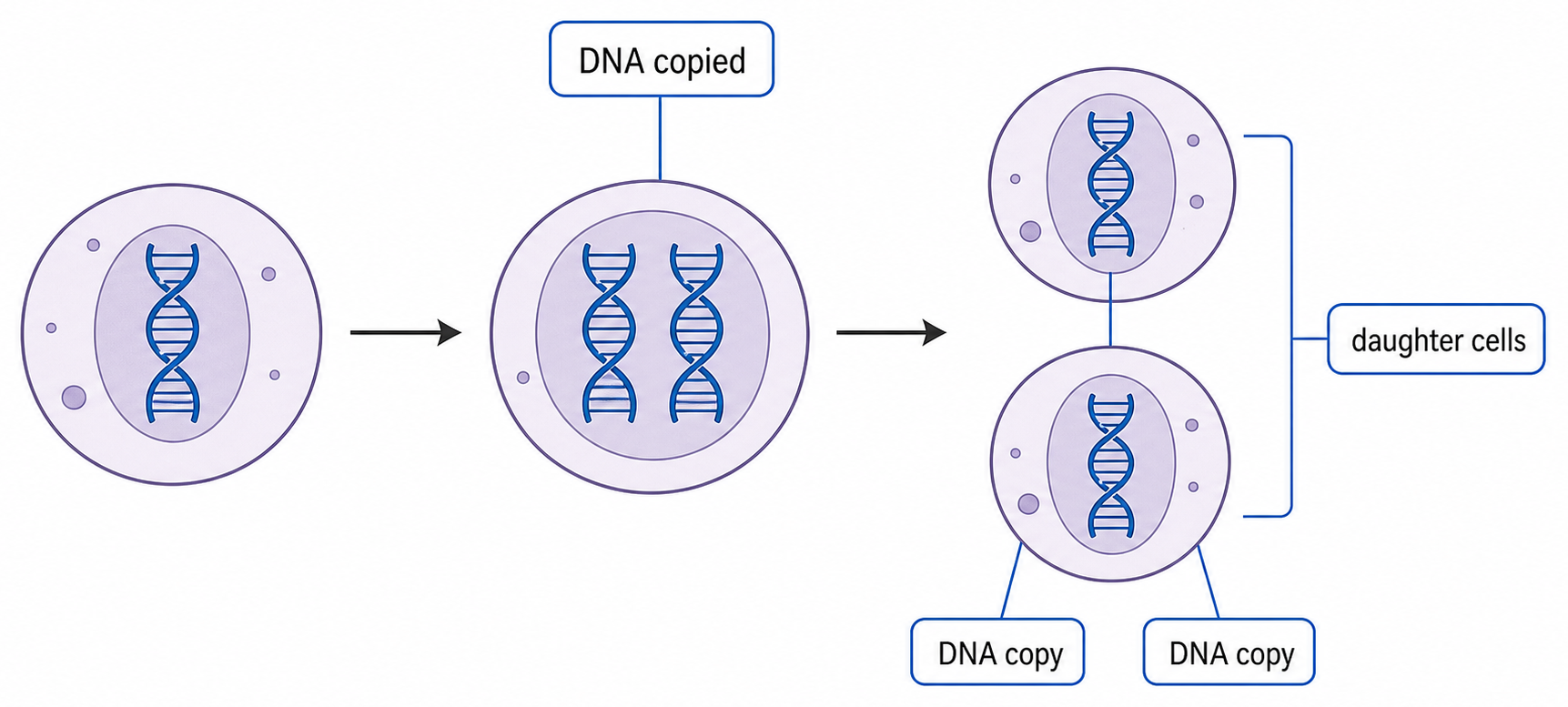
DNA replication makes a matching copy of a DNA molecule so each daughter cell can receive the genetic information needed for its functions.

Complementary base pairing lets each original strand guide a new strand. The double helix is opened, nucleotides are added and the two resulting molecules carry the same sequence information, barring copying errors.

Trace: helix opens; each old strand templates a new strand; complementary nucleotides join; two DNA molecules result.

Before a cell divides, one DNA molecule becomes two molecules with matching base sequences so each daughter nucleus can inherit a copy.

Replication is copying DNA, not translating it into protein and not making two completely new strands without templates.

DNA replication

Assessment in practice

1–8 marks
How it is assessed

This objective is assessed through structured response, commonly using Identify / Explain.

Command terms

Identify / Explain

What earns marks

Build the answer around this relationship: DNA replication depends on matching each strand, enzyme or laboratory step to its exact function.

Watch for

Saying both parental strands stay together instead of one parental strand entering each daughter molecule.

Representative question

Question 1

[Maximum number: 8]

Growth in living organisms includes replication of DNA. Explain DNA replication.

Core DNA Replication

DNA replication produces exact DNA copies before cell division and maintains genetic continuity for reproduction, growth, and tissue replacement. Semi-conservative replication gives each new DNA molecule one original strand and one new strand; complementary base pairing and Meselson-Stahl isotope evidence support the model. Helicase unwinds DNA and breaks hydrogen bonds; DNA polymerase joins complementary nucleotides to build new strands. PCR amplifies selected DNA using primers, temperature cycles, and Taq polymerase; gel electrophoresis separates DNA fragments by size and charge. PCR and gel electrophoresis support DNA profiling for forensic identification and paternity testing.

Concept essentials

  • DNA replication depends on matching each strand, enzyme or laboratory step to its exact function.
  • Template strands and complementary base pairing give dna replication its copying accuracy.
  • DNA replication is clearer when amplification, separation and profiling are not confused.
  • Molecular evidence for dna replication must be interpreted from bands, isotopes, primers or enzyme roles.
ConceptIB Biology HL