EduNinja

IGCSE Chemistry Extended6.2.1—Rate changes caused by concentrationTopic Practice

6.2.1—Rate changes caused by concentration

• Describe rate changes caused by concentration, gas pressure, solid surface area, temperature and adding/removing catalysts, including enzymes

Question 1(e)(iv)

[Maximum number: 2]

Some elements are shown in the order they appear in the reactivity series. The most reactive element is at the top.
> sodium calcium magnesium aluminium zinc iron hydrogen copper

When zinc granules are added to aqueous copper(II) sulfate, a reaction occurs. During the reaction, a red-pink solid is formed and the solution becomes colourless.

Suggest two other ways of increasing the rate of this reaction.

1

2
Question 13

[Maximum number: 1]

Magnesium powder reacts with an excess of dilute hydrochloric acid to produce hydrogen gas.
Which statements about this reaction are correct?
1 The smaller the particles of magnesium powder, the more slowly the hydrogen is produced.

2 The higher the temperature, the faster the magnesium powder disappears.
3 The lower the concentration of dilute hydrochloric acid, the faster the rate of reaction.

4 The faster the magnesium powder disappears, the faster the rate of reaction.

A

1 and 2

B

2 and 3

C

2 and 4

D

3 and 4

Question 14

[Maximum number: 1]

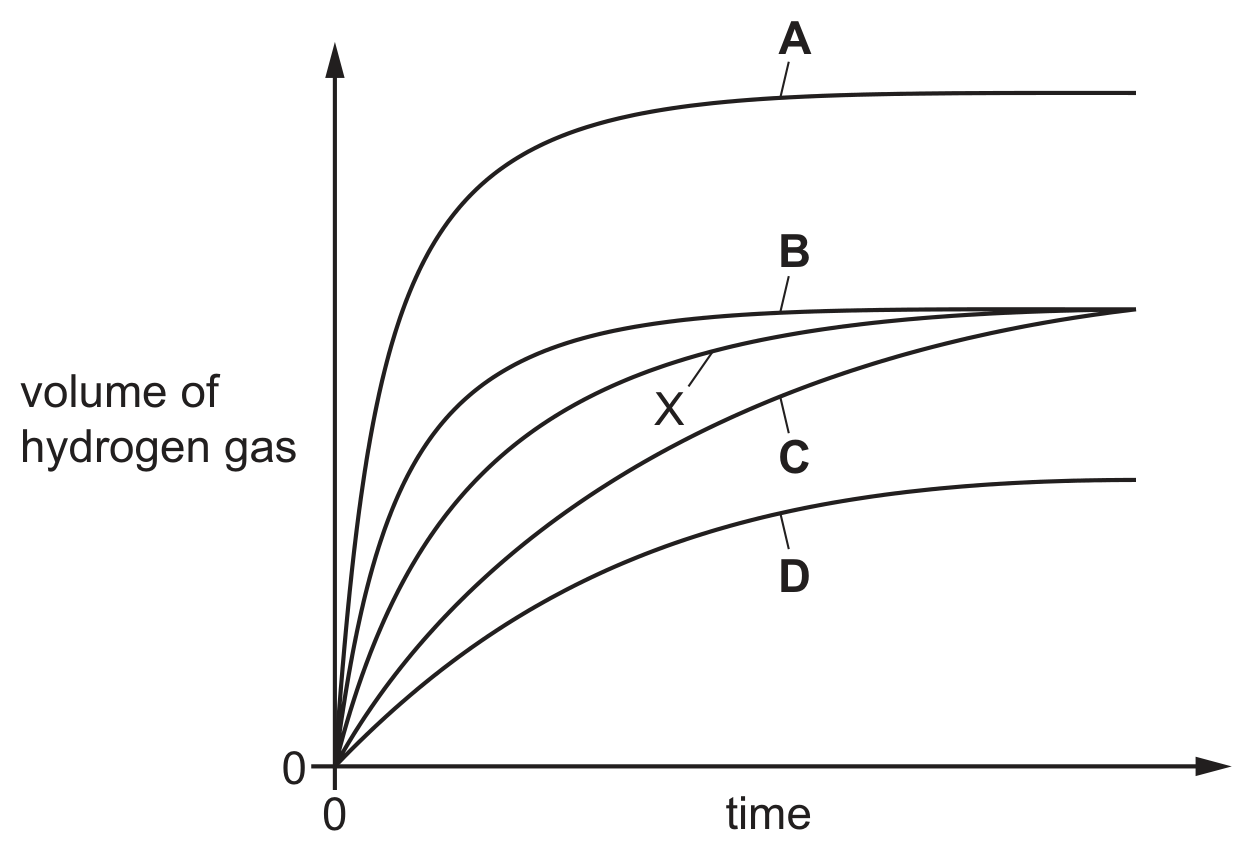
A student adds excess zinc to dilute hydrochloric acid at 25C25^{\circ} \mathrm{C}.
The hydrogen gas produced is collected and measured at room temperature and pressure.
The results are plotted and labelled as curve X on the graph.
The experiment is repeated at 50C50^{\circ} \mathrm{C} with all other conditions remaining the same.
Which graph shows the results at 50C50^{\circ} \mathrm{C} ?

Question image

Question 14

[Maximum number: 1]

The rate of reaction between magnesium ribbon and 2 mol/dm32 \mathrm{~mol} / \mathrm{dm}^{3} hydrochloric acid at 25C25^{\circ} \mathrm{C} to produce hydrogen gas is measured.

In another experiment, either the concentration of the hydrochloric acid or the temperature is changed. All other conditions are kept the same.

Which conditions increase the rate of reaction?

A

1 mol/dm31 \mathrm{~mol} / \mathrm{dm}^{3} hydrochloric acid at 25C25^{\circ} \mathrm{C}

B

2 mol/dm32 \mathrm{~mol} / \mathrm{dm}^{3} hydrochloric acid at 10C10^{\circ} \mathrm{C}

C

2 mol/dm32 \mathrm{~mol} / \mathrm{dm}^{3} hydrochloric acid at 20C20^{\circ} \mathrm{C}

D

3 mol/dm33 \mathrm{~mol} / \mathrm{dm}^{3} hydrochloric acid at 25C25^{\circ} \mathrm{C}

Question 14

[Maximum number: 1]

Dilute hydrochloric acid reacts with 1 g of limestone.
Which conditions produce the fastest rate of reaction?

A

2 mol/dm32 \mathrm{~mol} / \mathrm{dm}^{3} hydrochloric acid and a single lump of limestone

B

4 mol/dm34 \mathrm{~mol} / \mathrm{dm}^{3} hydrochloric acid and a single lump of limestone

C

4 mol/dm34 \mathrm{~mol} / \mathrm{dm}^{3} hydrochloric acid and small pieces of limestone

D

4 mol/dm34 \mathrm{~mol} / \mathrm{dm}^{3} hydrochloric acid and powdered limestone

Question 14

[Maximum number: 1]

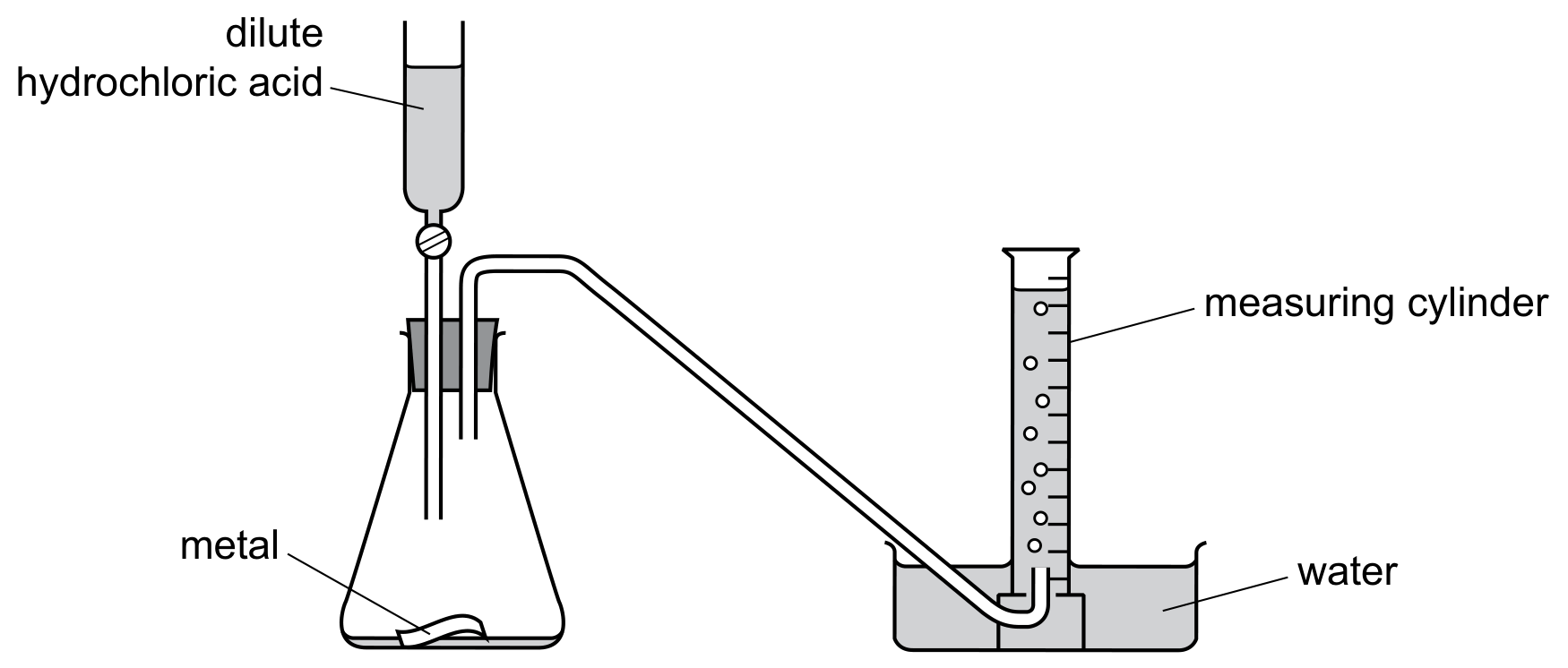
The diagram shows an experiment to measure the rate of a chemical reaction.

Question image

Which change decreases the rate of reaction?

A

adding water to the flask

B

heating the flask during the reaction

C

using more concentrated acid

D

using powdered metal

Question 14

[Maximum number: 1]

Hydrogen peroxide, H2O2\mathrm{H}_{2} \mathrm{O}_{2}, decomposes to form water and oxygen.

2H2O2(aq)2H2O(l)+O2( g)2 \mathrm{H}_{2} \mathrm{O}_{2}(\mathrm{aq}) \rightarrow 2 \mathrm{H}_{2} \mathrm{O}(\mathrm{l})+\mathrm{O}_{2}(\mathrm{~g})

Manganese(IV) oxide catalyses the decomposition reaction.
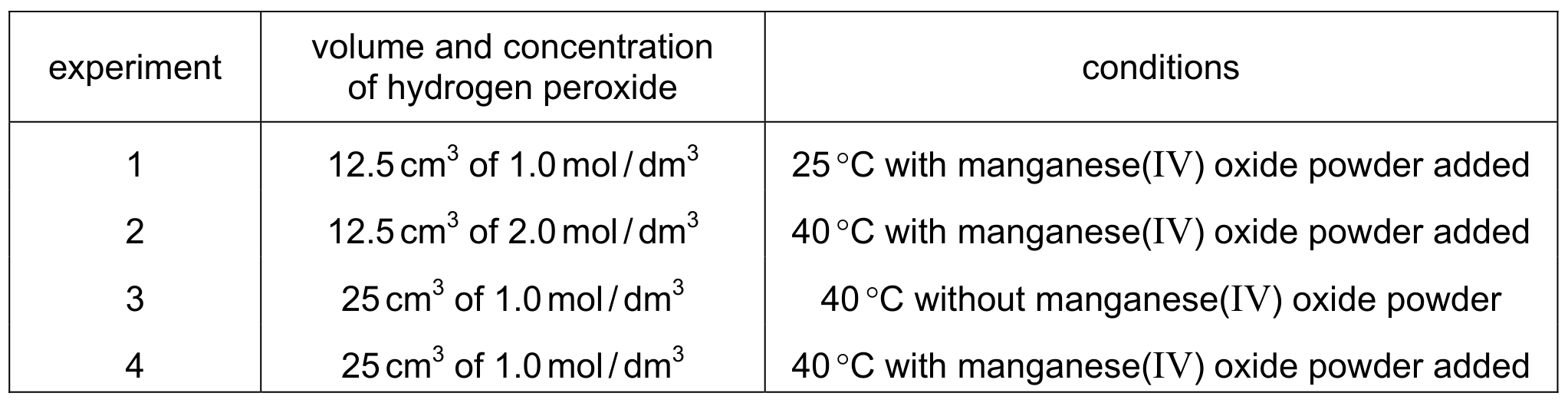
The reaction is investigated in four experiments.

Table

All reactions go to completion and all measurements of gas volumes are at room temperature and pressure.

Which statement is correct?

A

Experiment 1 produces less gas than experiment 4, but at the same rate.

B

Experiment 2 produces more gas than experiment 1, but at the same rate.

C

Experiment 2 and experiment 4 each produce the same volume of gas, but at different rates.

D

Experiment 3 and experiment 4 each produce the same volume of gas and at the same rate.

Question 14

[Maximum number: 1]

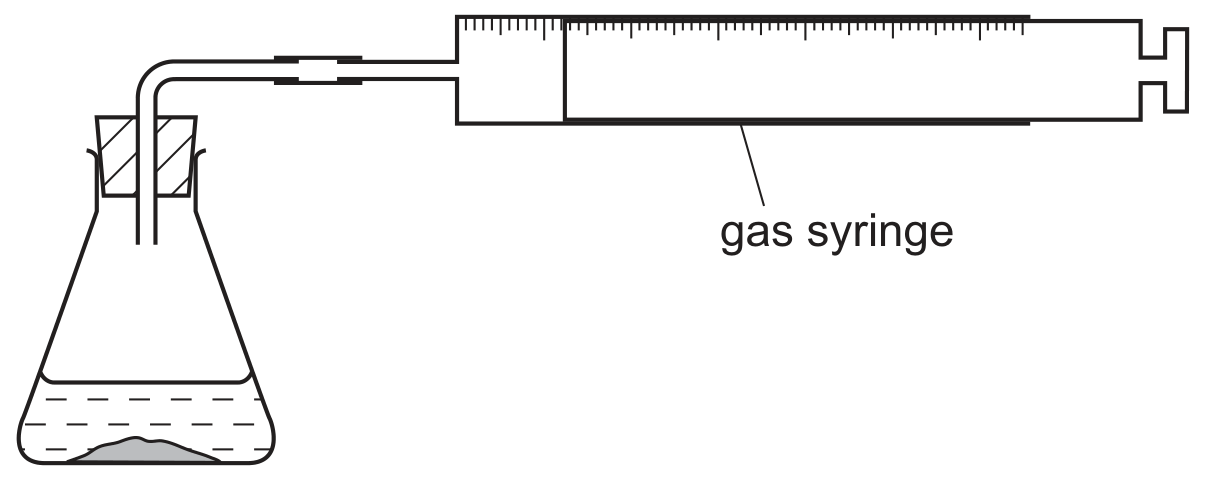
An experiment X is carried out between a solid and a solution using the apparatus shown.

Question image

The volume of gas given off is measured at different times and the results plotted on a graph.
In a second experiment Y , the surface area of the solid is increased but all other factors remain the same.

Which graph shows the results of experiments X and Y ?

Question 14

[Maximum number: 1]

Copper(II) carbonate reacts with dilute sulfuric acid.

CuCO3( s)+H2SO4(aq)CuSO4(aq)+CO2( g)+H2O(l)\mathrm{CuCO}_{3}(\mathrm{~s})+\mathrm{H}_{2} \mathrm{SO}_{4}(\mathrm{aq}) \rightarrow \mathrm{CuSO}_{4}(\mathrm{aq})+\mathrm{CO}_{2}(\mathrm{~g})+\mathrm{H}_{2} \mathrm{O}(\mathrm{l})

The rate of the reaction can be changed by varying the conditions.
Which changes always increase the rate of this chemical reaction?
1 increasing the concentration of sulfuric acid
2 increasing the size of the pieces of copper(II) carbonate
3 increasing the temperature
4 increasing the volume of sulfuric acid

A

1, 3 and 4

B

1 and 3 only

C

2 and 3

D

3 and 4 only

Question 15

[Maximum number: 1]

Which statement explains why coal dust forms an explosive mixture with air?

A

Coal dust catalyses the explosion.

B

Coal dust has a large surface area.

C

Crushing coal increases the concentration of the coal.

D

Crushing coal increases the temperature of the coal.

0 selected