EduNinja

IGCSE Chemistry Extended2.2.5—Electronic configuration of elementsTopic Practice

2.2.5—Electronic configuration of elements

• Determine the electronic configuration of elements and their ions with proton number 1 to 20, e.g. 2,8,3

Question 1

[Maximum number: 3]

The Periodic Table is very useful to chemists.
Refer only to elements with atomic numbers 1 to 36 in the Periodic Table provided when answering Question 1.

Question 1(a)

(a)

Use information from the Periodic Table provided to identify one element which:

[ 3 ]

Question 1(a)(iv)

(i)

has atoms with an electronic structure of 2,8,6

[ 1 ]

Question 1(a)(v)

(ii)

forms ions with a charge of 3- containing 18 electrons

[ 1 ]

Question 1(a)(vi)

(iii)

forms ions with a charge of 2+ containing 10 electrons

[ 1 ]

Question 1(g)

[Maximum number: 1]

The names of the elements of Period 2 of the Periodic Table are shown.
lithium beryllium boron carbon nitrogen oxygen fluorine neon Answer the following questions about these elements. Each element may be used once, more than once or not at all.

Identify the element which:

has only 5 electrons in each of its atoms

Question 1(b)

[Maximum number: 1]

This question is about the first 30 elements in the Periodic Table.
Name the element which:

has atoms with an electronic structure of 2,8,1

Question 1

[Maximum number: 3]

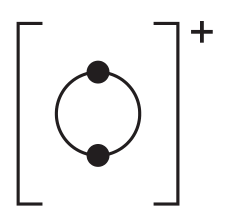
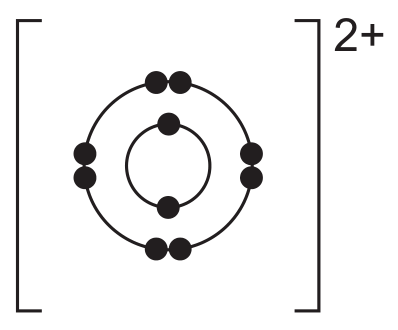
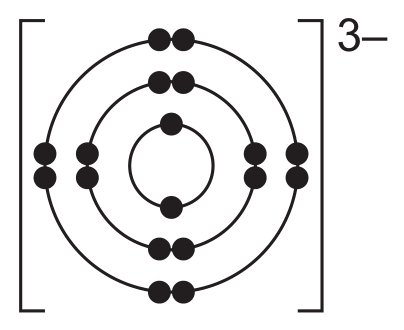
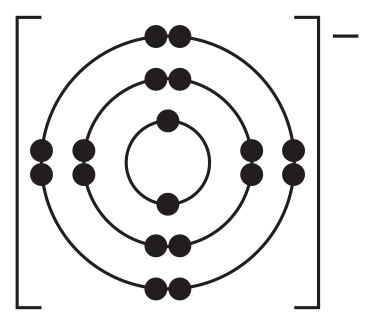
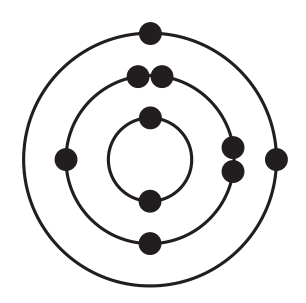
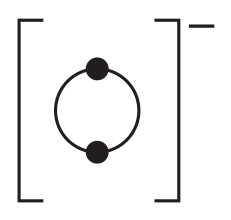
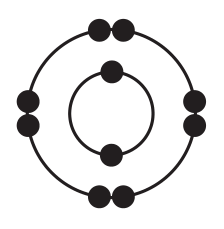
The electronic structures of some atoms and ions are shown.

A

A

B

B

C

C

D

D

E

E

F

F

G

G

H

H

Question 1(b)

(a)

State which electronic structure, A, B, C, D, E, F, G or H, is incorrect.

Explain why.
incorrect electronic structure
explanation

[ 2 ]

Question 1(d)

(b)

Use the Periodic Table to deduce:

[ 1 ]

Question 1(d)(ii)

(i)

the element which forms an ion with a 3+ charge and the same electronic structure as H.

[ 1 ]

Question 1(a)(vi)

[Maximum number: 1]

This question is about elements.
> aluminium
> carbon iron hydrogen oxygen silicon sodium sulfur

Answer the following questions about these elements.
Each element may be used once, more than once or not at all.

Name the element that has atoms with the electronic structure 2,6 .

Question 1(a)(iv)

[Maximum number: 1]

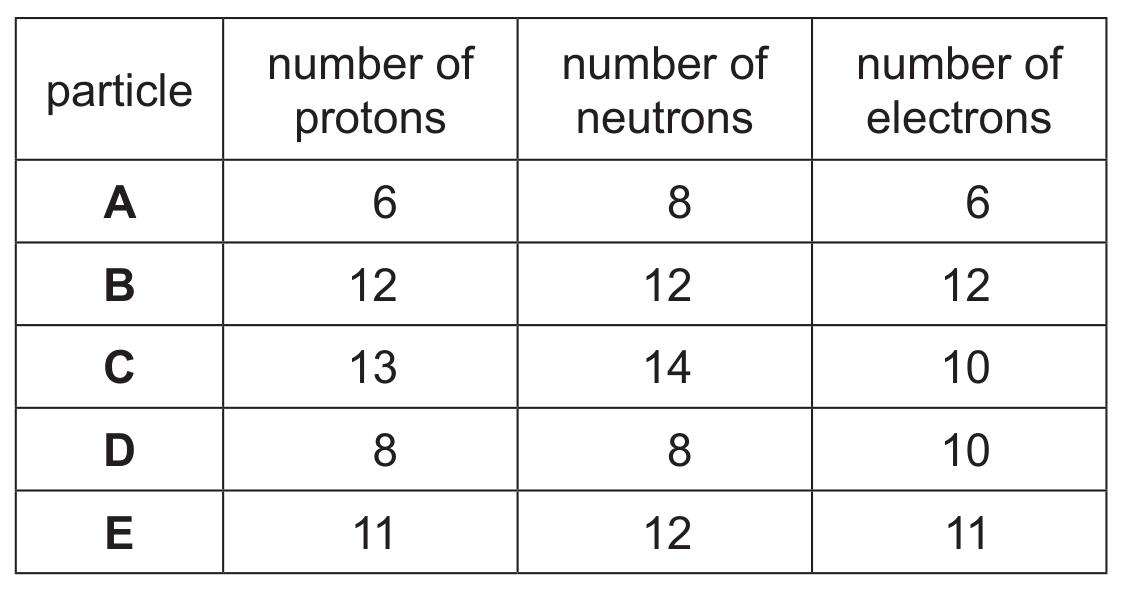
The table gives information about five particles. The particles are all atoms or ions.

Table

Answer the following questions using the information in the table. Each particle may be used once, more than once or not at all.

Which particle, A, B, C, D or E,

has only one electron in its outer shell?

Question 1(a)

[Maximum number: 4]

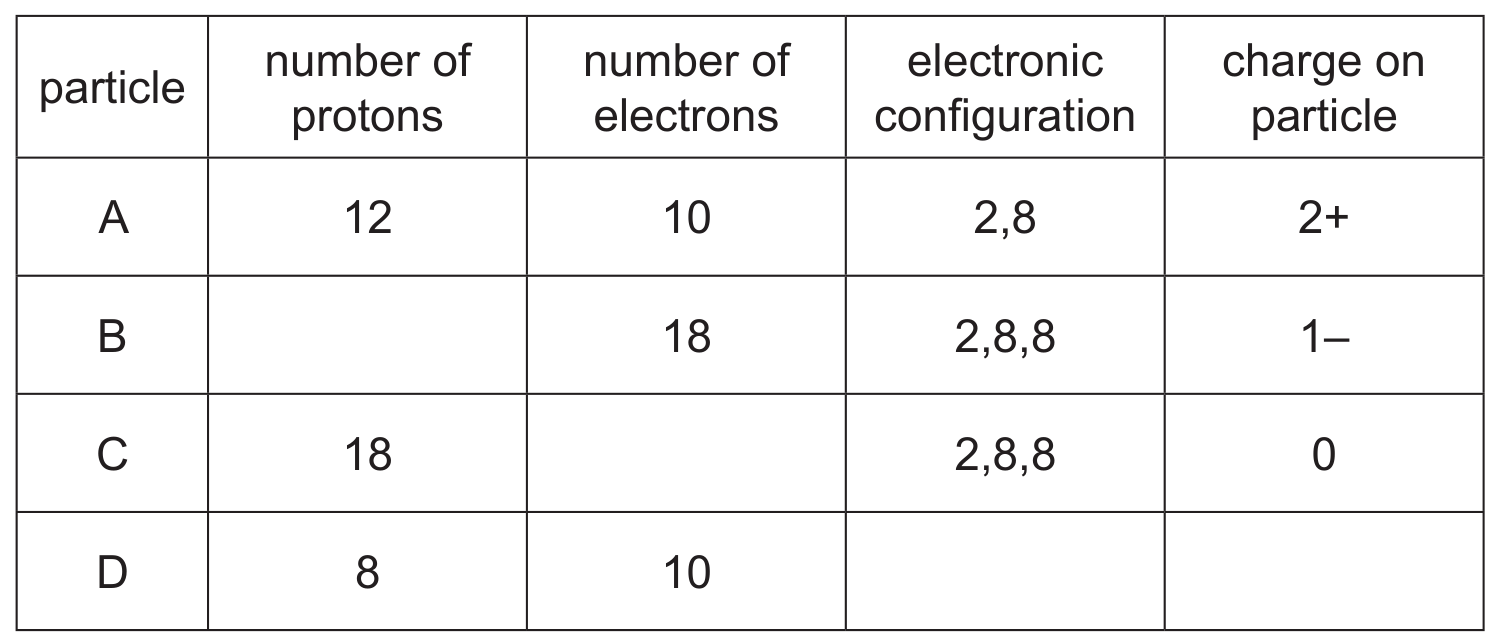
The table below gives information about particles.
Complete the table. The first line has been done for you.

Table

Question 1(a)(iv)

[Maximum number: 1]

Six different atoms can be represented as follows.
13 A{ }_{1}^{3} \mathrm{~A}23D{ }_{2}^{3} \mathrm{D}612E{ }_{6}^{12} E613G{ }_{6}^{13} \mathbf{G}714 J{ }_{7}^{14} \mathrm{~J}919{ }_{9}^{19} L

Answer the following questions using atoms from the list. Each atom may be used once, more than once or not at all.

Select one atom from the six shown which

has the electronic structure [2,5],

Question 1(a)(iv)

[Maximum number: 1]

This question is about elements X, Y and Z.

An atom of element X is represented as 1634X{ }_{16}^{34} \mathbf{X}.

What is the electronic structure of the ion X2\mathbf{X}^{2-} ?

Question 1(d)

[Maximum number: 2]

This question is about the structures of atoms and ions.

State the electronic structure of the following atom and ion.

Al
S2\mathrm{S}^{2-}

0 selected