EduNinja

IGCSE Chemistry Extended11.8.2—Formation of poly(ethene) as anTopic Practice

11.8.2—Formation of poly(ethene) as an

• Describe formation of poly(ethene) as an example of addition polymerisation using ethene monomers

Question 1(e)

[Maximum number: 1]

A list of gases is shown.
ammonia
carbon dioxide
carbon monoxide
ethene
fluorine
oxygen
sulfur dioxide
xenon

Answer the following questions using only the gases from the list. Each gas may be used once, more than once or not at all.

Give the name of the gas that:

can form a polymer

Question 37

[Maximum number: 1]

In reaction R, 2000 molecules of CH2=CH2\mathrm{CH}_{2}=\mathrm{CH}_{2} react to form a single molecule X only.

2000CH2=CH2X2000 \mathrm{CH}_{2}=\mathrm{CH}_{2} \rightarrow \mathrm{X}

Which terms describe reaction R,CH2=CH2\mathrm{R}, \mathrm{CH}_{2}=\mathrm{CH}_{2} and X ?

reaction R

CH2=CH2\mathrm{CH}_{2}=\mathrm{CH}_{2}

X

addition

monomer

polymer

addition

polymer

monomer

substitution

monomer

polymer

substitution

polymer

monomer

Question 38

[Maximum number: 1]

The flow diagram shows how poly(ethene) may be made from petroleum.

Question image

What are stages 1,2 and 3 ?

1

2

3

cracking

polymerisation

fractional distillation

cracking

fractional distillation

polymerisation

fractional distillation

cracking

polymerisation

fractional distillation

polymerisation

cracking

Question 38

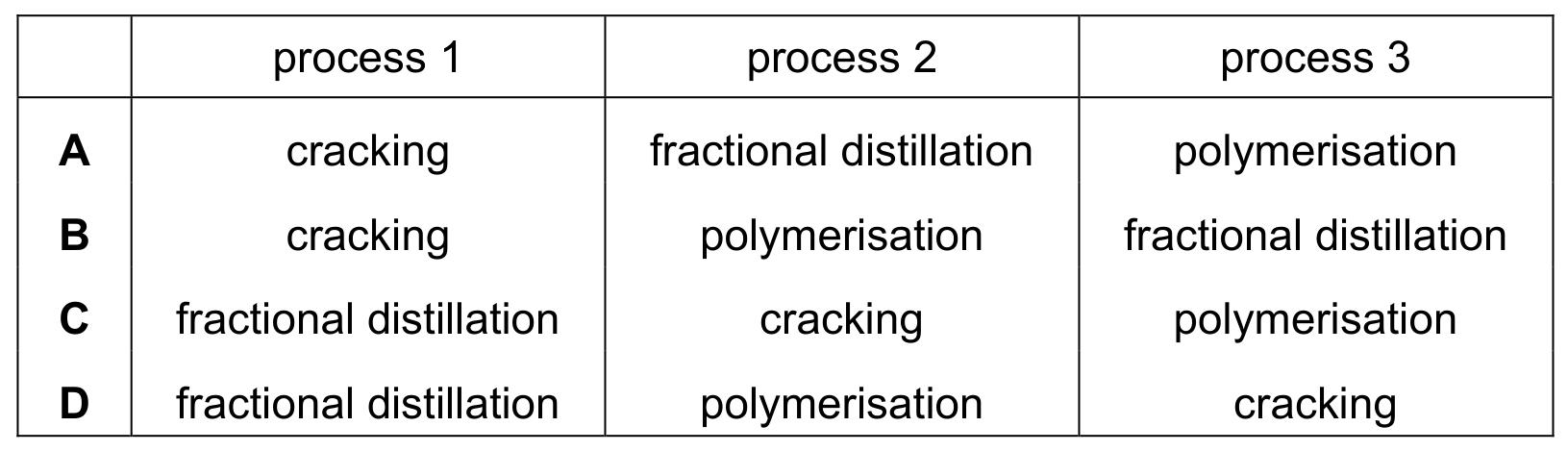
The flow chart shows how petroleum may be turned into a plastic.

Question image

What are processes 1,2 and 3 ?

Table

Question 38

[Maximum number: 1]

Ethene can be polymerised.
Which diagram represents the structure of the product formed?

Question 39

[Maximum number: 1]

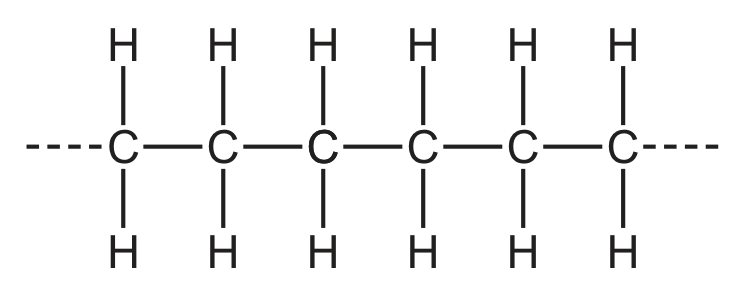
The diagram shows the structure of an important product.

Question image

This product is formed by …… 1 …… of an …… 2 …… .
Which words complete gaps 1 and 2?

1

2

addition polymerisation

alkane

addition polymerisation

alkene

cracking

alkane

cracking

alkene

Question 40

[Maximum number: 1]

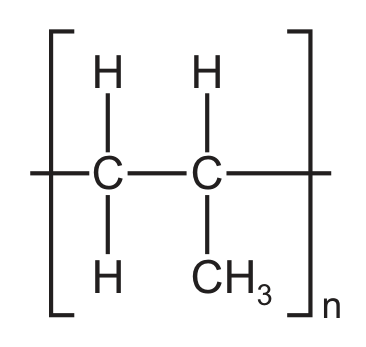
The structure of a polymer is shown.

Question image

Which monomer forms this polymer?

A

ethane

B

ethene

C

propane

D

propene

Question 5

Question 5(c)

(a)

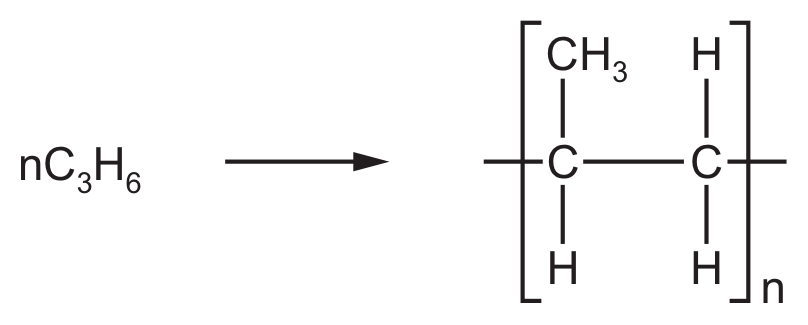
Propene can be polymerised. The only product is polypropene. The equation for the polymerisation is:

Question image
[ 2 ]

Question 5(c)(i)

(i)

Name the type of polymerisation that occurs.

[ 1 ]

Question 5(c)(ii)

(ii)

Deduce the maximum mass of polypropene that could be produced from 1 kg of propene. kg

[ 1 ]

Question 5(g)(i)

[Maximum number: 1]

The structures of five alkenes, A, B, C, D and E, are shown.

A

A

B

B

C

C

D

D

E

E

Alkene C can be converted into a polymer.

C

C

What type of polymerisation occurs?

Question 6

[Maximum number: 3]

The table shows the structures of four hydrocarbons.

Table

Question 6(f)

(a)

Compound Q undergoes polymerisation.

[ 3 ]

Question 6(f)(i)

(i)

Name the polymer formed.

[ 1 ]

Question 6(f)(ii)

(ii)

Complete the chemical equation to show the polymerisation of compound Q.

nCH2=CH2n \mathrm{CH}_{2}=\mathrm{CH}_{2} \quad \rightarrow
[ 2 ]
0 selected